
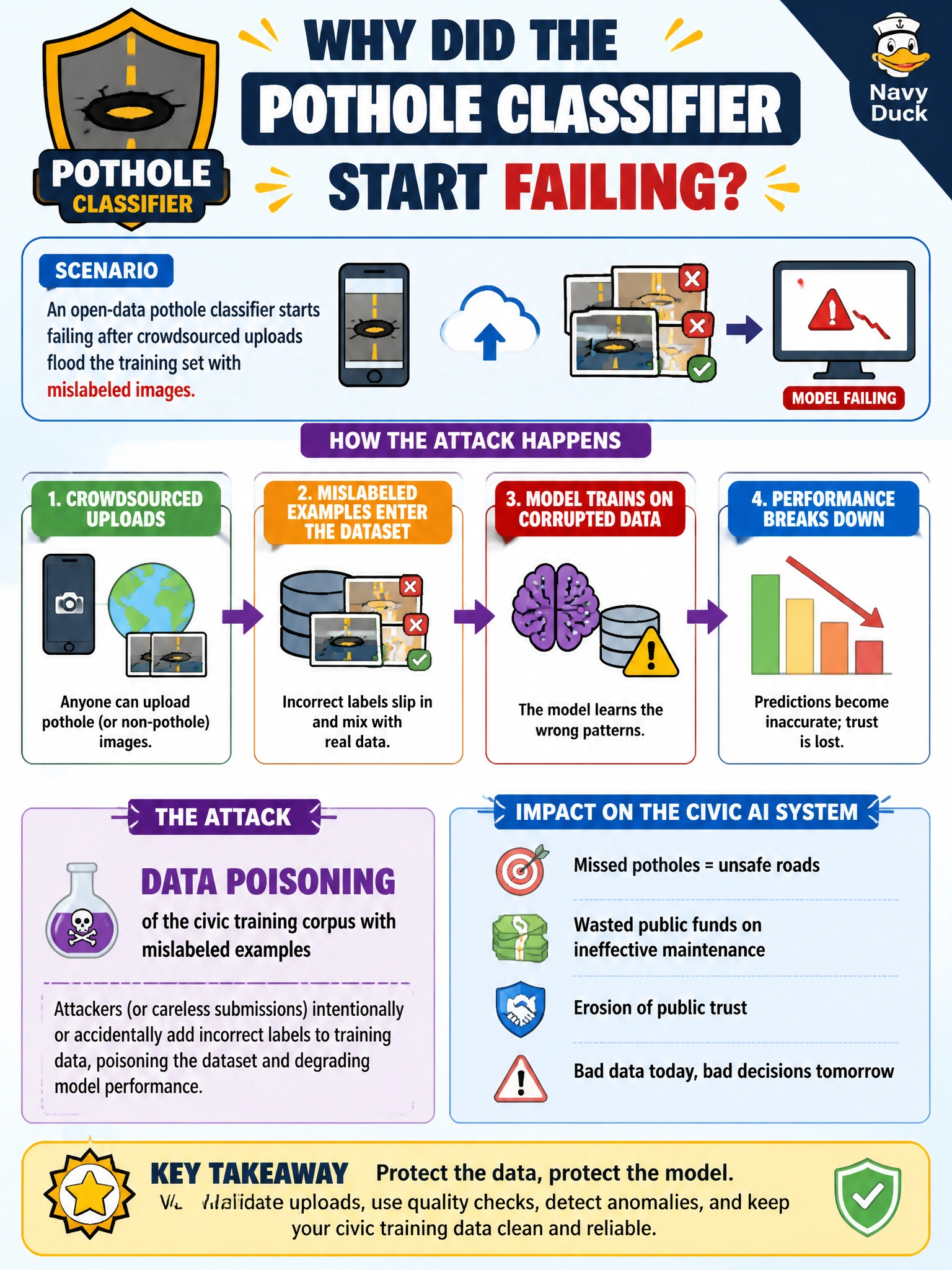
An open-data pothole classifier starts failing after crowdsourced uploads flood the training set with mislabeled images. Which attack best describes this?
Select an answer to reveal the explanation.
Short Explanation
Trash labels in, trash predictions out. Flooding the pothole training set with mislabeled crowdsourced images is data poisoning. The asphalt itself was not the target—the dataset was.
Full Explanation
When an open-data pothole classifier starts failing after crowdsourced uploads flood the training set with mislabeled images, the attack best described is data poisoning of the civic training corpus. Attackers (or coordinated abusers) corrupt labels or examples so the model learns incorrect associations—e.g., treating intact road as pothole or vice versa—degrading detection that public works relies on. Crowdsourced open-data pipelines are attractive poisoning surfaces because contribution barriers are low and trust assumptions are optimistic. The asphalt itself may be fine; the dataset was the target, and model failure is the symptom.
Model evasion of the civic training corpus with mislabeled examples fails as a description of this evidence—evasion is tricking live predictions at inference time, not corrupting learning; flooding training with mislabeled examples to teach wrong associations is poisoning. Prompt injection of the civic training corpus with mislabeled examples fails because the pothole classifier here is an image classifier learning visual associations, not an instruction-following model that executes prompts; corrupting labels to teach errors is poisoning, not prompt hijacking. Model extraction of the civic training corpus with mislabeled examples fails because the described failure traces to corrupted labels degrading accuracy, not to an attacker stealing or cloning the model; training corpus snapshots hold images and labels, not model weights.
Exam caveat: Not all label noise is intentional poisoning; exam answers still expect "data poisoning" when mislabeled floods are framed as attack evidence. Distinguish data poisoning (training-time corpus corruption that teaches wrong pothole associations) from evasion of the civic training corpus with mislabeled examples, prompt injection of the civic training corpus with mislabeled examples, or extraction of the civic training corpus with mislabeled examples, which use training-stage wording but describe the wrong mechanism for this mislabeled-flood evidence. Crowdsourcing increases poisoning risk without review and integrity controls.
Operational check: Freeze the tainted pothole training set; retrain from verified labels; require review or reputation checks on crowdsourced uploads; monitor accuracy after each data refresh; and treat sudden label-flip floods as security incidents as well as data-quality events.
Prefer to study offline? Printable PDF study book + test engine ($7.50, unofficial). These questions stay free here.