
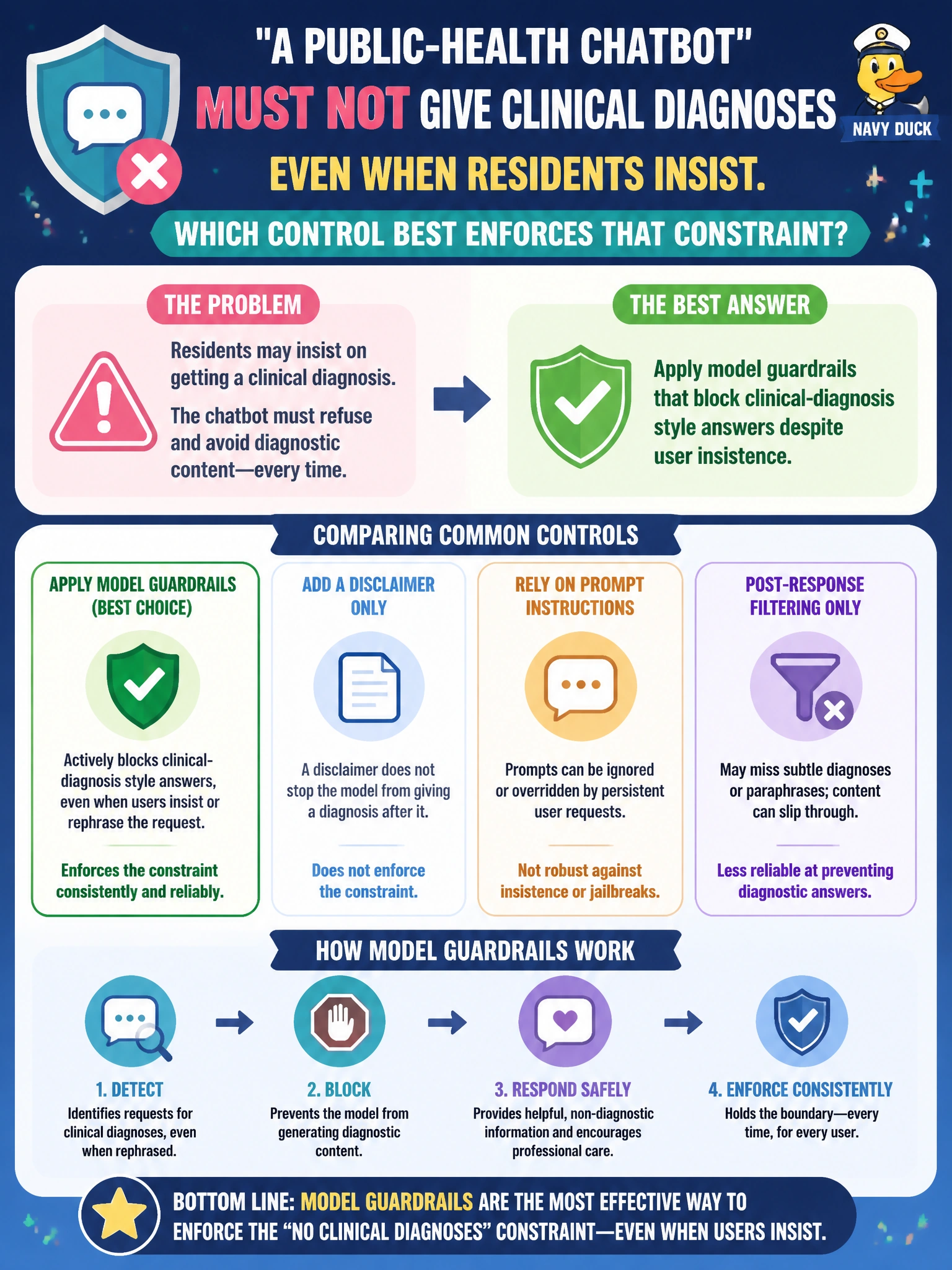
A public-health chatbot must not give clinical diagnoses even when residents insist. Which control best enforces that constraint?
Select an answer to reveal the explanation.
Short Explanation
System prompt instructions that claim to block diagnoses and PII redaction filters that claim to block them won't keep you safe since one's still overridable and the other's built for identifiers, not diagnoses. Model guardrails that refuse diagnosis-style answers keep the public-health bot in its lane even when residents push. Counting on logging to block answers after they've gone out turns your FAQ helper into a liability machine because you'll only see it after harm's done.
Full Explanation
Model guardrails enforce hard behavioral constraints on municipal assistants that soft prompts alone cannot guarantee. A public-health chatbot must not provide clinical diagnoses even when residents insist; applying guardrails that block diagnosis-style answers keeps the bot in an informational, triage-to-care lane and reduces medical and liability risk for the city. Guardrails operate despite user pressure, jailbreak-ish insistence, or social-engineering phrasing that would defeat a one-time polite refusal, which is essential when distressed residents push for definitive clinical conclusions.
Adding system prompt instructions that block clinical-diagnosis style answers despite user insistence remains a soft, overridable suggestion because prompt text cannot reliably enforce a block when residents insist or rephrase. Enabling conversation logging that blocks clinical-diagnosis style answers despite user insistence confuses recording with enforcement because logging happens after the fact and cannot stop a diagnosis from being delivered in the moment. Deploying PII redaction filters that block clinical-diagnosis style answers despite user insistence does not enforce clinical boundaries; redaction targets identifiers, not diagnostic reasoning, while leaving the bot free to give unsafe diagnoses.
Exam caveat: high-risk clinical boundaries need enforceable model guardrails, not system prompt instructions that claim to block clinical-diagnosis style answers despite user insistence but remain overridable, logging that records but cannot block answers in the moment, or PII redaction filters that cannot stop a diagnosis in the moment. Operational check: implement and test refusal policies for diagnosis requests, red-team insistent phrasings, log blocked attempts, and route users to official care resources instead of clinical conclusions.
Prefer to study offline? Printable PDF study book + test engine ($7.50, unofficial). These questions stay free here.