
A permits desk embeds building-code sections so a chatbot can retrieve relevant clauses before answering contractors. What role do those embeddings play?
Select an answer to reveal the explanation.
Short Explanation
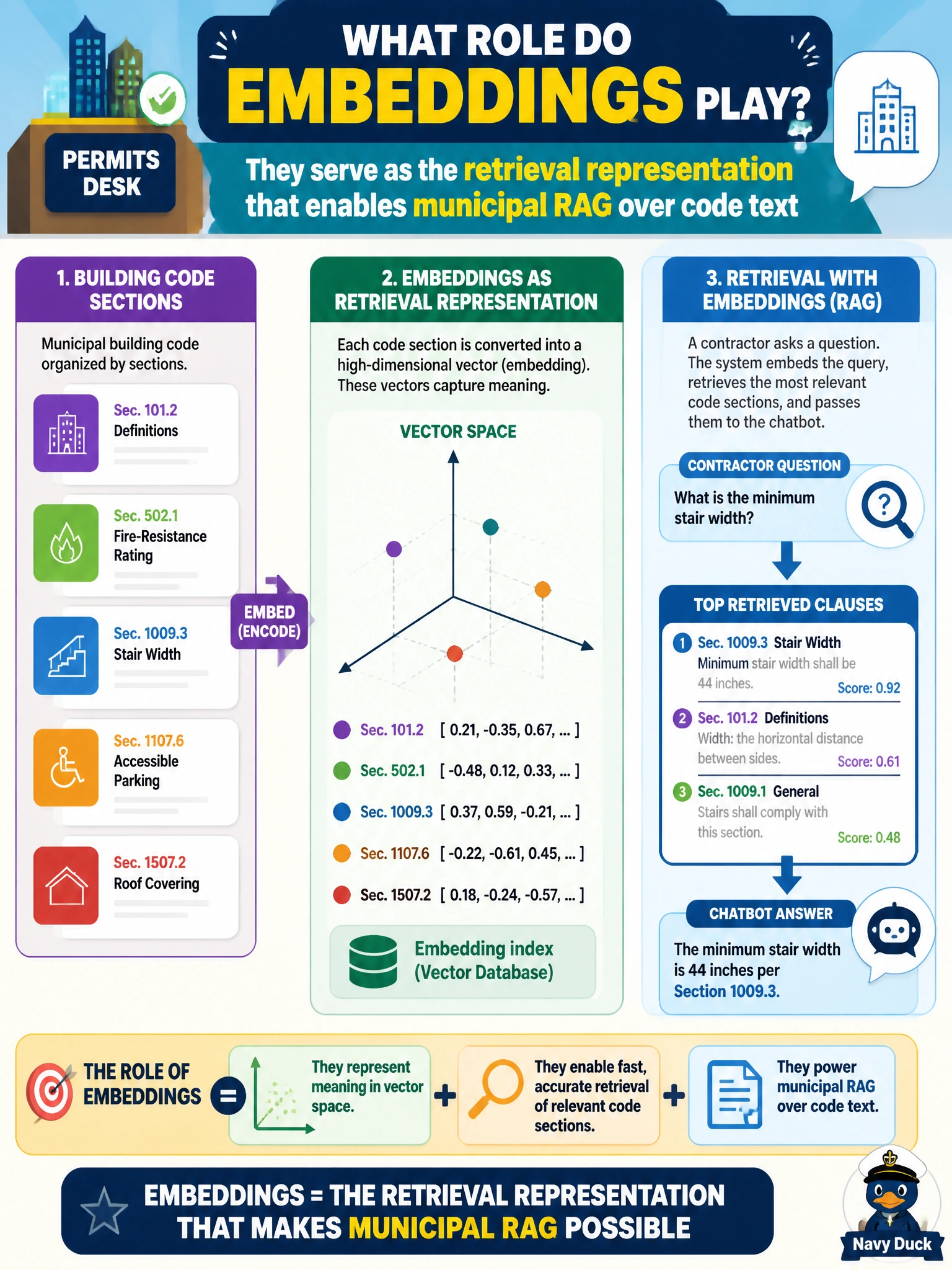
Embeddings turn building-code chunks into findable vectors—like giving each clause a library call number the bot can look up before it answers. That's the retrieval half of municipal RAG.
Full Explanation
Embedding building-code sections so a permits chatbot can retrieve relevant clauses before answering contractors makes embeddings the retrieval representation that enables municipal RAG over code text. Vectors index semantic similarity so the system can pull pertinent code chunks into context rather than relying only on parametric memory of a general model. Serving as the conversational memory that tracks contractor dialogue across sessions fails because embeddings encode building-code clauses for retrieval, not a dialogue history or session-state store for contractor conversations. Serving as the ranked answer text presented directly to contractors for permits fails because embeddings are vector indexes used to retrieve relevant code chunks, not the final answer text presented to contractors. Serving as the fine-tuned model parameters encoding municipal code updates fails because embeddings are retrieval representations over code text, not the model's trained parameters or a way to encode code updates into model weights. Exam caveat: embeddings retrieve similar text, not guaranteed correct legal applicability; contractors may still receive outdated or jurisdiction-mismatched clauses if the corpus is wrong. Operational check: chunk and version building-code embeddings with effective dates, cite retrieved clause IDs in answers, evaluate retrieval hit rate on contractor FAQs, and block answers when no code chunk meets a similarity threshold.
Prefer to study offline? Printable PDF study book + test engine ($7.50, unofficial). These questions stay free here.