
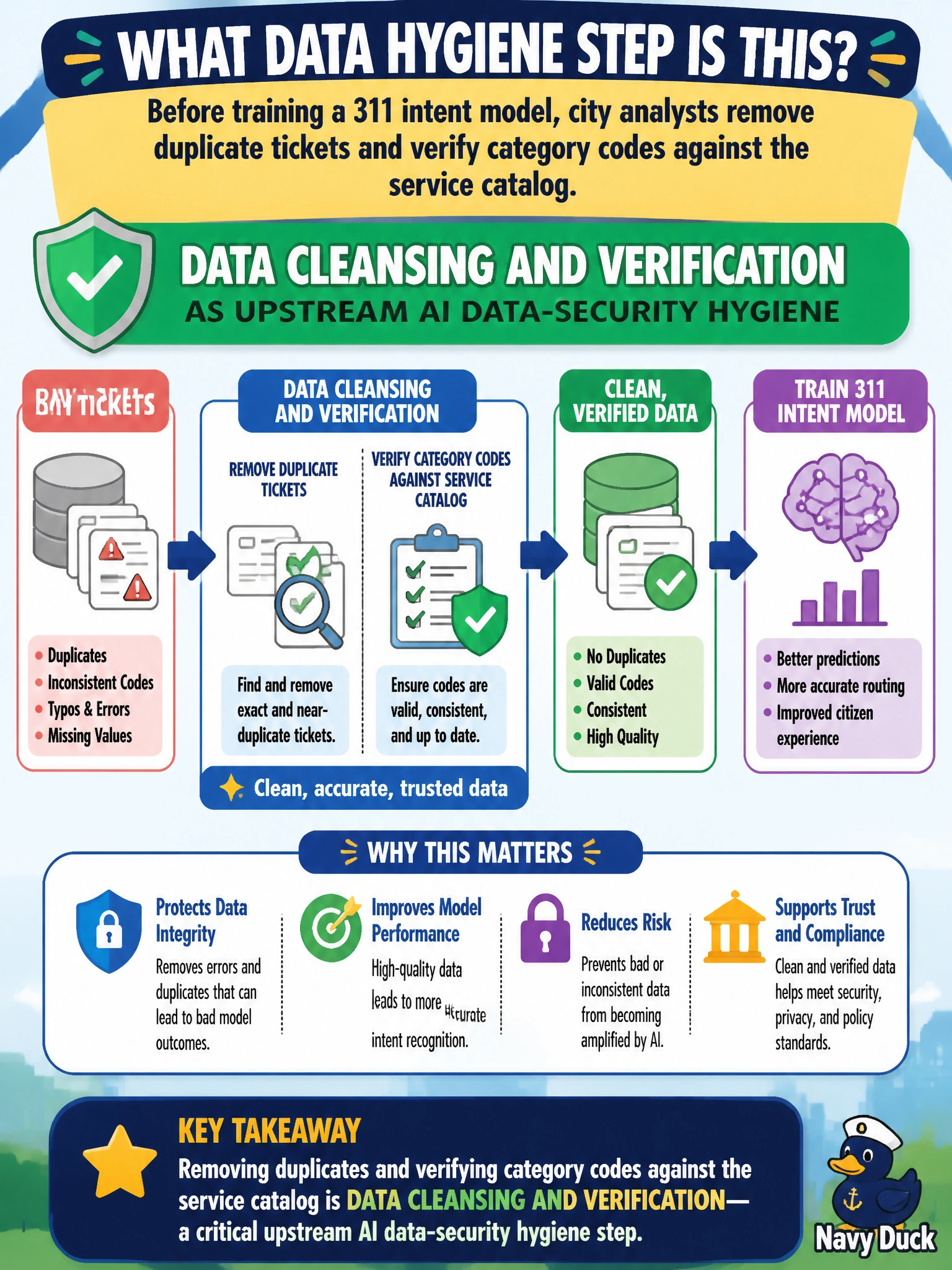
Before training a 311 intent model, city analysts remove duplicate tickets and verify category codes against the service catalog. Which data-security hygiene step is that?
Select an answer to reveal the explanation.
Short Explanation
Cleaning dupes and checking category codes is tidying the kitchen before you cook—upstream data hygiene. Skip that and the 311 intent model learns garbage ticket labels.
Full Explanation
Removing duplicate 311 tickets and verifying category codes against the service catalog before training is data cleansing and verification as upstream AI data-security hygiene. Clean, validated labels and records reduce poisoning by garbage labels, leakage of inconsistent codes, and models that learn noise instead of resident intent. Data standardization and catalog mapping as downstream reporting hygiene fails because it formats codes for consistent downstream reports and dashboards, but it does not remove duplicate tickets or verify category codes as upstream cleansing before training. Data validation and integrity attestation as model output trust assurance fails because it attests to the integrity and trustworthiness of model outputs after inference, but it does not cleanse duplicates or validate category codes in the training extract beforehand. Data profiling and quality scoring as exploratory ingestion assessment fails because profiling only measures and scores data quality during exploratory ingestion, but it does not remove duplicate tickets or verify category codes, so the model can still learn noise instead of resident intent. Exam caveat: cleansing can itself introduce bias if "duplicates" from marginalized neighborhoods are over-removed or if catalog mapping silently drops rare but important intents. Operational check: document cleansing rules, retain pre/post statistics on ticket volumes by category and geography, require dual review of remapped codes, and freeze a validated training snapshot with checksums before each model build.
Prefer to study offline? Printable PDF study book + test engine ($7.50, unofficial). These questions stay free here.