
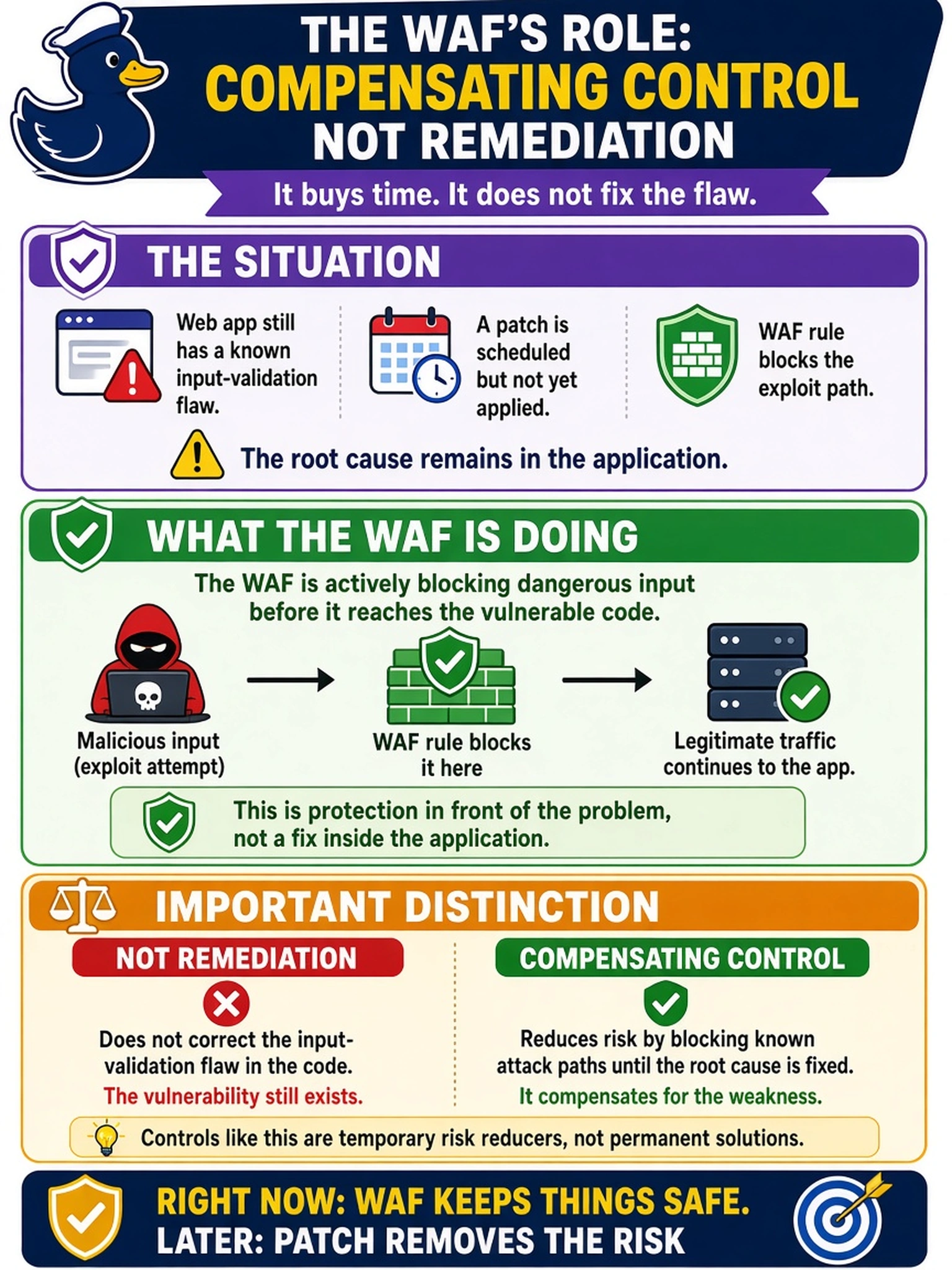
A SOC analyst notices a web application still contains a known input-validation flaw, but a WAF rule blocks the exploit path while a patch is scheduled. Which statement best describes the WAF's role?
Select an answer to reveal the explanation.
Short Explanation
Think of a WAF as a fence in front of a broken door; it keeps some intruders out, but it doesn’t fix the door. If you let the patch slip because the fence seems to work, you’re just accepting extra risk and betting the rule never gets bypassed. The right move is to use it as a temporary shield while you remediate the app.
Full Explanation
A web application firewall placed in front of a vulnerable application functions as a compensating control when the underlying defect cannot be fixed immediately. It reduces exploitability by inspecting and filtering malicious requests, but it does not change the application code, input handling, or data flow that create the vulnerability. Because the root cause remains, risk persists through bypasses, rule misconfigurations, application changes, and traffic that the WAF does not inspect. A control that only blocks known attack paths cannot be treated as permanent removal of the flaw, since the vulnerable logic is still present and may be reachable through another route. It also cannot be treated as eliminating patching or secure-coding responsibilities, because remediation addresses the cause and reduces dependence on perimeter filtering. It is not a false positive either; the scanner may still identify the application defect even if exploit attempts are blocked at the network edge. Exam caveat: WAF rules can support risk acceptance or interim mitigation, but they do not replace vulnerability closure. Operational check: link the WAF rule to the vulnerability ticket, set an expiration or review date, verify the patch in staging, then retire the rule after closure.