
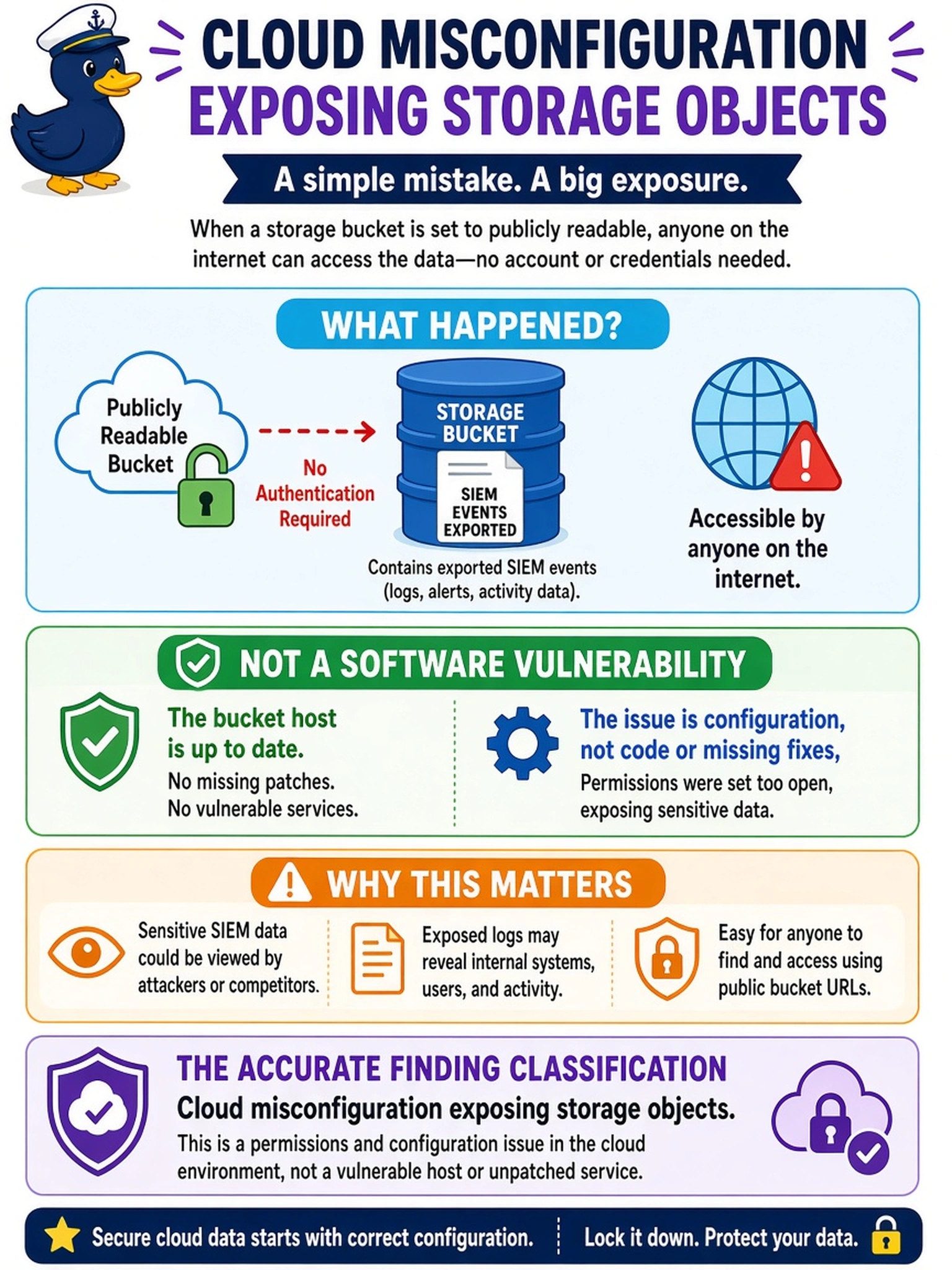
A cloud vulnerability scan reports a storage bucket as publicly readable, with no authentication required, and confirms it contains exported SIEM events. The bucket host shows no missing patches or vulnerable services. Which finding classification is most accurate?
Select an answer to reveal the explanation.
Short Explanation
Think of a bucket policy like the front door sign: if it says open to everyone, that's a permission problem, not a broken lock in the OS. You don't patch a misconfigured access rule-you fix the policy and confirm no secrets are exposed. That's why the finding is a cloud access misconfiguration, not a guest OS vulnerability.
Full Explanation
A vulnerability scanner evaluating cloud resources can flag findings that are not CVEs in a guest operating system. Anonymous object access is an exposure caused by identity, policy, and storage permissions. The correct classification is a cloud misconfiguration exposing storage objects because the observed state is permission-based and retrieval can occur without valid credentials. It is not a guest operating system vulnerability on the bucket host, because the scan shows no missing patches or vulnerable services, and managed object storage generally does not expose a customer-managed guest OS for patching. It is not an application-layer vulnerability in the bucket service code, because no evidence of code execution, injection, or service defect is present; the issue is the configured access control. It is not credential compromise evidenced by exported SIEM events, because public bucket access can occur without stolen credentials and the finding describes permission exposure, not authentication abuse. Exam caveat: distinguish CVE-based findings from cloud posture findings that are remediated through policy and identity controls. Operational check: review the bucket policy, disable public access, rotate any exposed secrets, and re-scan the resource.