
A vulnerability scan result for a web server lists a CVE identifier, a CWE identifier, and a CPE identifier. The analyst must explain what each identifier tells them before prioritizing remediation. Which mapping is correct?
Select an answer to reveal the explanation.
Short Explanation
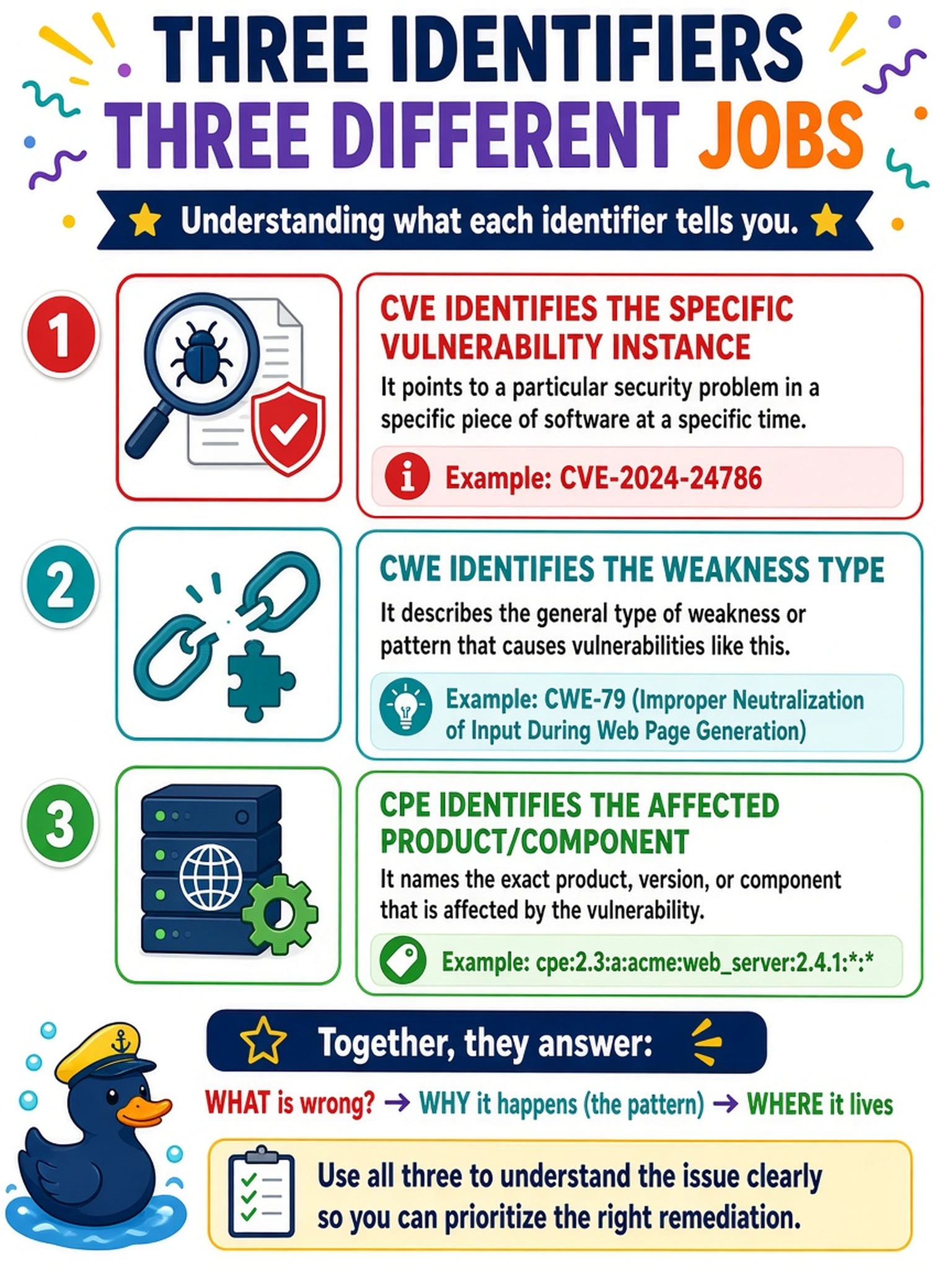
Think of CVE as the barcode on one recalled part, CWE as the defect class, and CPE as the exact product it's in. You don't need every ID to answer what broke, but you do need them to prove which component is vulnerable. If you mix them up, your remediation notes will point to the wrong place.
Full Explanation
Vulnerability assessment output uses structured identifiers to make findings repeatable and machine-readable. CVE is a public enumeration for a specific vulnerability instance, so it lets analysts correlate the same issue across vendor advisories, scanner plugins, and remediation tickets. CWE describes the underlying weakness category, such as improper neutralization of input during web page generation, which supports root-cause analysis, secure development follow-up, and mapping to attack patterns. CPE names the affected software or hardware component using a standardized URI, so it supports asset identification, version matching, and product inventory. A wrong mapping that treats CVE as the affected product confuses the vulnerability itself with the asset that contains it, making inventory queries unreliable. Another wrong mapping assigns the specific instance to CWE and the weakness type to CVE, reversing instance-level and weakness-level identifiers. A third mistake treats CPE as the weakness type or product as the instance, which breaks asset-based prioritization and patch matching. Exam caveat: CS0-004 expects you to interpret what each identifier means, not memorize a registry. Operational check: confirm the CVE appears in the scan detail, match the CWE to the weakness description, and verify the CPE against the discovered asset inventory before ticketing.