
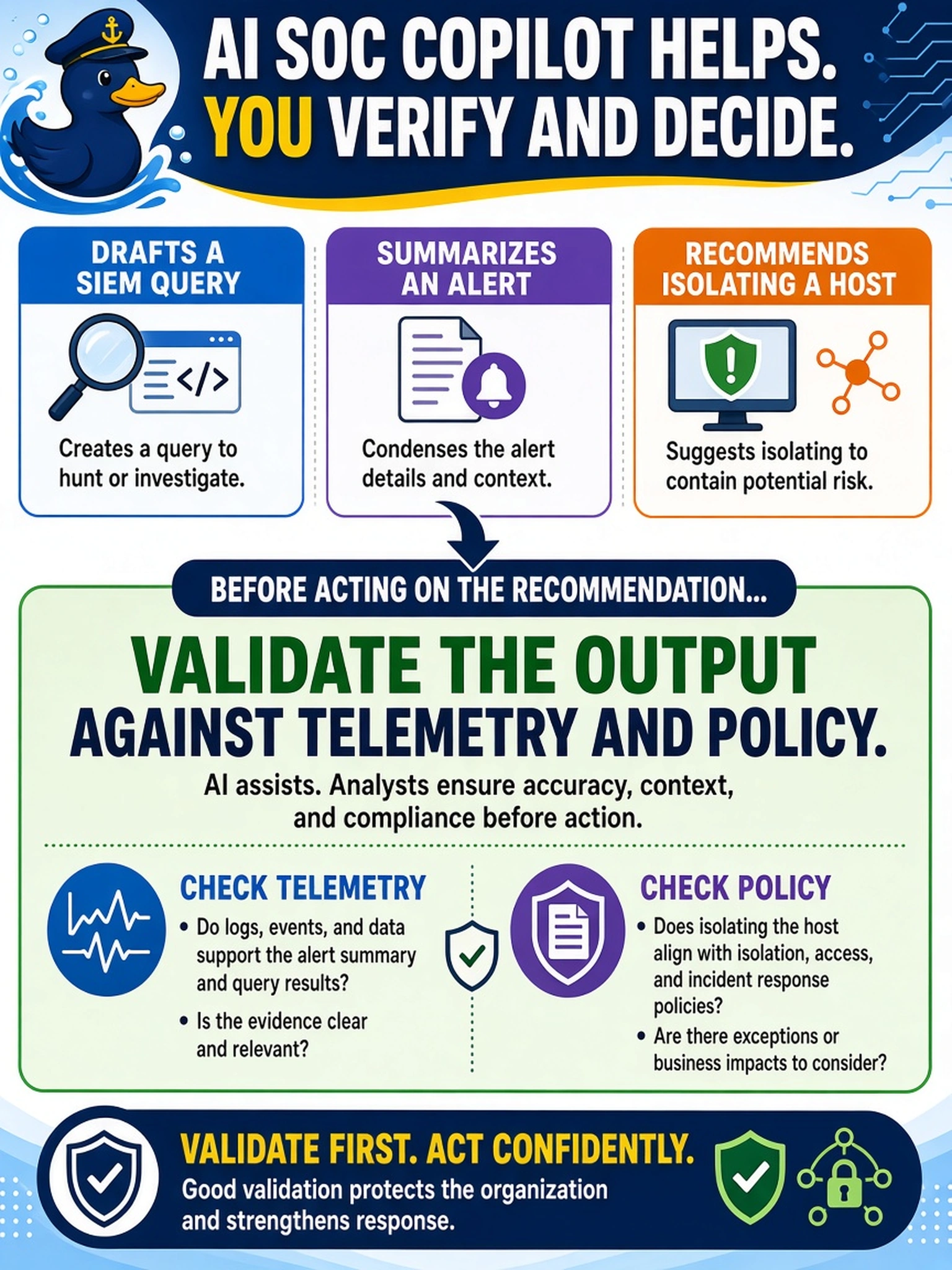
An AI SOC copilot drafts a SIEM query, summarizes an alert, and recommends isolating a host. What is the analyst’s primary responsibility before acting on the recommendation?
Select an answer to reveal the explanation.
Short Explanation
Think of a SOC copilot like a fast intern with great notes: it drafts, but you’re the one who signs off. You still have to check the telemetry and policy before it touches production. The trap is trusting the summary because it sounds confident.
Full Explanation
AI SOC copilots are assistive tools that can draft queries, summarize alerts, and suggest response steps, but their outputs are probabilistic and context-dependent. The analyst must validate generated artifacts against authoritative telemetry, incident scope, and organizational policy before action, because the copilot may miss asset criticality, false-positive patterns, or containment impact. A copilot is not authoritative merely because it ingests enterprise logs; log access does not guarantee correct interpretation or safe action. It also cannot replace manual triage simply because accuracy improves over time, since high-impact actions still require accountable human review and exception handling. Relying on a confidence threshold is insufficient when the threshold may reflect statistical certainty rather than operational safety, and thresholds can be miscalibrated across data sources. The correct role is augmentation with validation, not autonomous decision-making. Exam caveat: CS0-004 expects analysts to know AI can improve efficiency while introducing model limitations, so choose the answer that preserves analyst accountability. Operational check: before executing a copilot-suggested containment, compare the target host's EDR and SIEM evidence to the relevant playbook and document the validation step.