
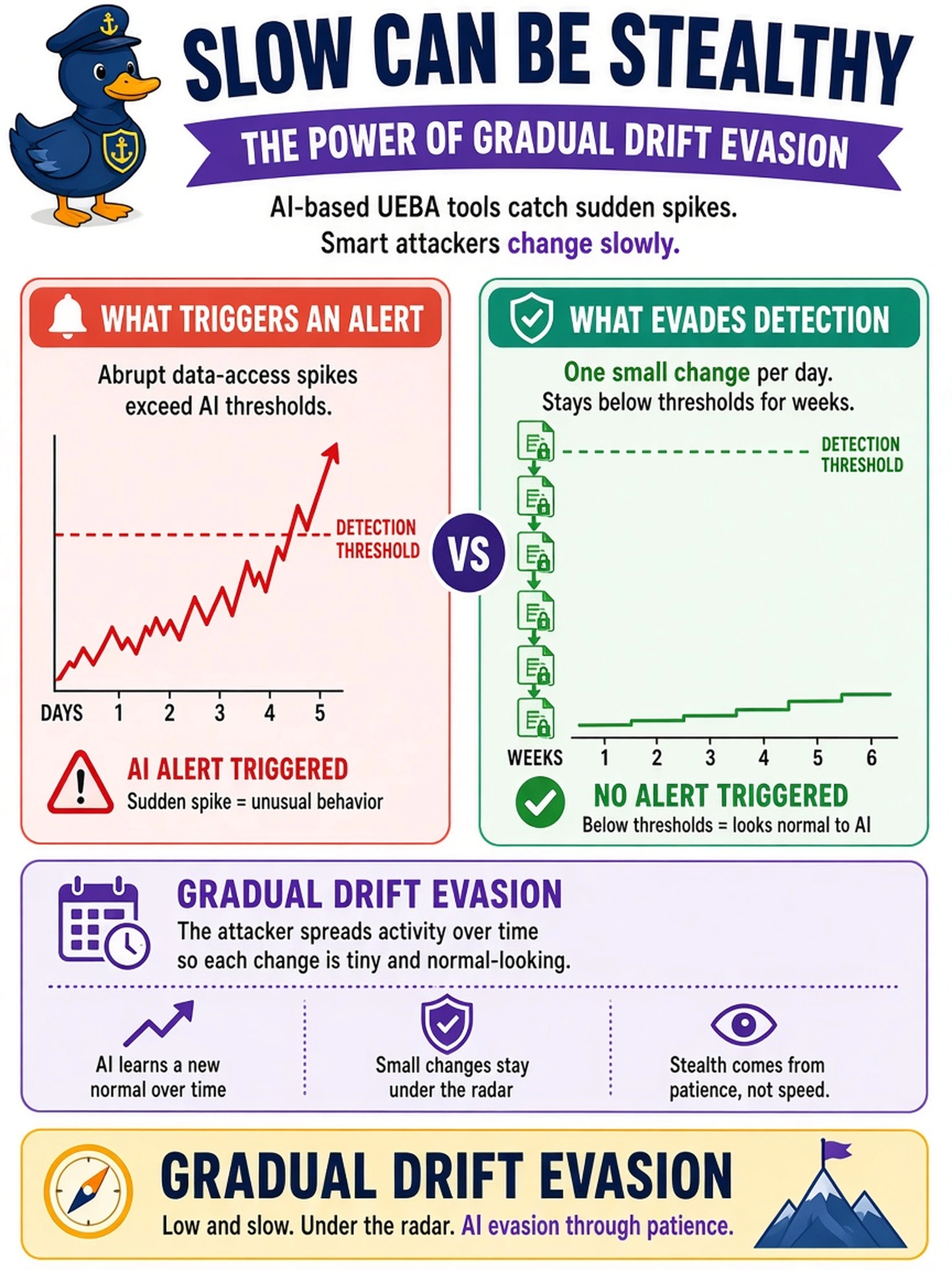
An AI-based UEBA tool alerts on abrupt data-access spikes. An attacker instead adds one sensitive file per day for six weeks, staying below thresholds. What type of AI evasion is this?
Select an answer to reveal the explanation.
Short Explanation
Think of an AI detector as a motion sensor: a sudden sprint trips it, but a slow creep doesn't. The attacker here is using gradual drift, moving just enough over time to slip past the threshold. If you assume this is poisoning or prompt injection, you miss the real trick: the behavior changed slowly, not the model.
Full Explanation
AI models that score activity often rely on baselines, thresholds, or anomaly detection built from historical patterns. When malicious behavior is introduced in tiny increments, each individual event can remain within the learned normal range, so the model never sees a statistically significant deviation. This is gradual drift or slow-change evasion: the attacker manipulates the pace of activity rather than directly corrupting the model, defeating simple spike-based detection. Adversarial model poisoning is different because it attempts to alter the training data or model weights so the model learns incorrect boundaries. Prompt injection targets generative or LLM-based systems by inserting crafted instructions into inputs, not by pacing normal telemetry over weeks. False-positive flooding evasion tries to overwhelm analysts with noisy alerts, which may hide activity but does not describe incremental behavior staying below model thresholds. Exam caveat: choose the concept that matches the evasion mechanism, not the tool or output type. Operational check: review baseline windows and alert thresholds for slow-moving anomalies, and tune UEBA models to consider cumulative behavior over longer periods rather than isolated spikes alone.