
Your SOC manager wants to prove a triage workflow improved outcomes, not just alert volume. Which metric best reflects analyst efficiency and response effectiveness?
Select an answer to reveal the explanation.
Short Explanation
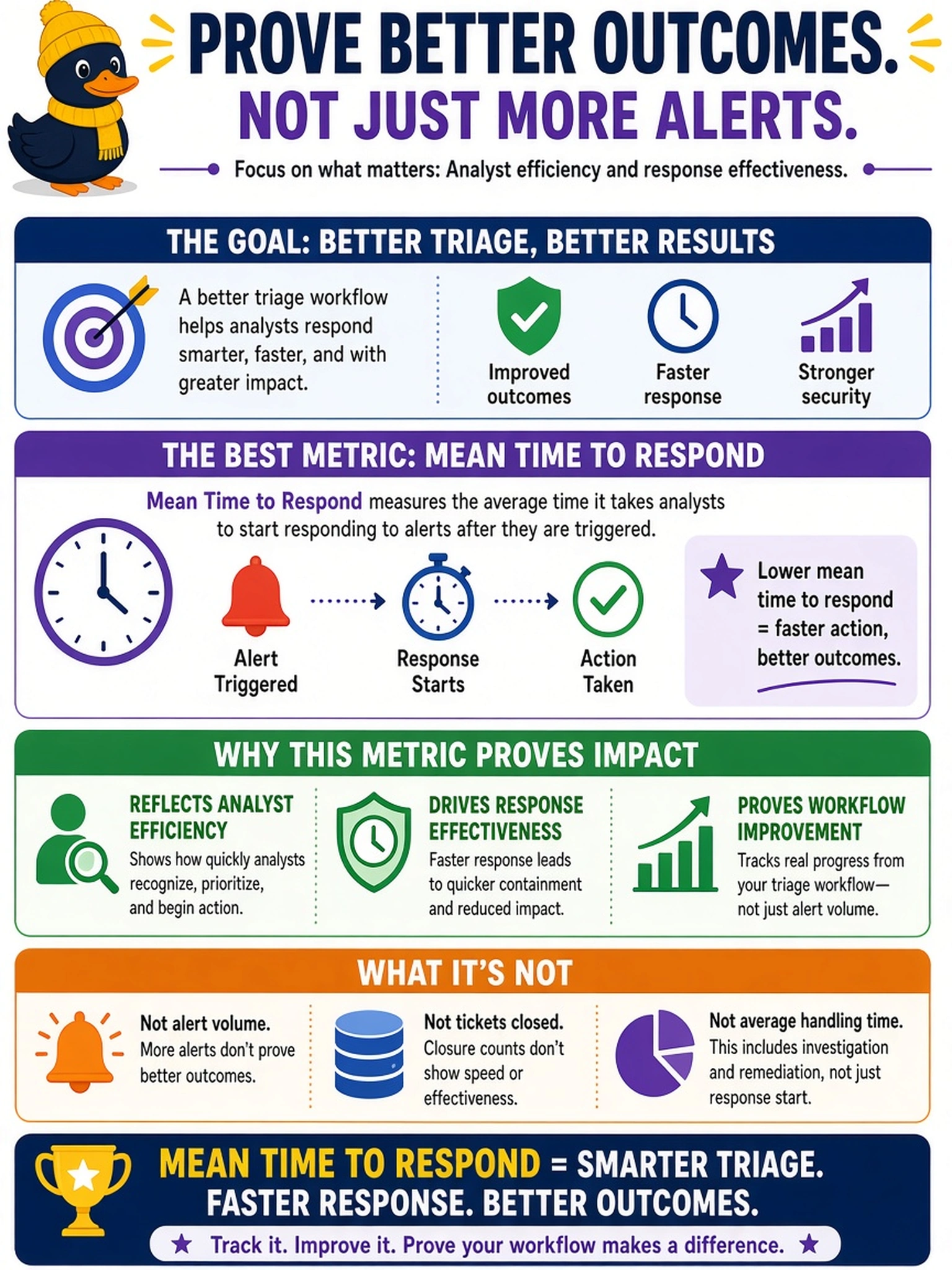
Think of SOC metrics like a scoreboard: if you only count shots taken, you'll never learn whether they hit. You want mean time to respond because it shows how fast your team turns a signal into action, while alert volume alone doesn't measure outcomes. The trap is celebrating more alerts or more rules instead of better results.
Full Explanation
Mean time to respond is an outcome indicator because it measures elapsed time from detection to containment or remediation, tying telemetry to the operational objective of reducing dwell time and limiting impact. It is useful when paired with quality measures such as false-positive rate and analyst capacity, because speed without accuracy creates rework, while accuracy without speed leaves risk uncontained. Counting alerts generated by the platform reflects sensor volume, not whether the SOC recognized meaningful threats or acted on them, so a larger number can indicate noisy tuning rather than better security. Counting enabled rules measures configuration breadth, but a rule set can be broad, redundant, or poorly tuned, and the count does not show whether detections are actionable or how quickly analysts resolve them. Counting escalations to another tier shows workflow handoff volume, but it does not capture time to resolution or whether escalation improved the outcome; it may simply reveal poor first-tier triage or routing.
Exam caveat: CompTIA expects efficiency metrics to combine speed, quality, and workload rather than reward raw alert volume or tool configuration counts.
Operational check: Calculate mean time to respond for a defined detection window and segment results by alert category, then compare against false-positive and re-opened ticket rates.