
Your SOC receives dozens of daily alerts that require the same enrichment steps: checking reputation feeds, correlating EDR process trees, and updating ticket notes. Which change most directly reduces manual analyst effort while preserving triage quality?
Select an answer to reveal the explanation.
Short Explanation
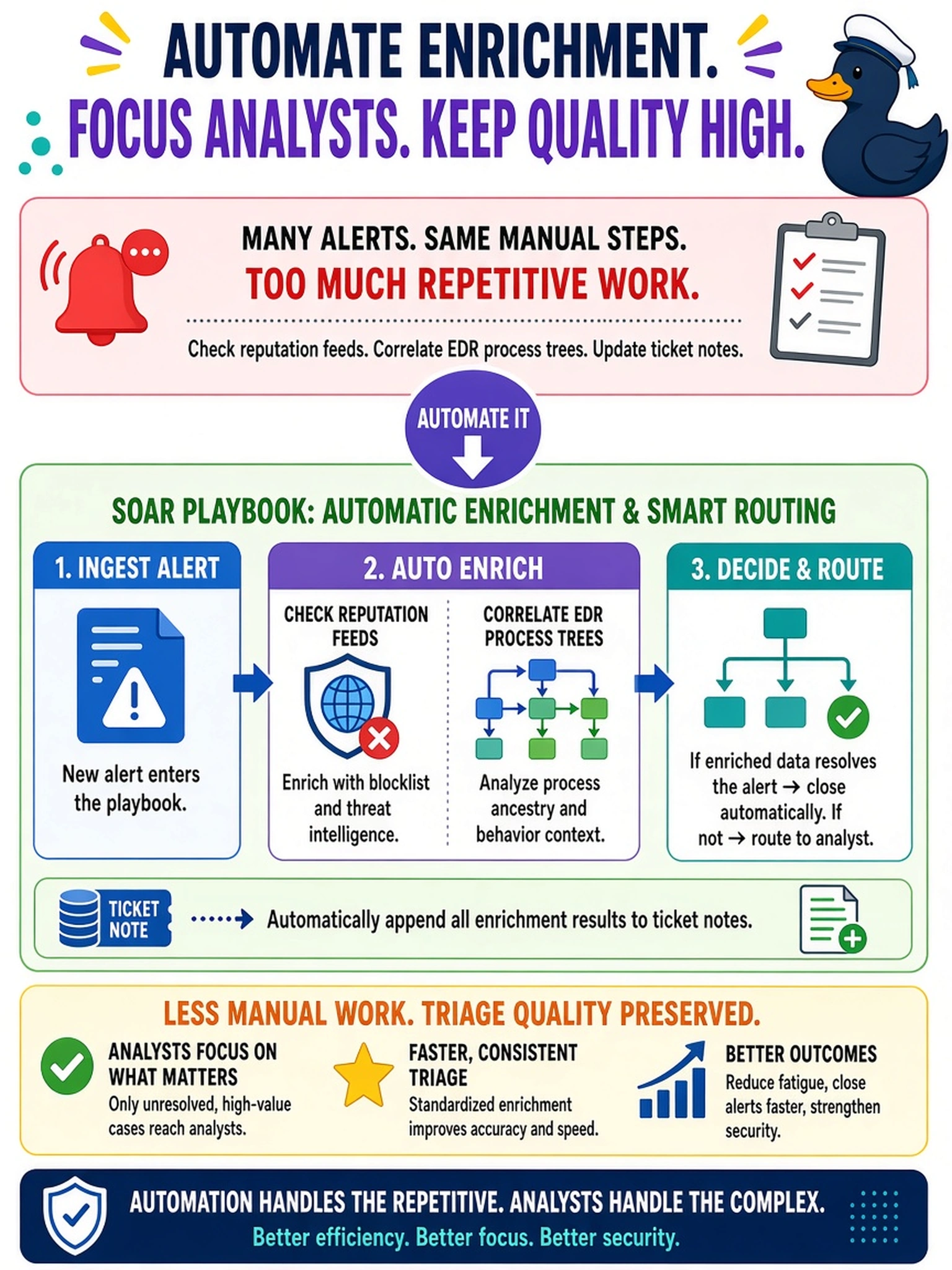
Think of a SOAR playbook like a conveyor belt for routine alert chores: it fetches the same evidence every time so your eyes only land on the exceptions. You're not replacing judgment; you're cutting the copy-paste work that makes triage slow. The trap is adding more dashboards or manual checks, which just moves the bottleneck.
Full Explanation
SOAR playbooks improve security operations efficiency by orchestrating deterministic, repeatable tasks across tools such as SIEM, EDR, threat intelligence platforms, and ticketing systems. When an alert matches a known pattern, the playbook can retrieve reputation data, expand process trees, check blocklists, normalize fields, and create or update a case. This reduces manual effort because analysts no longer perform identical enrichment steps by hand, while still preserving triage quality by routing only unresolved or anomalous cases for human judgment. Adding more manual review steps increases workload and can create fatigue without addressing the repetitive nature of the task. Relying only on the highest CVSS scores ignores that many operational alerts are low severity but high volume or high business impact, and it does not automate enrichment. A dashboard that centralizes open alerts improves visibility but does not reduce the underlying manual steps required to investigate each item. Exam caveat: efficiency questions reward choosing automation for repeatable, well-defined tasks rather than visibility, documentation, or additional human checks. Operational check: review a week of closed alerts, identify the five most common enrichment actions, and automate those actions in a playbook with analyst escalation conditions.