
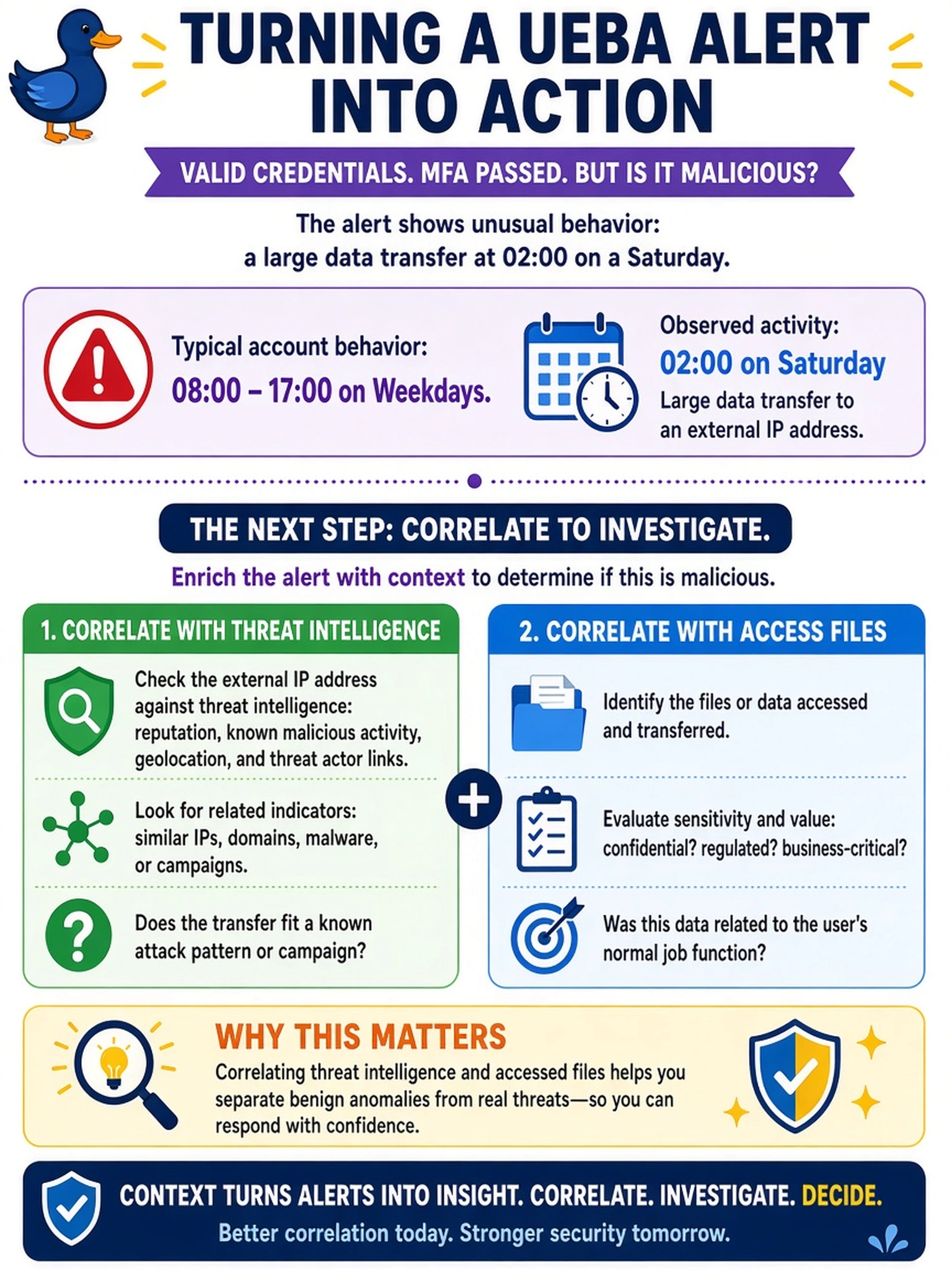
A security analyst reviews a SIEM alert generated by the organization's UEBA platform. The alert indicates that a user account, typically active between 08:00 and 17:00 on weekdays, initiated a large data transfer to an external IP address at 02:00 on a Saturday. The analyst confirms the account credentials are valid and MFA was successfully completed. What is the most appropriate next step to determine if this activity is malicious?
Select an answer to reveal the explanation.
Short Explanation
Think of UEBA like a neighbor who notices you walking a dog at 2 AM instead of 6 PM. Just because the dog is on a leash (MFA) doesn't mean you're not stealing it. You don't kick them out immediately; you look for other signs. Correlate the destination and the files to see if the behavior actually makes sense.
Full Explanation
User and Entity Behavior Analytics (UEBA) tools establish baselines of normal activity and flag deviations, such as unusual timing or volume. However, a deviation alone does not confirm malicious intent; it merely prioritizes the event for investigation. The correct approach is to gather context by correlating the technical indicators, such as the destination IP and accessed files, with threat intelligence and business logic to determine if the anomaly is benign or malicious. Disabling the account and quarantining the endpoint immediately is a containment step that should follow confirmation of a threat, not precede investigation, as it risks disrupting legitimate business operations. Marking the alert as a false positive solely because MFA succeeded is incorrect because MFA mitigates credential theft but does not prevent authorized users from performing malicious actions. Waiting for the user to return is poor practice in incident response, as it allows potential exfiltration to continue unchecked and violates the principle of timely detection and response. Exam caveat: UEBA alerts are often noisy; the skill tested is context-aware triage, not automated blocking. Operational check: Always verify the destination IP against threat intelligence feeds and review the specific file paths accessed before escalating or containing the user.