
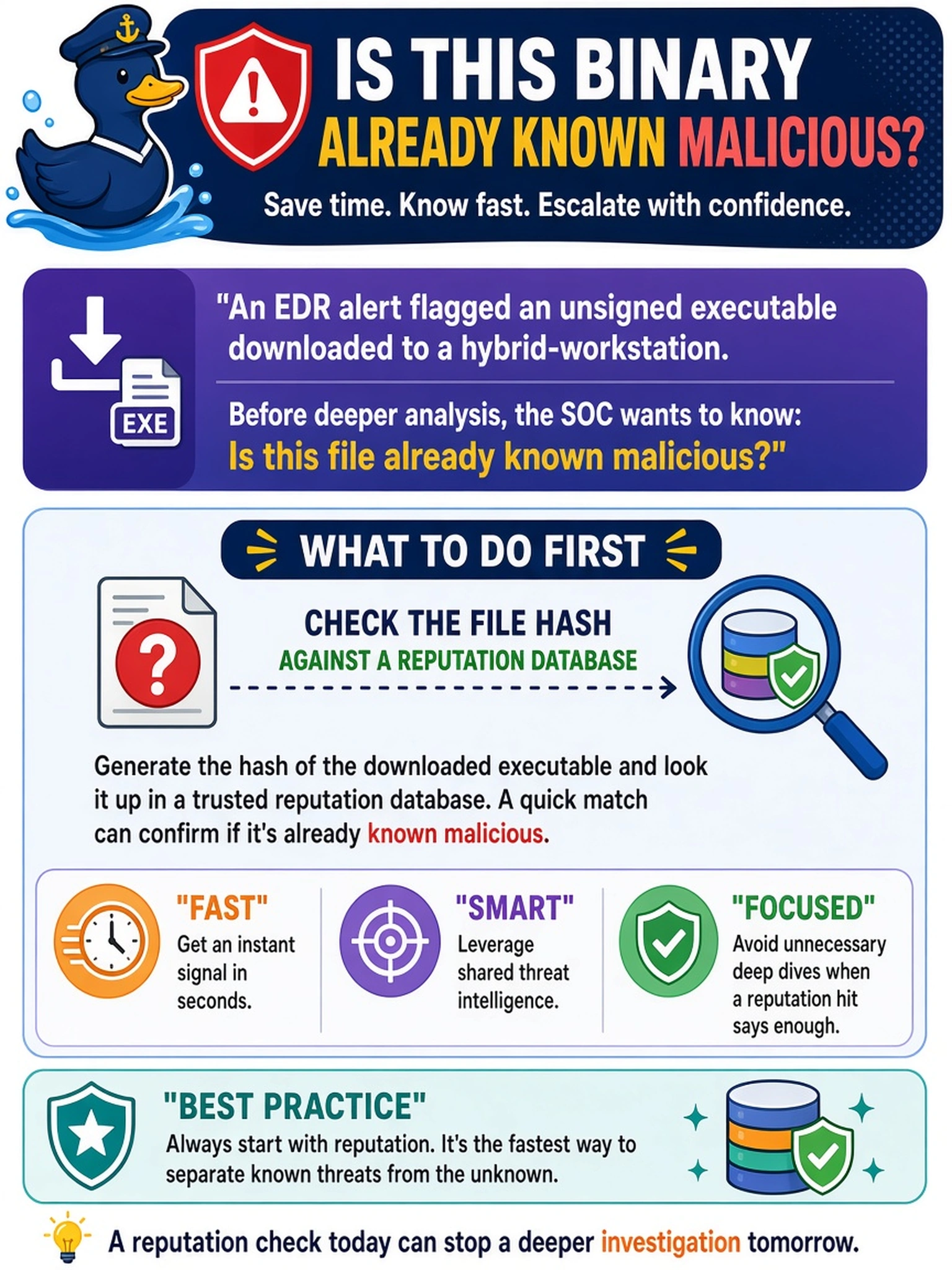
An EDR alert flags an unsigned executable downloaded to a hybrid-workstation. The SOC wants to know if the binary is already known malicious before deeper analysis. What should the analyst do first?
Select an answer to reveal the explanation.
Short Explanation
Think of a hash reputation check like running the file's fingerprint through a wanted-poster database. You get a quick yes-or-no on whether the binary is already known bad, so you don't waste time detonating a harmless file. If the hash comes back clean, then you move on to sandboxing or string analysis.
Full Explanation
Hash reputation services provide a fast enrichment step for suspicious files by matching a cryptographic digest, typically SHA-256 or MD5, against known malicious, known good, and unknown verdicts. A hash hit can also supply malware family, first-seen date, and source confidence, which supports triage and correlation across EDR, SIEM, and threat-intel feeds. Behavioral sandbox detonation is a later, more expensive analysis technique that reveals runtime activity, but it is not the quickest way to learn whether the binary is already cataloged as malicious. Entropy comparison can suggest packing or obfuscation, yet a clean entropy result does not prove the file is benign, and a packed file may still be known malware. Extracting embedded strings supports static triage and IOC discovery, but it produces indicators rather than a reputation verdict and can miss encrypted or obfuscated payloads. Exam caveat: a hash reputation miss does not prove benignity, because new, repacked, or signed-but-abused binaries may have no prior reputation. Operational check: query the SHA-256 in the TIP or SIEM enrichment lookup, log the source, timestamp, and verdict, and route unknown hashes to sandbox or deeper static analysis.