
Your SOC receives an alert regarding unauthorized access attempts to the private key store supporting the organization's internal Certificate Authority. The security architect confirms that the private keys are generated and stored exclusively within a dedicated hardware security module (HSM), with no keys ever leaving the device's boundary. An analyst argues that because the keys are hardware-protected, the HSM itself provides real-time detection of anomalous cryptographic operations. Which statement correctly evaluates the HSM's role in this scenario?
Select an answer to reveal the explanation.
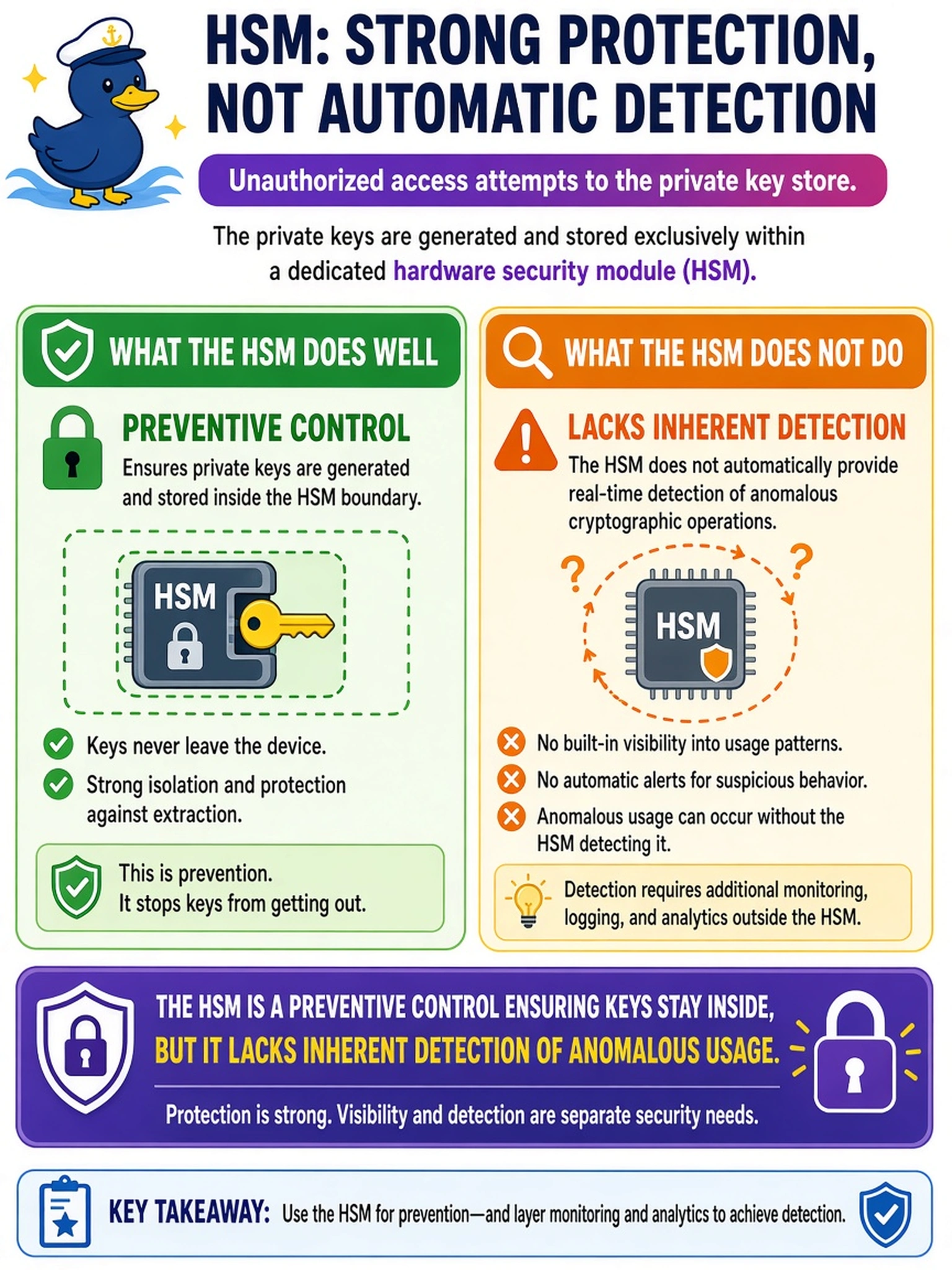
Short Explanation
Think of an HSM like a bank vault: it keeps your gold (keys) safe, but it doesn't call the police if someone is trying to pick the lock. It stops the keys from leaving, sure, but it doesn't know if the usage is weird. You still need a SIEM or EDR to spot the bad behavior. Don't confuse protection with detection.
Full Explanation
Hardware Security Modules (HSMs) are specialized, tamper-resistant devices designed to protect the entire lifecycle of cryptographic keys. Their primary function is to ensure that private keys are generated, stored, and used within a secure hardware boundary, preventing them from being extracted or exposed to the operating system or applications. This makes them a critical preventive control for data confidentiality and integrity. However, an HSM does not natively perform behavioral analysis or threat detection. It executes cryptographic operations as instructed by the host system. If an attacker compromises the host application and requests valid cryptographic operations using the protected keys, the HSM will comply, as it cannot distinguish between authorized and malicious usage based on context. Detection of anomalous cryptographic activity, such as high-volume signing or unusual access times, requires external telemetry, such as logs sent to a SIEM or monitoring via EDR agents. Distractors incorrectly attribute detective or hunting capabilities to the hardware itself. An HSM does not automatically block based on behavioral baselines, nor does it perform threat hunting or replace the need for centralized logging. It is a custody control, not a detection engine. Exam caveat: Always distinguish between controls that protect assets (preventive) and controls that identify misuse (detective). Operational check: Verify that your HSM logs are being exported to your SIEM to enable correlation with other security events.