
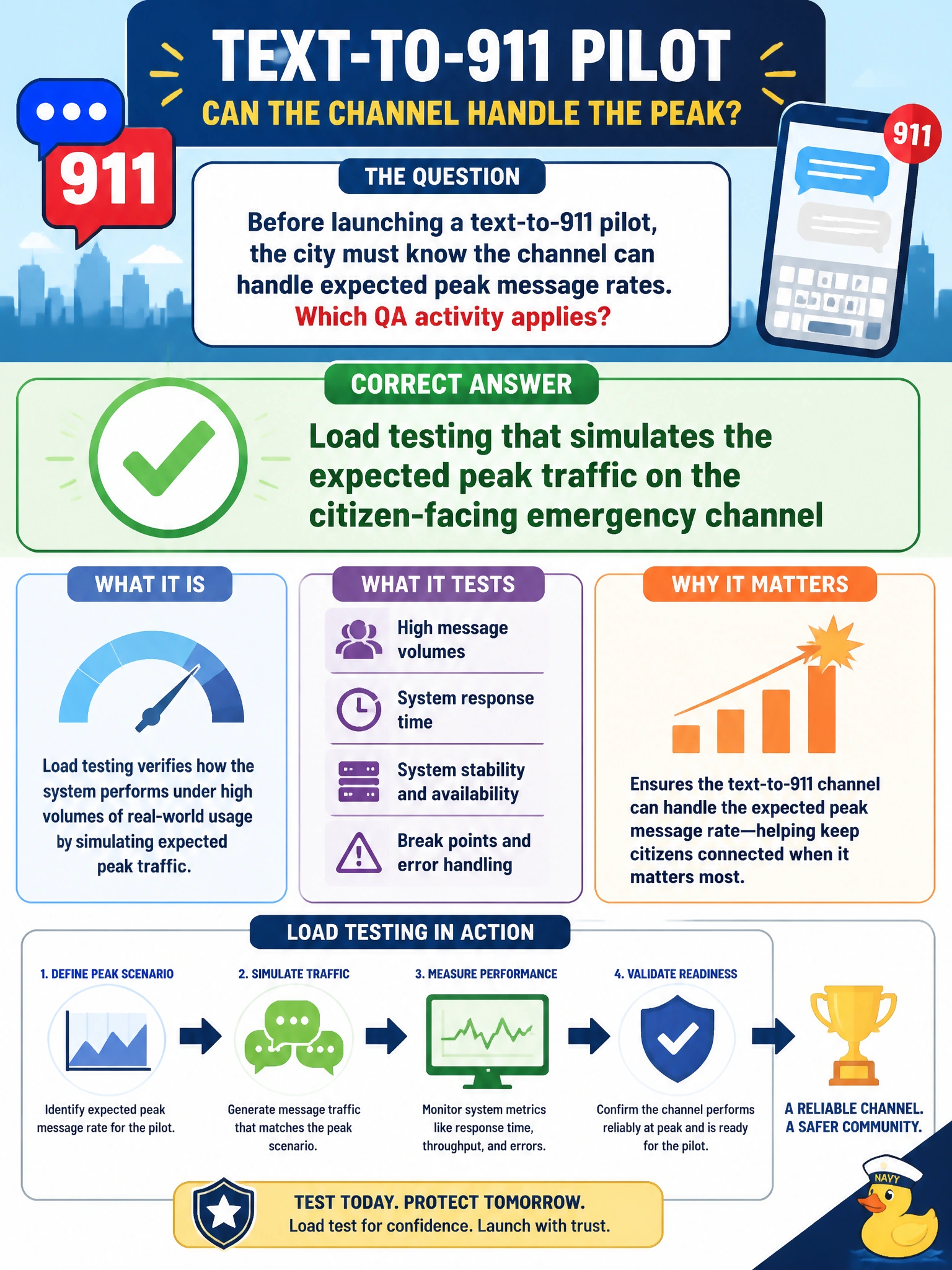
Before launching a text-to-911 pilot, the city must know the channel can handle expected peak message rates. Which QA activity applies?
Select an answer to reveal the explanation.
Short Explanation
Load testing is rehearsal day for text-to-911 when everyone texts at once. Spell-check and single-function unit tests do not prove the emergency channel survives the peak.
Full Explanation
Load testing simulates expected or peak concurrent traffic to prove capacity before a citizen-facing channel goes live. Before launching a text-to-911 pilot, the city must know the channel can handle expected peak message rates under incident spike conditions; load testing that simulates that peak on the citizen-facing emergency channel is the QA activity that answers throughput, queuing, latency, and failure behavior under stress.
Spell-checking the emergency-ops runbook markdown files improves documentation quality but says nothing about message throughput or latency under load. Unit-testing a single formatter function with one sample string validates a micro-unit of code, not the end-to-end emergency channel at peak. Manual review of marketing copy for the pilot announcement is communications QA, not capacity proof for text-to-911 when many residents message at once.
Exam caveat: load profiles should reflect realistic civic peak patterns (incident spikes, not average noon traffic) and include failure/timeout assertions, not only “requests completed.” Keep tests off live 911 rails—use dedicated pilot or staging endpoints. Operational check: run a staged load test against the text-to-911 path at expected peak rates in a controlled window, capture latency and error rates against the pilot’s criteria, and clear go-live only if results meet capacity requirements.