
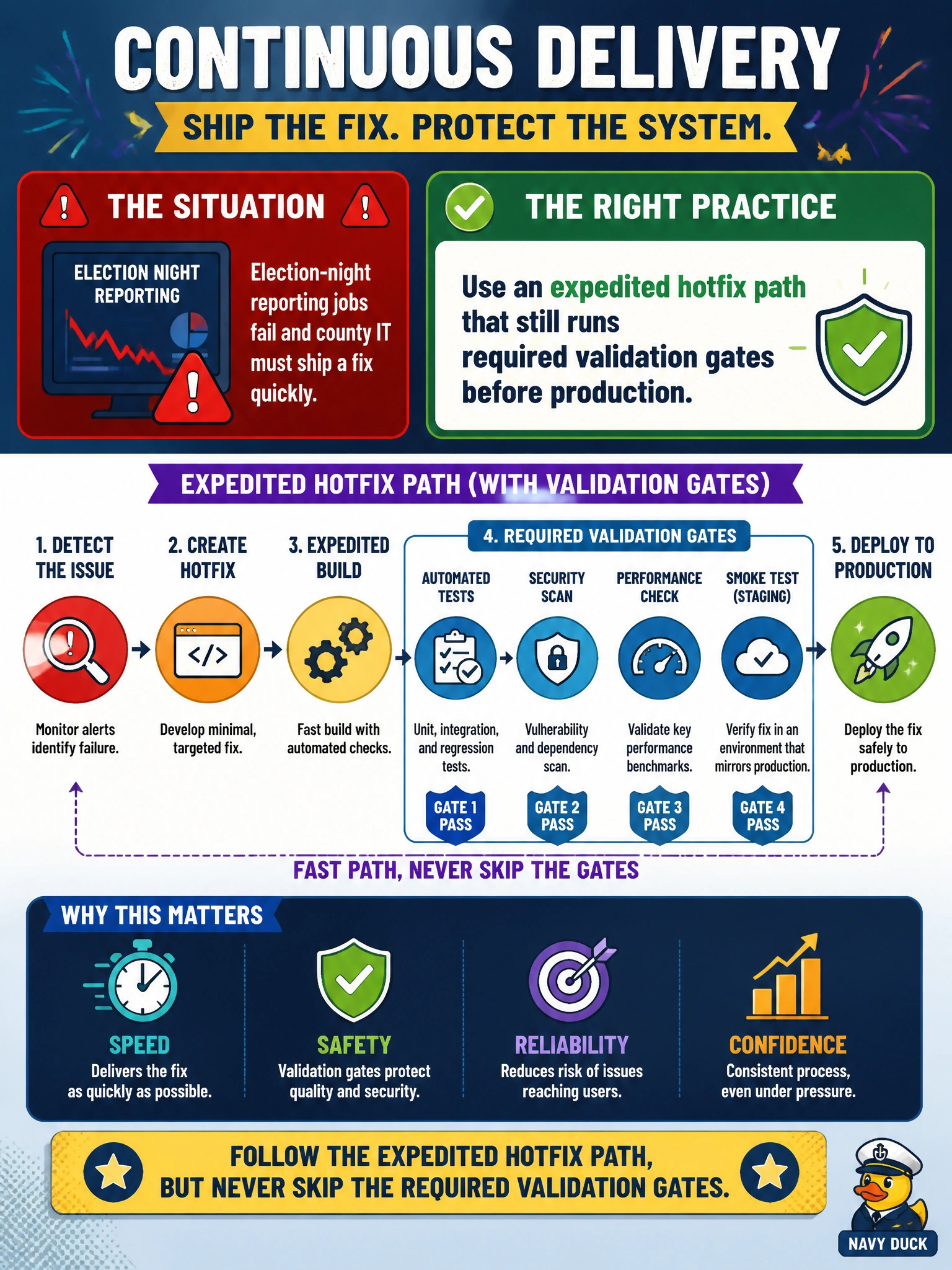
Election-night reporting jobs fail and county IT must ship a fix quickly. Which continuous-delivery practice is appropriate?
Select an answer to reveal the explanation.
Short Explanation
An election-night hotfix can move quickly, but you still need to run the required validation gates before production. Pushing untested binaries, delaying the replacement until the next quarterly release, or disabling monitoring won’t safely restore reporting.
Full Explanation
Continuous delivery allows an expedited hotfix when election-night reporting jobs fail, but the fix must still pass required validation gates before production. The appropriate practice is to shorten the delivery path while retaining mandatory checks and auditable promotion: speed without validation risks replacing one outage with an unverified binary in the civic reporting path. Pushing untested binaries straight to production with no pipeline removes the safety net when pressure is highest and can multiply defects. Disabling the failing job, documenting the issue, and bundling a replacement into the next quarterly release leaves a time-critical service without a timely fix; election night cannot wait for that release. Disabling all monitoring so the outage looks resolved hides symptoms from dashboards but does not restore reporting, leaving leadership and the public without visibility. Exam caveat: an expedited hotfix path should be a pre-approved playbook with a defined minimum gate set, such as a build, critical tests, and approval—not an ad-hoc bypass. Practical check: open the hotfix change, run the required pipeline gates on the fix commit, deploy through the expedited path, confirm the election-night jobs succeed, and retain the ticket trail for after-action review.