
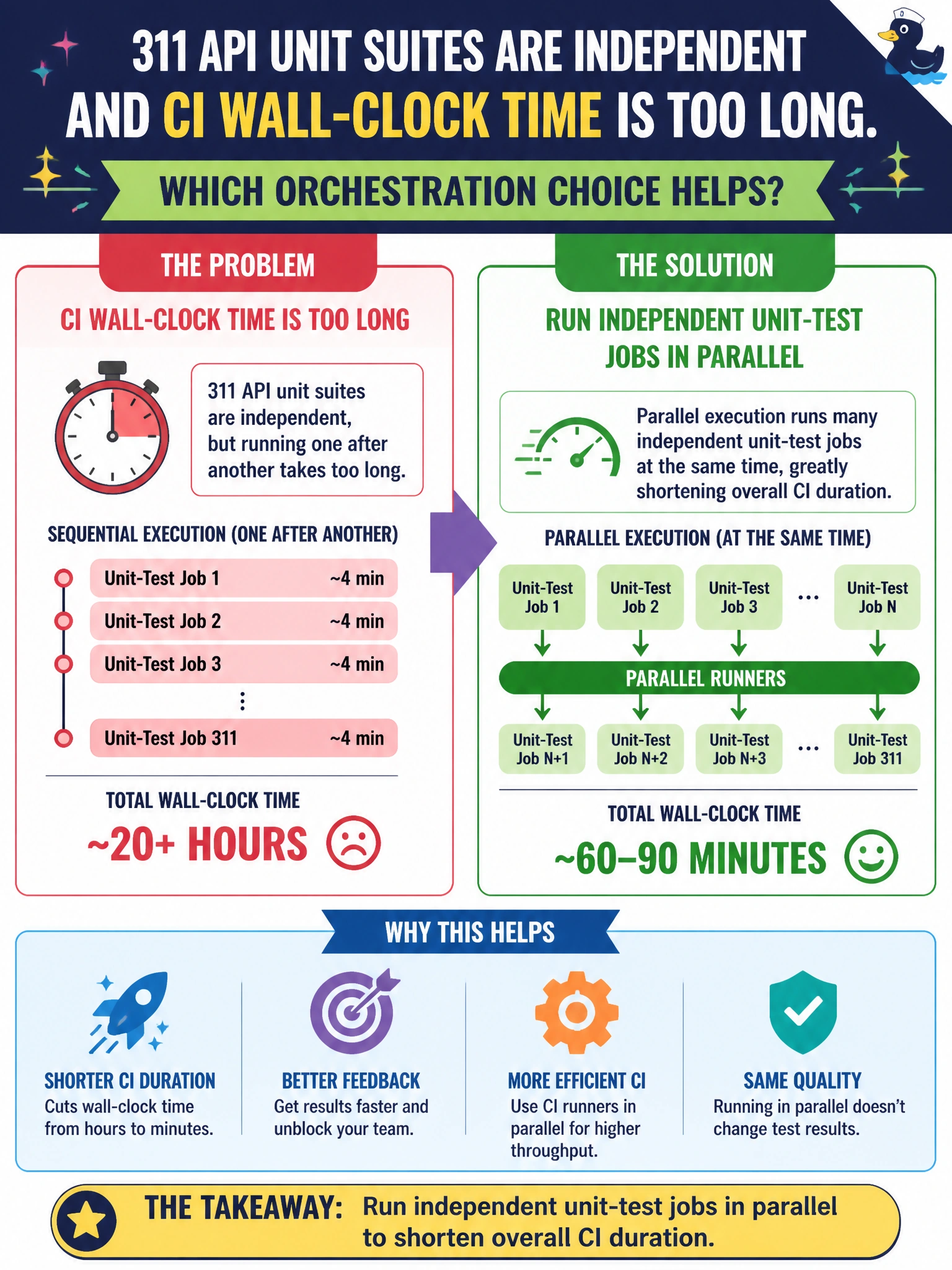
311 API unit suites are independent and CI wall-clock time is too long. Which orchestration choice helps?
Select an answer to reveal the explanation.
Short Explanation
Independent 311 unit suites are like opening multiple permit windows at once—parallel jobs finish the line faster than one clerk doing every form solo. Serializing everything or skipping tests just makes citizens wait (or breaks prod).
Full Explanation
Parallel orchestration runs independent CI jobs concurrently so overall wall-clock time drops without sacrificing coverage. For 311 API unit suites that share no prerequisites, fan-out across parallel jobs finishes the validation line faster than a single serial worker. The correct choice works because CI duration is often dominated by waiting: when suites are truly independent, serialization wastes agent capacity and delays merge feedback for municipal service APIs that need frequent, safe changes.
Running every suite only after midnight on a single shared laptop under someone's desk fails because a personal laptop is not an elastic, monitored CI estate—jobs become fragile, unreproducible, and invisible to on-call. Serializing all tests into one job even when suites share no prerequisites fails conceptually: forced serialization of independent work creates artificial bottlenecks and longer feedback loops without improving correctness. Canceling testing entirely and promoting every commit straight to production fails because throughput without validation is not CI improvement—it is uncontrolled change to a citizen-facing 311 API.
Exam caveat: parallelize only what is independent; shared fixtures, ordered migrations, or contended external services can make naive fan-out flaky—use parallel jobs for independent unit suites and keep true dependencies sequential. Operational check: split 311 unit suites into parallel jobs, measure pipeline duration before and after, confirm total coverage is unchanged, and watch for resource contention (rate limits, shared DBs) that would require isolation rather than more parallelism.