
City platform teams need a controlled place to store container images produced by CI. What fulfills that role?
Select an answer to reveal the explanation.
Short Explanation
An artifact registry is the city's evidence locker for built images—checked in, labeled, and access-controlled. Laptops and morning email tarballs do not scale as the store of record.
Full Explanation
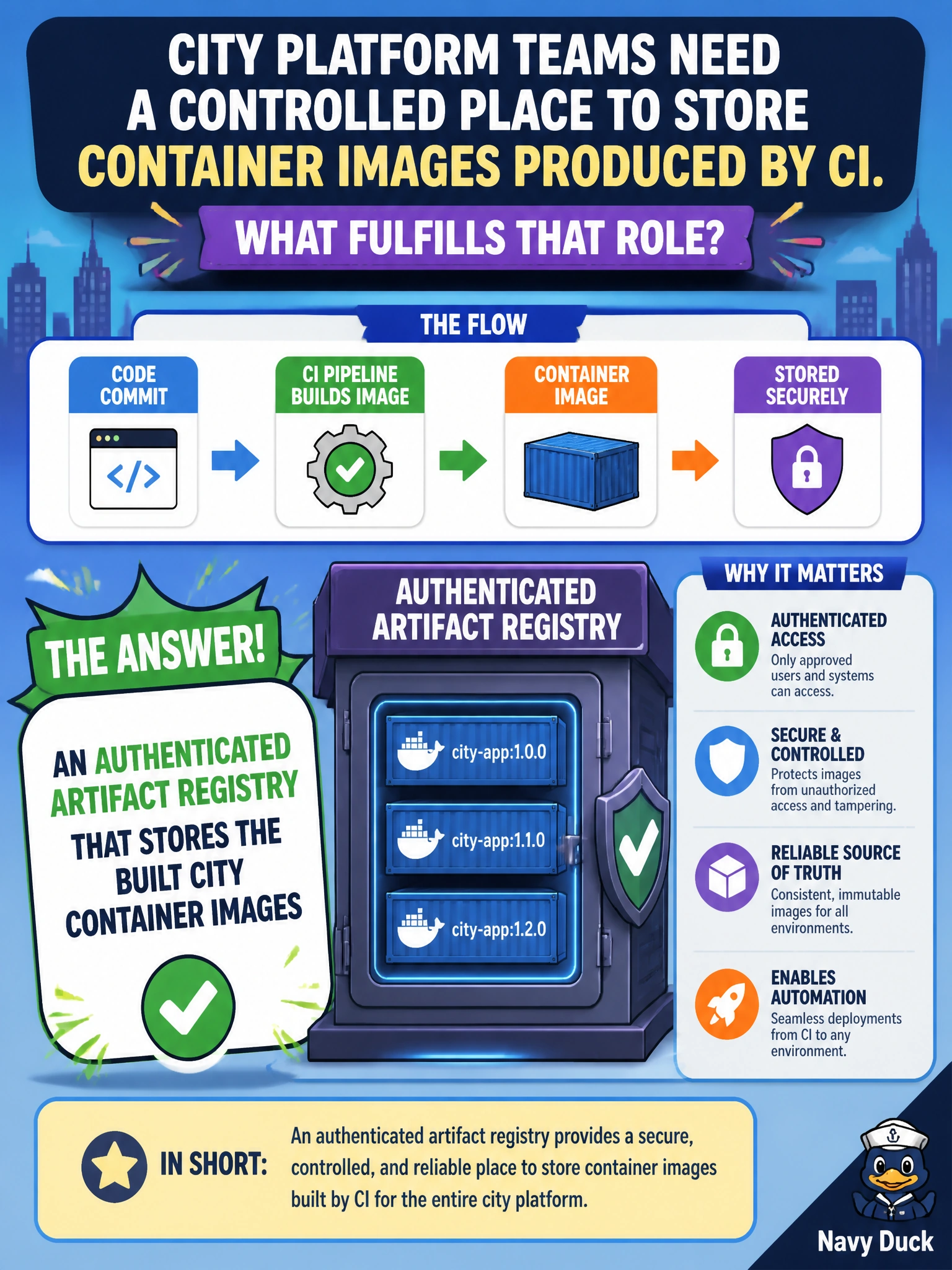
City analytics container builds need a durable, controlled place to store versioned images. The correct practice is an authenticated artifact registry that stores the built city container images. Registries provide tagging, digest addressing, access control, and integration with CI promote/pull paths so municipal workloads pull known builds rather than ad-hoc files. Authentication ensures only authorized pipelines publish and only authorized environments pull.
Anonymous public file shares as the long-term image storage location fail by concept: they lack trustworthy AuthN/Z, inventory, and immutability guarantees for production-grade civic systems. Storing solely on an analyst’s laptop fails durability, bus-factor, and controlled distribution—laptops are not the system of record for city container images. Emailing compressed image tarballs each morning fails scalability, integrity verification, and secret hygiene; email is not an artifact registry.
Exam caveat: “authenticated artifact registry” covers cloud container registries and on-prem equivalents; the exam point is controlled registry storage, not a brand. Digests and signatures complement registries but do not replace the need for a real registry.
Operational check: configure CI to push images to the municipal registry with service credentials, require auth on pull for non-public images, retain version history, block email/laptop as official distribution, and verify deploy jobs reference registry digests rather than unmanaged tarballs.