
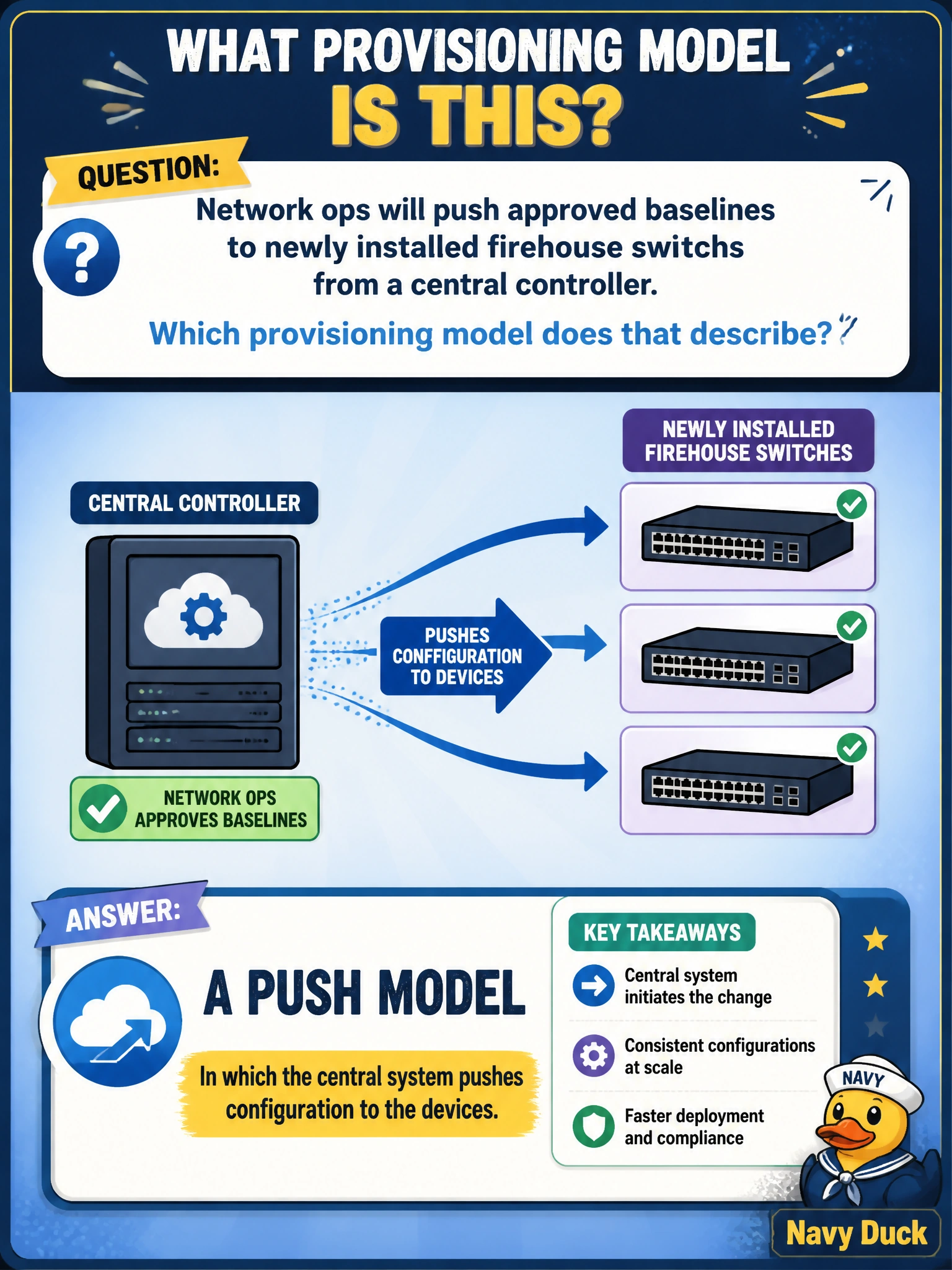
Network ops will push approved baselines to newly installed firehouse switches from a central controller. Which provisioning model does that describe?
Select an answer to reveal the explanation.
Short Explanation
Push is the fire chief radioing orders out to every station—the center speaks first. When a controller pushes switch baselines to new firehouse gear, that is push provisioning. Pull would be each switch asking for homework on its own schedule.
Full Explanation
When network operations pushes approved baselines to newly installed firehouse switches from a central controller, that is a push provisioning model: the central system initiates delivery of configuration to the devices. Push fits day-zero or day-one baselining where a controller, NMS, or orchestration platform writes VLANs, ACLs, SNMP, and AAA settings to switches as soon as they are reachable on the management plane, establishing a known-good municipal standard without waiting for each device to invent its own config.
A pure pull model where each switch invents its own baseline overnight fails the scenario because inventing local baselines is not centrally approved push, and the stem describes controller-initiated delivery. Citizen self-service portals that reconfigure switch VLANs from phones fail on authority and safety—public users must not alter firehouse network fabric. Air-gapping every switch with no management channel at all fails the provisioning requirement: without a management path, the controller cannot push baselines.
Exam caveat: real environments sometimes combine push for onboarding with later pull/agent or scheduled reconcile; classify the model by who initiates the configuration transfer. Here the controller pushes, so the answer is push.
Operational check: onboard a lab switch, confirm the controller pushes the approved template, compare running-config to the baseline, and verify management reachability exists only on the intended network-ops channels—not citizen portals or total isolation.