
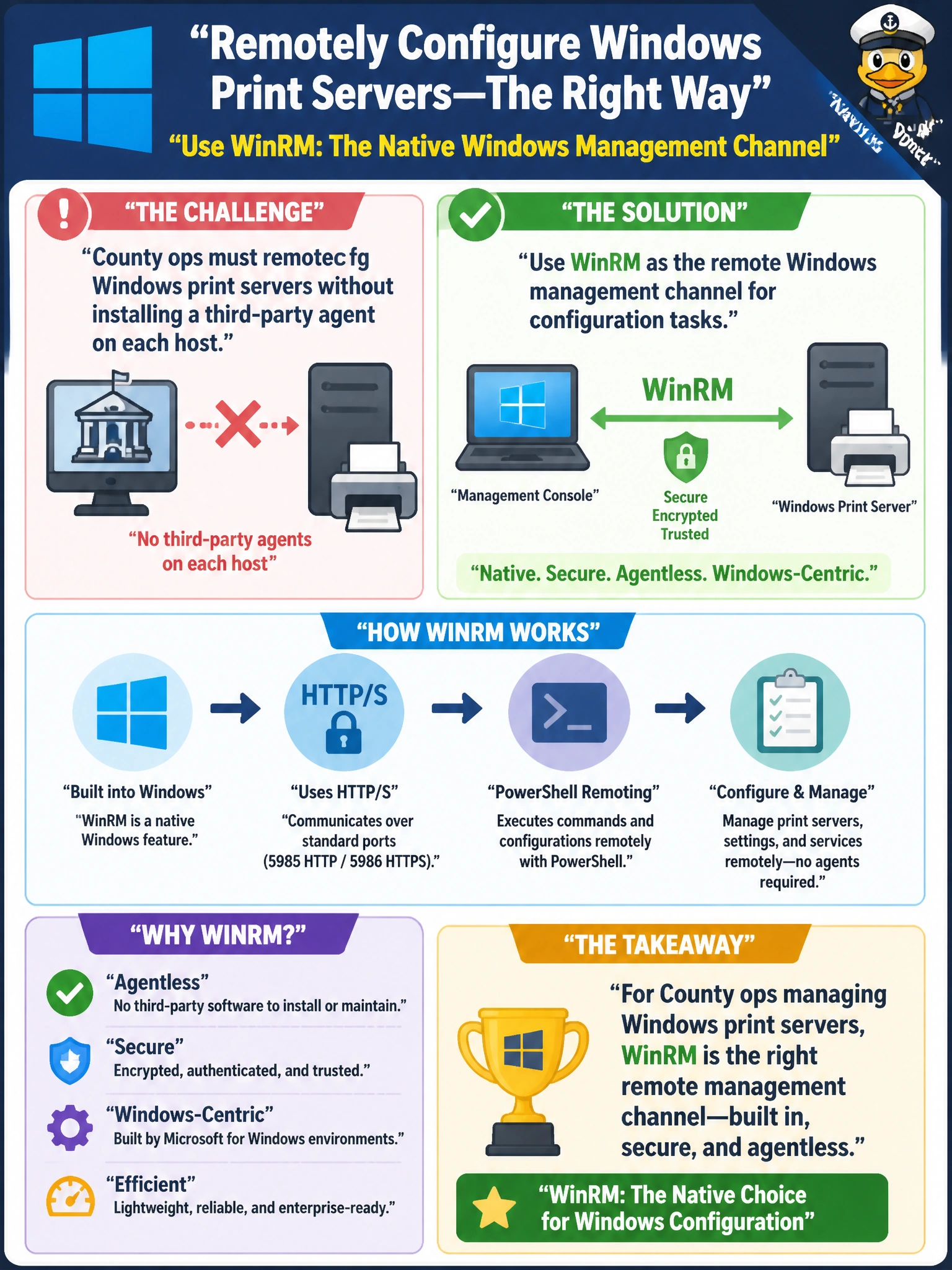
County ops must remotecfg Windows print servers without installing a third-party agent on each host. Which remote management channel fits that Windows-centric approach?
Select an answer to reveal the explanation.
Short Explanation
WinRM is the built-in hallway phone for talking to Windows boxes remotely—no extra agent hanging on the door. County print-server config fits that channel. Public RDP and USB-mail workflows are slow, risky, or both.
Full Explanation
County operators remoting into Windows print servers without installing a third-party agent should use WinRM as the Windows-native remote management channel. WinRM (Windows Remote Management) provides the remoting fabric commonly used by PowerShell Remoting and many configuration tools to execute commands and apply settings over an approved management path. For Windows-centric municipal print fleets, selecting WinRM matches the platform's built-in remote configuration approach while avoiding mandatory deployment of a separate vendor agent on every host.
Requiring physical console login for every print-queue change fails operationally at county scale: truck rolls or hands-on console work cannot keep up with routine queue, driver, and permission changes. Exposing each print server RDP to the public internet without MFA fails on security concept—it publishes a high-value interactive admin surface to the world and omits baseline identity controls municipal systems require. Shipping USB sticks of PowerShell scripts via interoffice mail only fails as a remote management channel: physical media is slow, untracked relative to live remoting, and does not provide continuous or on-demand remote configuration.
Exam caveat: WinRM must still be hardened (HTTPS listeners, restricted principals, network allowlists). "Agentless" relative to third-party agents does not mean "no authentication." The question asks which remote management channel fits Windows-centric remotecfg without a third-party agent—WinRM is that channel.
Operational check: confirm WinRM listeners are reachable only from management subnets, test a controlled PowerShell remoting change against a print server, verify RDP is not internet-exposed, and document that routine queue changes no longer depend on console visits or USB courier scripts.