
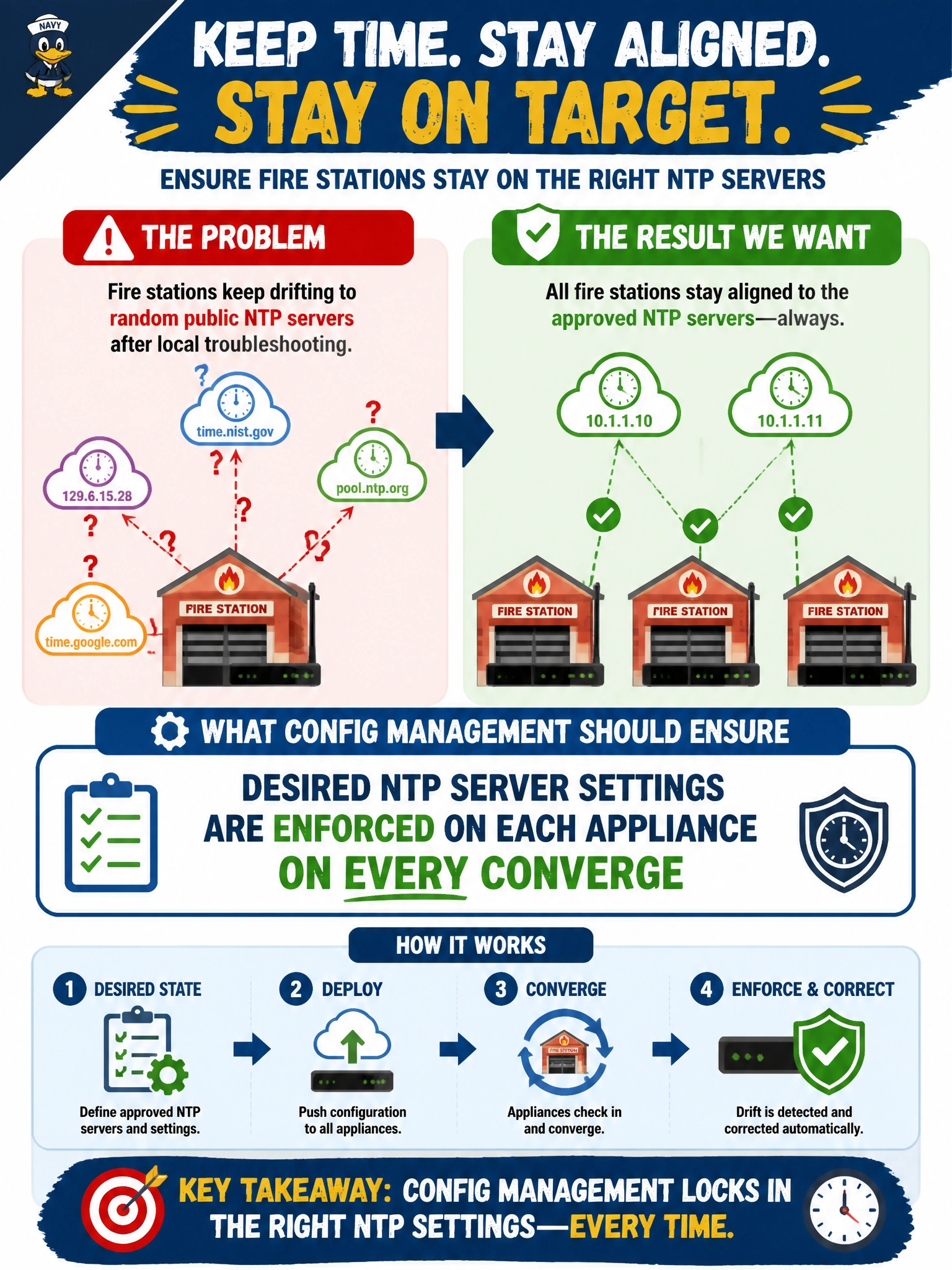
Fire stations keep drifting to random public NTP servers after local troubleshooting. What should config management ensure?
Select an answer to reveal the explanation.
Short Explanation
Time sync is the shared city clock on the wall—everyone should point at the same approved faces. Config management ensures those NTP servers stick after someone 'temporarily' changed them. Free-running clocks and captain's-choice pools create chaos.
Full Explanation
Fire stations that drift to random public NTP servers after local troubleshooting need configuration management to enforce desired NTP server settings on each appliance on every converge. Time sync underpins log correlation, certificate validity, Kerberos-like auth, and CAD event ordering; unmanaged “temporary” NTP changes become permanent station snowflakes and split the city’s timeline.
Removing NTP entirely so clocks free-run without external references guarantees drift between stations and breaks distributed troubleshooting. Letting each captain pick a favorite public pool with no central standard recreates the current failure mode and may violate network policy about outbound internet dependencies from station networks. Documenting time sync only on a laminated card beside the radio cannot reconverge an appliance after someone “fixed” NTP during an outage.
Exam caveat: enforcement should point at approved municipal NTP sources (internal stratum servers or sanctioned pools), not merely “any NTP.” Also consider authenticated NTP where the platform supports it. Converge must not flap settings every run—desired state should be idempotent. Emergency troubleshooting can temporarily change NTP, but remediation must restore the baseline afterward.
Operational check: query current NTP peers on a sample of fire-station appliances, compare to the declared servers, converge a drifted host, and confirm it returns to the approved peers and remains there after reboot and after a simulated local edit.