
A transit authority wants AVL worker nodes that never accumulate one-off SSH patches. Which IaC immutability practice should the ops team follow?
Select an answer to reveal the explanation.
Short Explanation
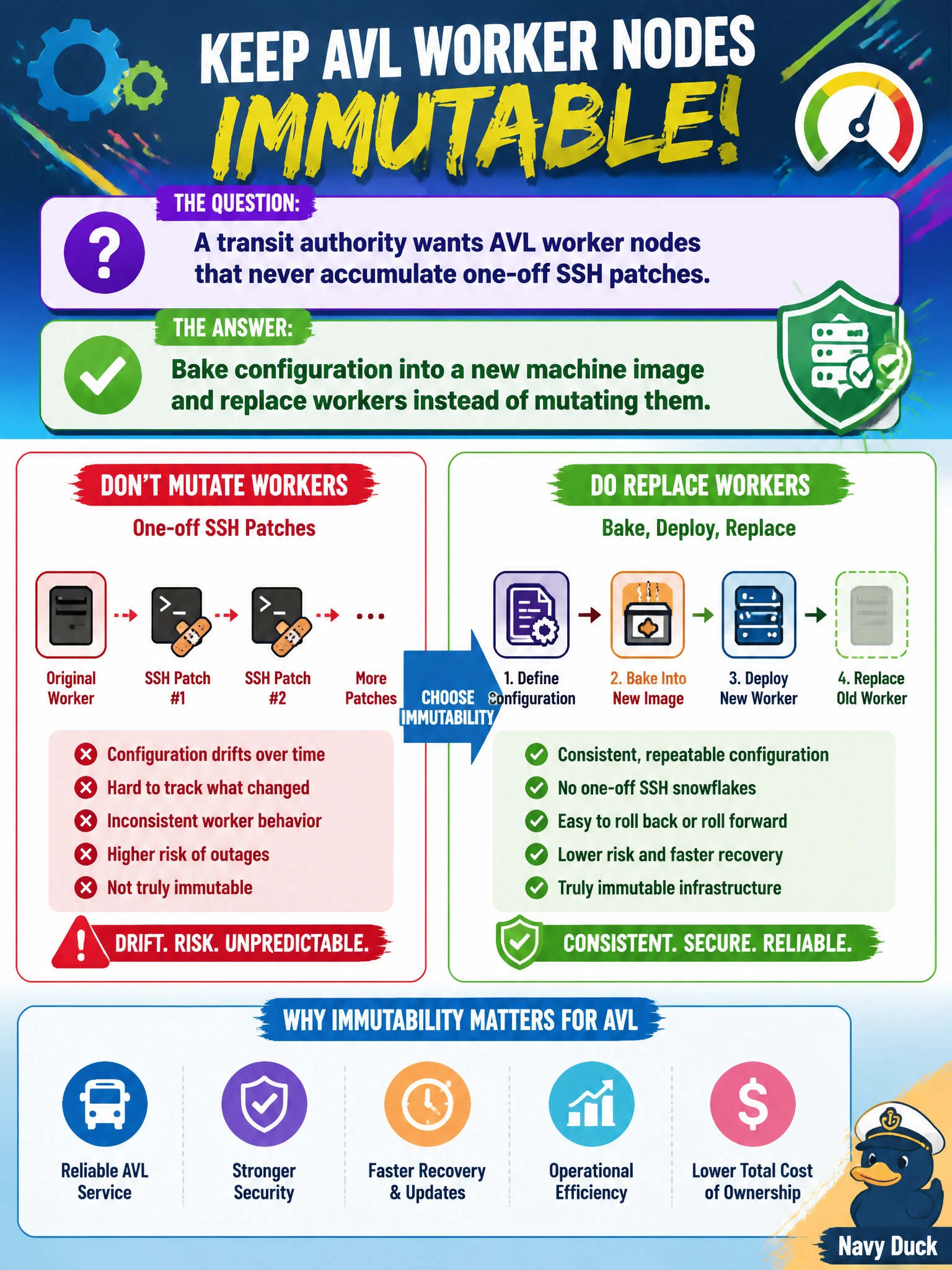
Think of AVL workers like sealed bus radios: you swap the whole unit instead of soldering random fixes on the road. Baking config into a fresh image and replacing the node keeps every garage worker identical. Long-lived SSH snowflakes are how drift sneaks in.
Full Explanation
Immutable infrastructure treats each AVL worker node as a replaceable unit rather than a long-lived snowflake. Baking configuration into a new machine image and replacing workers ensures every garage node starts from the same known-good baseline: OS packages, agent versions, AVL telemetry settings, and hardening flags travel together. One-off SSH patches never accumulate because the running instance is discarded and rebuilt from the image pipeline when change is required.
Keeping a golden VM for years and applying weekly hotfix scripts over SSH is the classic mutable anti-pattern. Drift compounds, rollback becomes guesswork, and two garages quietly diverge even when operators believe they followed the same checklist. Hand-editing production configs on each garage host after every release produces the same outcome at human speed: undocumented local differences and no reliable audit trail. Documenting console clicks in a wiki treats tribal notes as the live baseline; the wiki cannot converge a node or prove what is actually running.
Exam caveat: immutability does not forbid all remote access for break-glass diagnostics, but operational change must flow through image bake and replace—not persistent SSH mutation as the change mechanism. Patching “in place just this once” during a transit incident is still mutation unless the fix is immediately captured in the next image and the fleet is rolled.
Operational check: after a config change, confirm a new image build exists, workers were replaced (not SSH-edited), and garage node inventories report identical image IDs and agent versions with no lingering local hotfix scripts.