
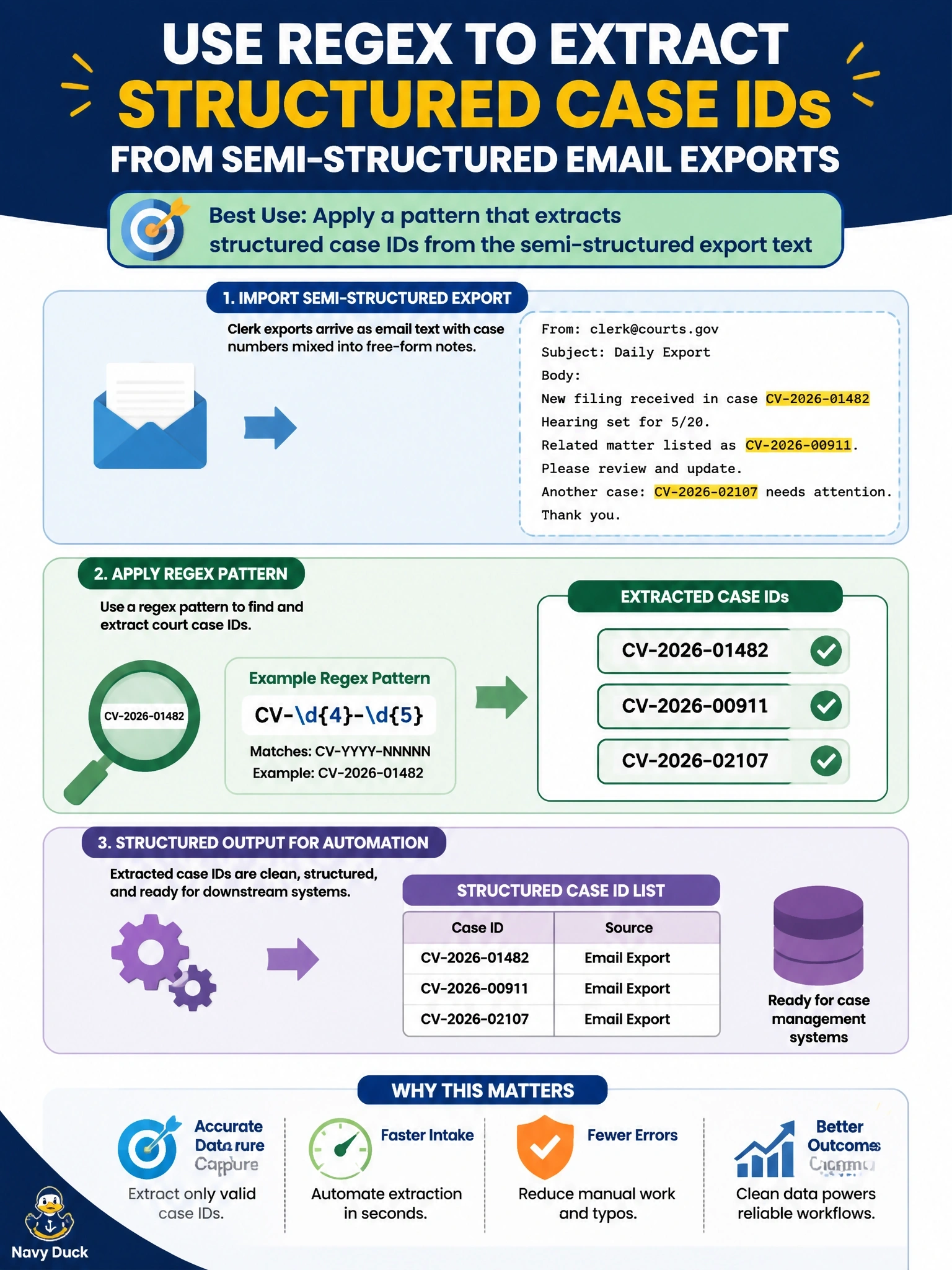
Courts clerk exports arrive as semi-structured email text containing case numbers like CV-2026-01482 mixed with free-form notes. What is the best use of regex in the intake automation?
Select an answer to reveal the explanation.
Short Explanation
Regex is the metal detector in a junk drawer—it pulls the case ID shape out of chatty clerk emails. You match the CV-year-number pattern and leave the free-form notes behind.
Full Explanation
Courts clerk exports often arrive as semi-structured email text: free-form notes mixed with structured tokens such as case numbers like CV-2026-01482. Regular expressions excel at locating those predictable patterns inside noisy text so intake automation can extract fields for routing and indexing. The best use of regex here is to apply a pattern that extracts structured case IDs from the semi-structured export text, then pass those IDs to downstream systems while leaving unrelated prose behind. The approach that replaces the entire export with a blank file so parsers never see noisy text destroys the only source of case data and guarantees empty intake—noise avoidance by deletion is not extraction. The approach that stores the raw MIME blob in a relational table without parsing fields preserves bytes but does not produce usable case identifiers for workflow; opaque storage postpones the same parsing problem. The approach that trains staff to retype case numbers manually into a spreadsheet each night abandons automation, introduces transcription errors, and fails under volume—regex exists precisely to avoid that nightly rekeying. Exam caveat: validate extracted IDs against an expected format and uniqueness rules; over-broad patterns can capture look-alikes, and under-broad patterns miss variants (spacing, prefixes). Prefer capturing groups and post-match validation over a single brittle expression. Operational check: run the regex against a fixture corpus of clerk emails with known case IDs, assert each expected ID is extracted and non-case text is ignored, measure false positives on notes that mention similar digit strings, and confirm downstream queues receive only validated case identifiers from the municipal courts intake path.