
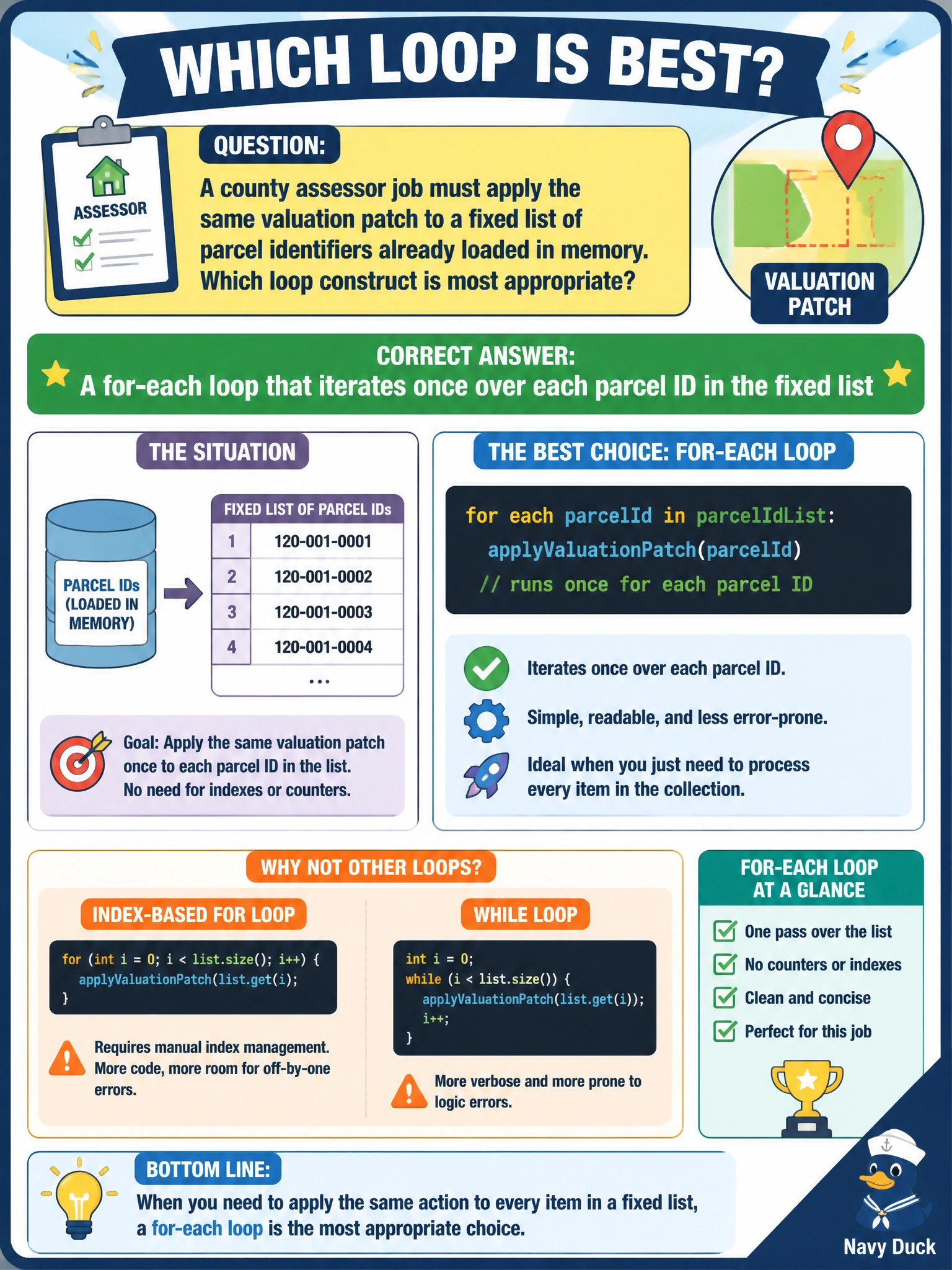
A county assessor job must apply the same valuation patch to a fixed list of parcel identifiers already loaded in memory. Which loop construct is most appropriate?
Select an answer to reveal the explanation.
Short Explanation
You've got a fixed roster of parcels—walk the list once like checking names on a clipboard. A for-each loop hits every ID without waiting on a keyboard or inventing infinity.
Full Explanation
When a county assessor job already holds a fixed list of parcel identifiers in memory and must apply the same valuation patch to each, the appropriate construct is a bounded for-each (or equivalent) loop that visits every element once. The collection size and contents are known up front, so iteration over the list maps one-to-one with the work items and terminates naturally when the list ends. An infinite while loop that waits for operators to type each parcel ID interactively replaces automated bulk update with manual data entry, introduces human error, and never finishes unattended overnight runs. A recursive call that doubles the parcel list on every failure without a base case risks stack overflow, uncontrolled growth, and undefined completion—none of which matches a finite in-memory roster. A scheduled cron entry that never iterates the in-memory list may start a process on a timer but does not itself traverse the parcels; without an inner loop or equivalent batch apply, the valuation patch never hits each ID. Exam caveat: for-each assumes the list is already loaded correctly; if parcels arrive from an external query, you may combine fetch-then-iterate, but the stem's fixed in-memory list points specifically to iterating that collection rather than inventing interactive or unbounded control flow. Operational check: run the job against a small fixture list, assert the patch executes exactly once per parcel ID, verify no interactive prompts block the batch, confirm termination after the last element, and sample assessor records to ensure valuations updated for every identifier in the roster.