
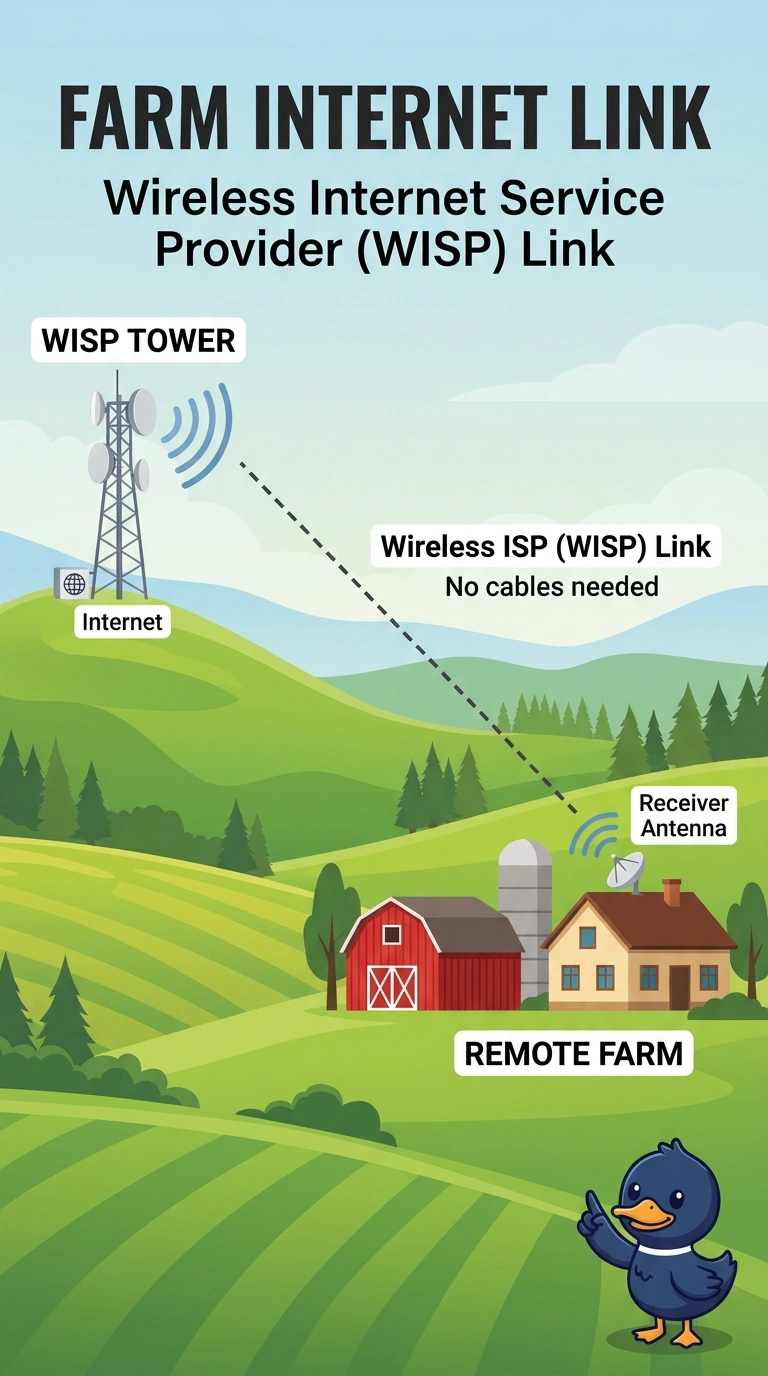
A farm's internet arrives by radio from a provider's tower to an antenna on the barn, not from a satellite dish and not from a phone line. Which connection type is that?
Select an answer to reveal the explanation.
Short Explanation
You can identify the connection by following the radio signal from the ground-based provider tower to the barn antenna. That is a wireless internet service provider link; the farm’s Wi-Fi, satellite service, and DSL use different paths.
Full Explanation
A wireless internet service provider sends internet by radio from a tower to a receiver at the site. The barn antenna receiving a signal from a provider tower, with no satellite dish and no phone line, matches this connection. A wireless LAN is the local Wi-Fi among devices at the farm; it is not the provider’s path to the barn. Satellite service uses a dish aimed at a satellite, so a link from a ground-based provider tower is not satellite. DSL uses telephone wiring, so a provider tower does not deliver DSL. Exam caveat: the radio link can still end at a router, and the farm can run its own Wi-Fi behind that router. The provider hop is the wireless internet service, not the local wireless LAN. Practical check: confirm that the barn antenna is associated with the provider tower and that the router receives an address through that radio link. Record the result on the ticket before closing it.