
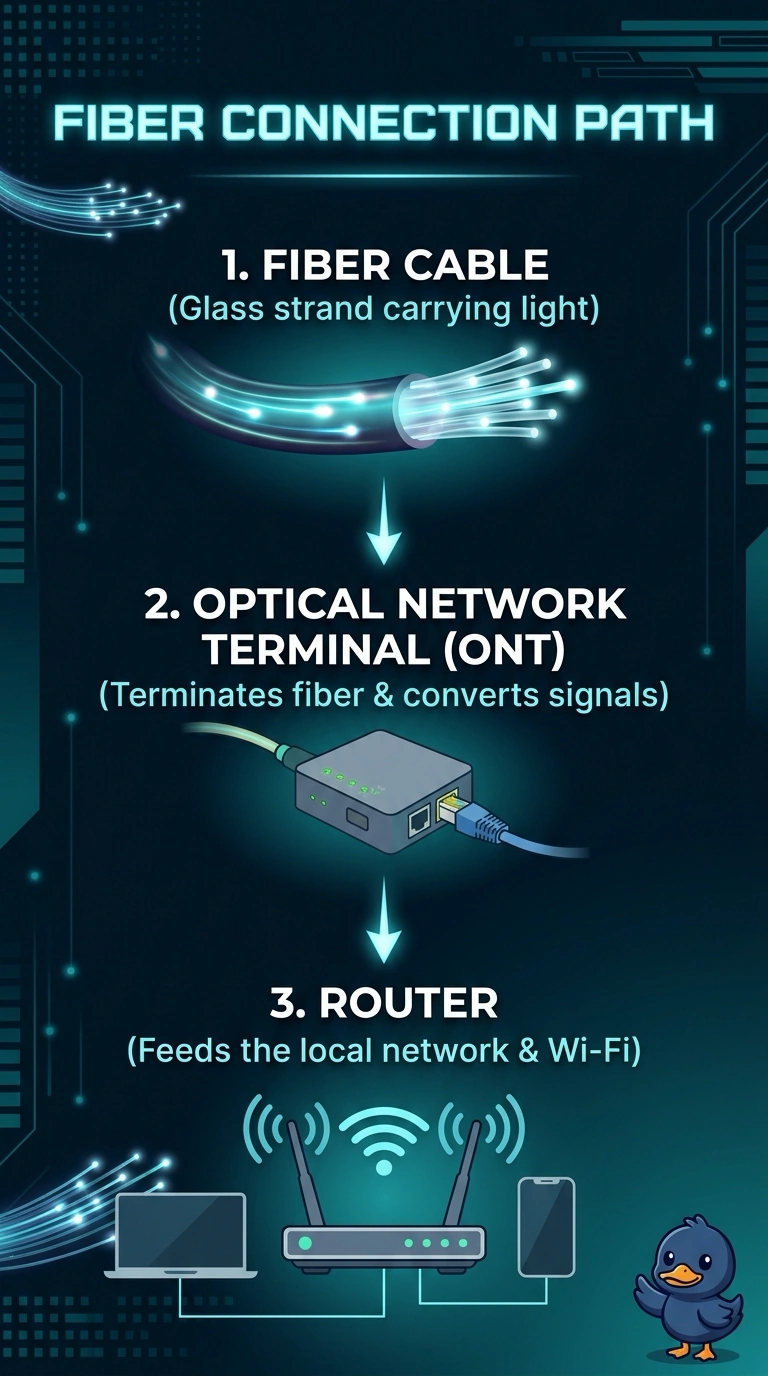
A provider terminates a glass strand on an optical network terminal at the building, and that terminal feeds the router. Which connection type is the strand?
Select an answer to reveal the explanation.
Short Explanation
You can identify the provider connection by tracing the glass strand to the optical network terminal that feeds the router. That handoff is fiber; a phone line, dish, or coaxial cable is a different connection.
Full Explanation
Fiber optic service carries data as light through a glass strand, and the optical network terminal converts that light into a connection for the router. Since the provider’s glass strand terminates on that device, the connection is fiber. DSL uses telephone wiring; an optical network terminal does not mean the service is on a phone line. Satellite service uses a dish and a radio path, so a glass strand is not a feed from a dish. Cable broadband uses coaxial cable, which is not the glass strand described here. Exam caveat: the run from the optical network terminal to the router is often ordinary Ethernet over copper. That copper tail does not change the provider connection from fiber or make it a second provider service. For a practical check, trace the strand to the optical network terminal, confirm the terminal is up, and verify that the router receives an address from it. Confirm that the copper tail is Ethernet, not another provider connection, and note the result on the ticket.