
A technician must find which port on a patch panel belongs to an unlabeled wall jack. Which tool puts a signal on that cable and finds it at the panel?
Select an answer to reveal the explanation.
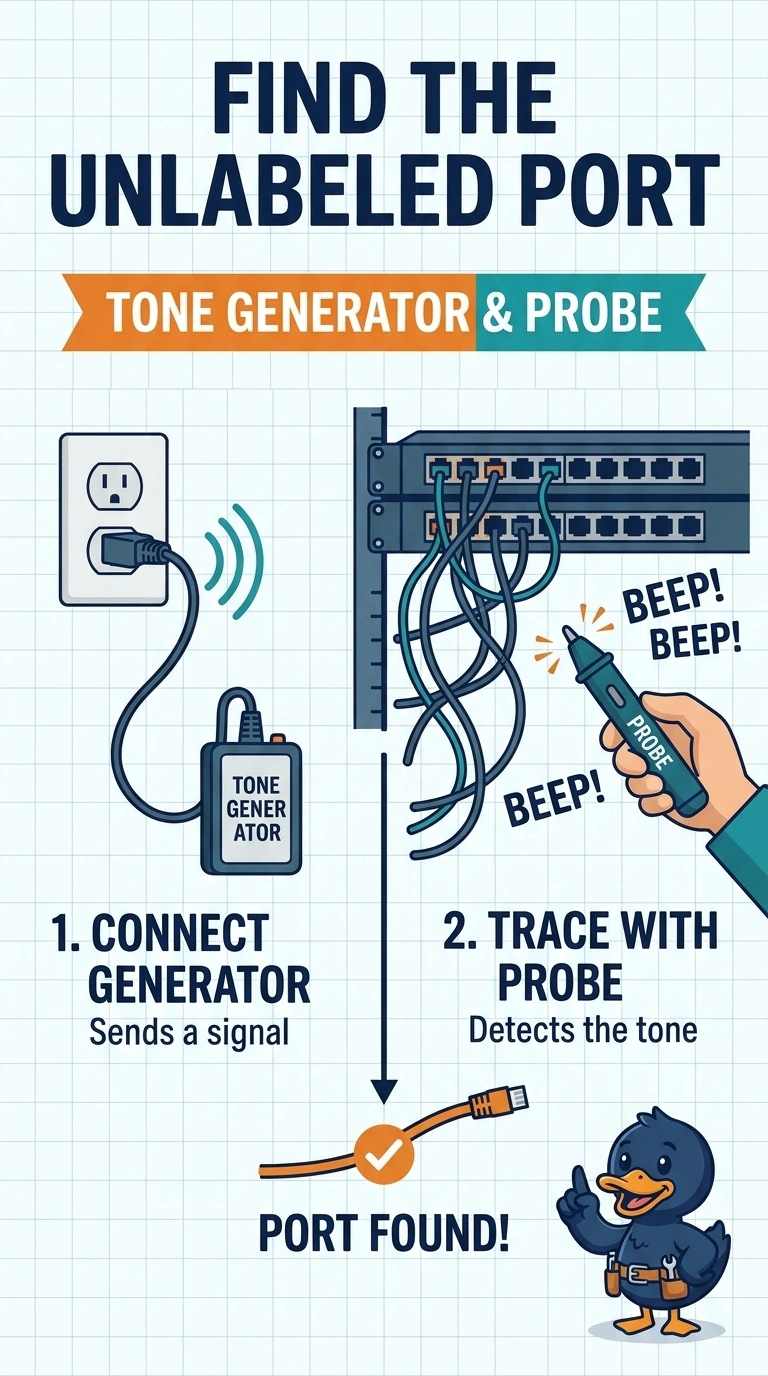
Short Explanation
You can put a tone on the unlabeled cable with a tone generator, then use its probe to find the signal at the patch panel. A loopback plug tests a port, a crimper attaches a connector, and a Wi-Fi analyzer shows wireless networks, so none of them traces the copper pair.
Full Explanation
A tone generator places an analog tone on a copper pair, and its inductive probe finds that tone at the patch panel without depending on a label. This lets you identify which panel port belongs to an unlabeled wall jack. A loopback plug connects a port’s transmit path back to its receive path so you can test the port; it does not trace a cable through a building. A crimper attaches a connector to a cable, but it does not detect a tone at the far end. A Wi-Fi analyzer shows wireless networks and signal, but it does not identify a pair on a patch panel. Exam caveat: a tone can couple onto neighboring pairs in a bundle, so confirm the pair by separating it or using a cable tester with a proper wire map. For a practical check, tone the jack, probe the panel, label both ends, and verify the pair with a cable tester. Once the wire map agrees, label the jack and panel port with the same room number. This helps ensure that tone bleed onto a neighboring pair is not what you document; tone only the pair you mean to find.