
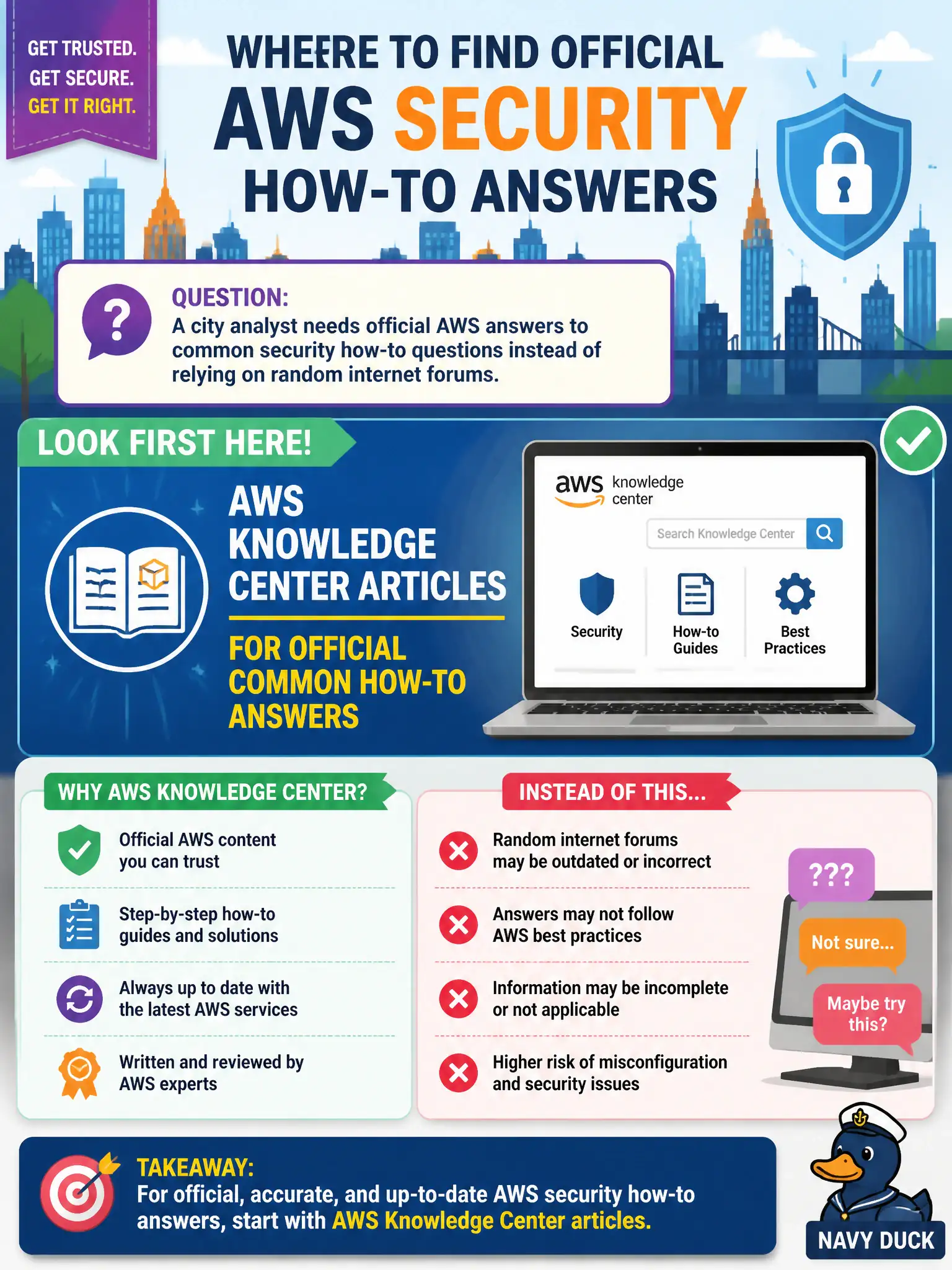
A city analyst needs official AWS answers to common security how-to questions instead of relying on random internet forums. Where should the analyst look first for that authoritative guidance?
Select an answer to reveal the explanation.
Short Explanation
When you want the official FAQ—not the loudest forum post—go to the AWS Knowledge Center. It is AWS’s curated answers to the questions people ask support all the time.
Full Explanation
When a city analyst needs official AWS answers to common security how-to questions, the AWS Knowledge Center is the authoritative first stop. Knowledge Center articles are curated AWS documentation responses to frequently asked operational and security questions—covering topics such as IAM troubleshooting, encryption patterns, certificate issues, and service configuration how-tos. For municipal staff who must prefer vendor-backed guidance over anecdotal posts, Knowledge Center sits alongside the Security Blog, whitepapers, and service docs as trusted AWS-authored material.
Unaudited social media threads are not a primary source of truth for production security decisions. They can surface ideas quickly, but they lack AWS review, may be outdated, and often omit account-specific caveats that matter for public-sector compliance. Third-party rumor blogs with no AWS review similarly risk incorrect claims about feature behavior, shared-responsibility boundaries, or deprecated APIs. Empty S3 buckets renamed to look like documentation sites are a classic phishing or typo-squatting pattern; they are not documentation and should never be treated as guidance for locking down a citizen portal.
Exam caveat: Cloud Practitioner security questions often ask where to find official answers. Map “common how-to / FAQ style” to Knowledge Center, “feature announcements and deep dives” to the AWS Security Blog, “compliance reports” to AWS Artifact, and “interactive learning” to Skill Builder. Do not confuse Artifact (audit artifacts) with Knowledge Center (how-to articles).
Operational check: bookmark the Knowledge Center from the AWS Support or documentation portal, search by service and error symptom before opening a support case, and cite Knowledge Center article IDs in municipal runbooks so auditors see that remediation steps came from official AWS guidance rather than forum folklore. Cross-check still-open feature behavior against current service documentation when an article predates a major API change.