
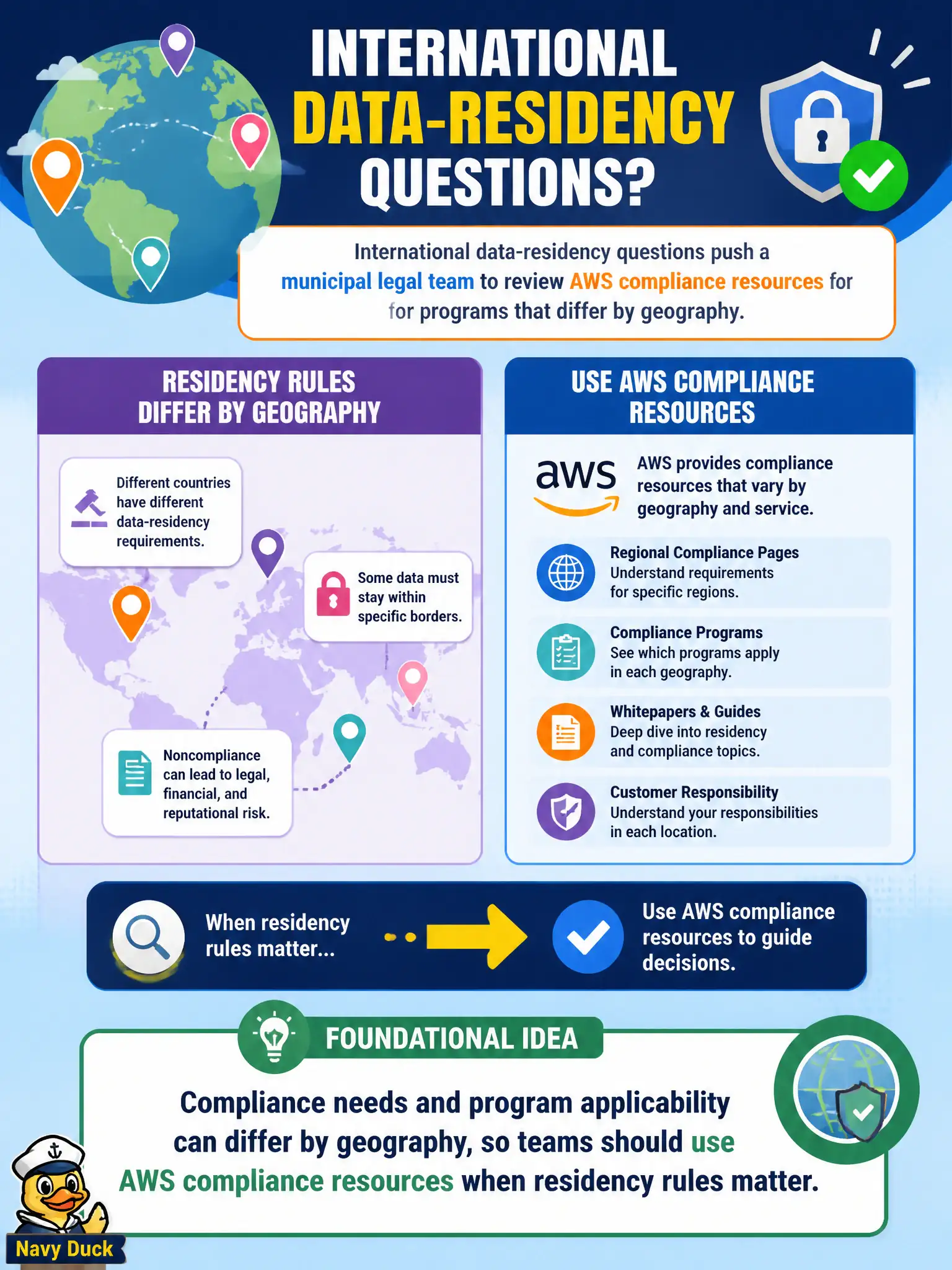
International data-residency questions push a municipal legal team to review AWS compliance resources for programs that differ by geography. What foundational idea should staff keep in mind?
Select an answer to reveal the explanation.
Short Explanation
Laws and programs can change with the map — a residency rule that matters for one country may not match another. AWS compliance resources help teams understand geographic and industry expectations; assuming the cloud erases geography or that the cheapest Region equals legal compliance is wishful thinking.
Full Explanation
Compliance needs and program applicability can differ by geography, so municipal legal and cloud teams should use AWS compliance resources when residency rules matter. Laws and programs can change with the map — a residency expectation that matters for one country may not match another. It is incorrect that geography never affects compliance expectations once data sits in any AWS Region. It is also incorrect that only on-premises data centers have geographic compliance rules while the cloud has none, or that choosing the cheapest Region automatically satisfies every international residency law. Distractors fail by erasing geography, by excluding cloud from geographic rules, or by equating price with legal compliance. Exam caveat: Region selection is necessary but not sufficient; customer architecture, contractual terms, and data classification still shape residency outcomes under shared responsibility. Operational check: inventory datasets with residency constraints, map them to approved Regions, review AWS compliance materials for those geographies, involve counsel early on cross-border flows, and document why each civic workload's Region choice satisfies policy. In practice, treat residency as a legal-and-architecture joint decision: inventory regulated datasets, lock approved Regions in SCPs or deployment pipelines where possible, and re-check assumptions whenever a new SaaS-style AWS service enters the civic stack.