
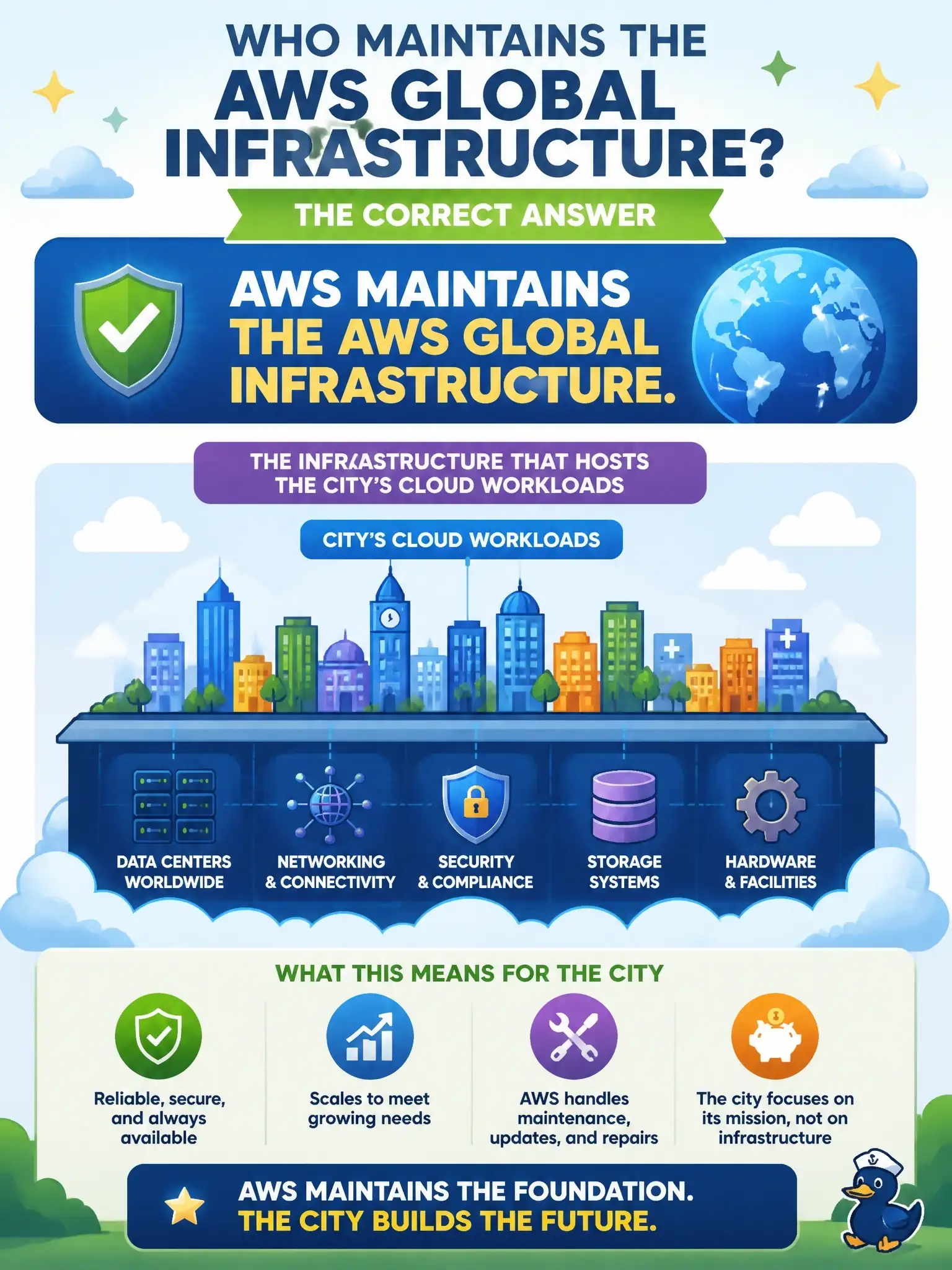
A compliance questionnaire asks who maintains the AWS global infrastructure that hosts the city's cloud workloads. What is the correct answer?
Select an answer to reveal the explanation.
Short Explanation
AWS maintains the AWS global infrastructure — Regions, Availability Zones, and edge locations — as the cloud platform's backbone. You consume that infrastructure by choosing Regions and running workloads, but you don't operate the Regions. Municipal teams don't maintain AWS Regions as if they were city-owned datacenters.
Full Explanation
AWS maintains the AWS global infrastructure — Regions, Availability Zones, and edge locations — as part of operating the cloud platform. Municipal IT teams consume that infrastructure; they do not maintain the AWS Regions they use as if those Regions were city-owned datacenters. Customers are not joint co-owners who operate AWS edge locations. AWS Marketplace sellers do not maintain Regions, Availability Zones, and edge sites as the backbone operators. The correct Cloud Practitioner framing is that the map of Regions and Availability Zones is AWS's backbone to run, while cities choose where to place workloads and how to architect for resilience. The claim that each municipal IT team maintains the AWS Regions it uses fails because municipal teams consume AWS Regions rather than operate them. The claim that customers jointly operate AWS edge locations as co-owners fails because it invents customer co-ownership of edge sites. The claim that AWS Marketplace sellers maintain Regions, Availability Zones, and edge sites fails because it misplaces infrastructure operations onto Marketplace vendors. Exam caveat: customers still choose which Regions to use for residency and latency and must design for Availability Zone resilience, but choosing and consuming is not the same as maintaining AWS's global infrastructure. Operational check: architecture reviews should confirm multi-Availability Zone patterns where needed, Region selection for data residency, clear audit language that AWS operates the Regions while the city operates its accounts and workloads inside them, and capacity planning that does not assume city staff 'maintain' Availability Zone power plants.