
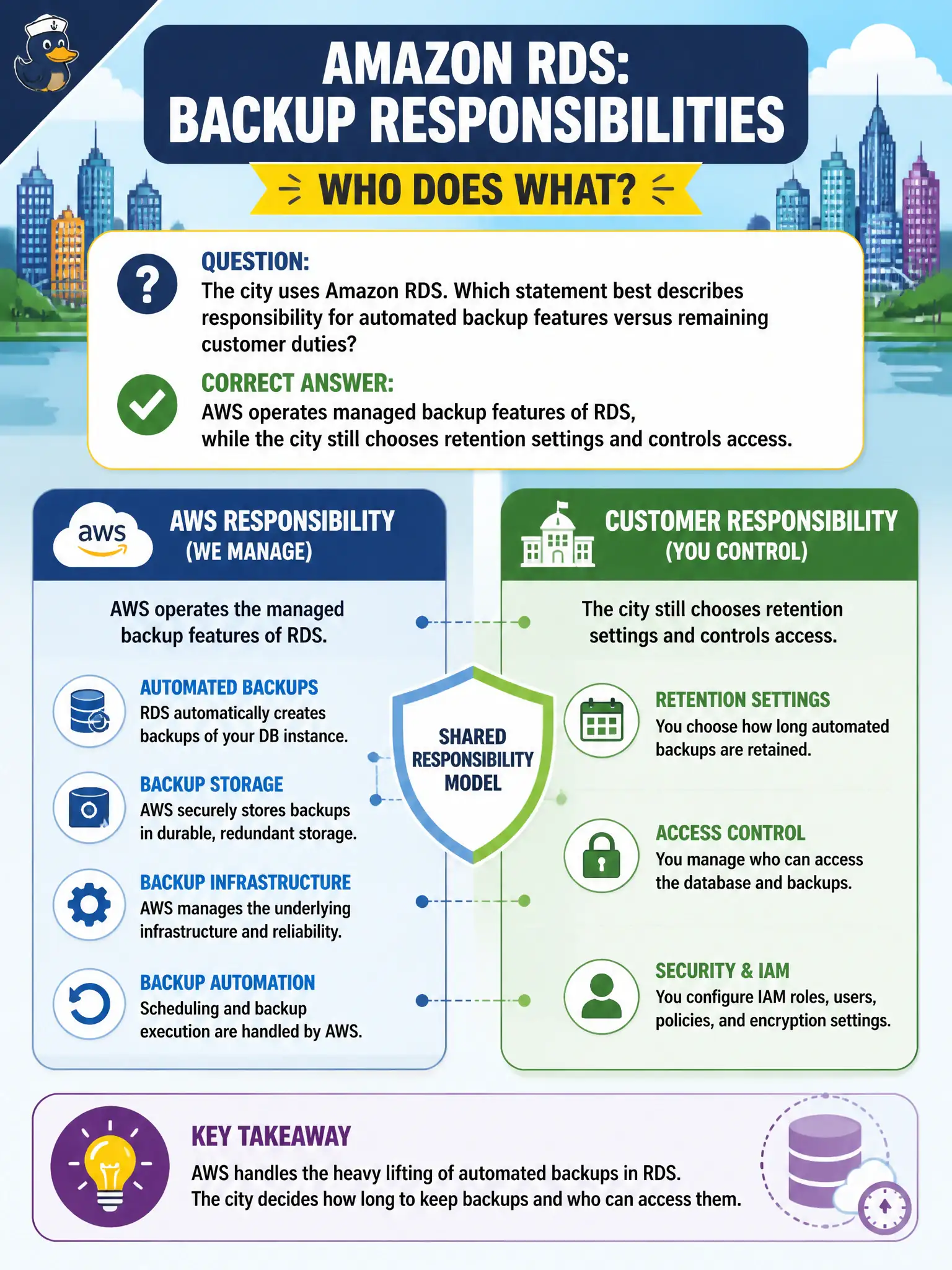
The city uses Amazon RDS. Which statement best describes responsibility for automated backup features versus remaining customer duties?
Select an answer to reveal the explanation.
Short Explanation
Managed backups are like a building that runs the sprinkler system while you still set the schedule and who has the alarm codes. AWS operates RDS backup capabilities as part of the managed service. The city still picks retention and locks down who can reach the database and its snapshots.
Full Explanation
For Amazon RDS, AWS operates managed backup capabilities as part of the managed database service, while the city still chooses retention settings and controls access to the database and its backups or snapshots. That split matches the idea of a building that runs the sprinkler system while occupants still set schedules and who holds alarm codes. It is incorrect to claim AWS alone chooses retention and access policies while the city operates backup storage hardware inside the Region. Automated backups do not eliminate all customer duties for data access and retention choices. The city also does not install tape libraries in the AWS Region to receive RDS backups under the normal managed service model. Distractors fail by reversing who runs backup infrastructure versus who sets retention and IAM-style access, by treating automation as a full waiver of customer data duties, or by inventing on-premises-style tape operations inside AWS Regions. Exam caveat: managed backups reduce undifferentiated heavy lifting but leave governance knobs — retention, encryption, access — in customer hands. Operational check: verify backup retention meets records policy, confirm who can copy or restore snapshots, test restore procedures for critical civic databases, and ensure encryption and IAM boundaries cover backup artifacts as well as live instances.