
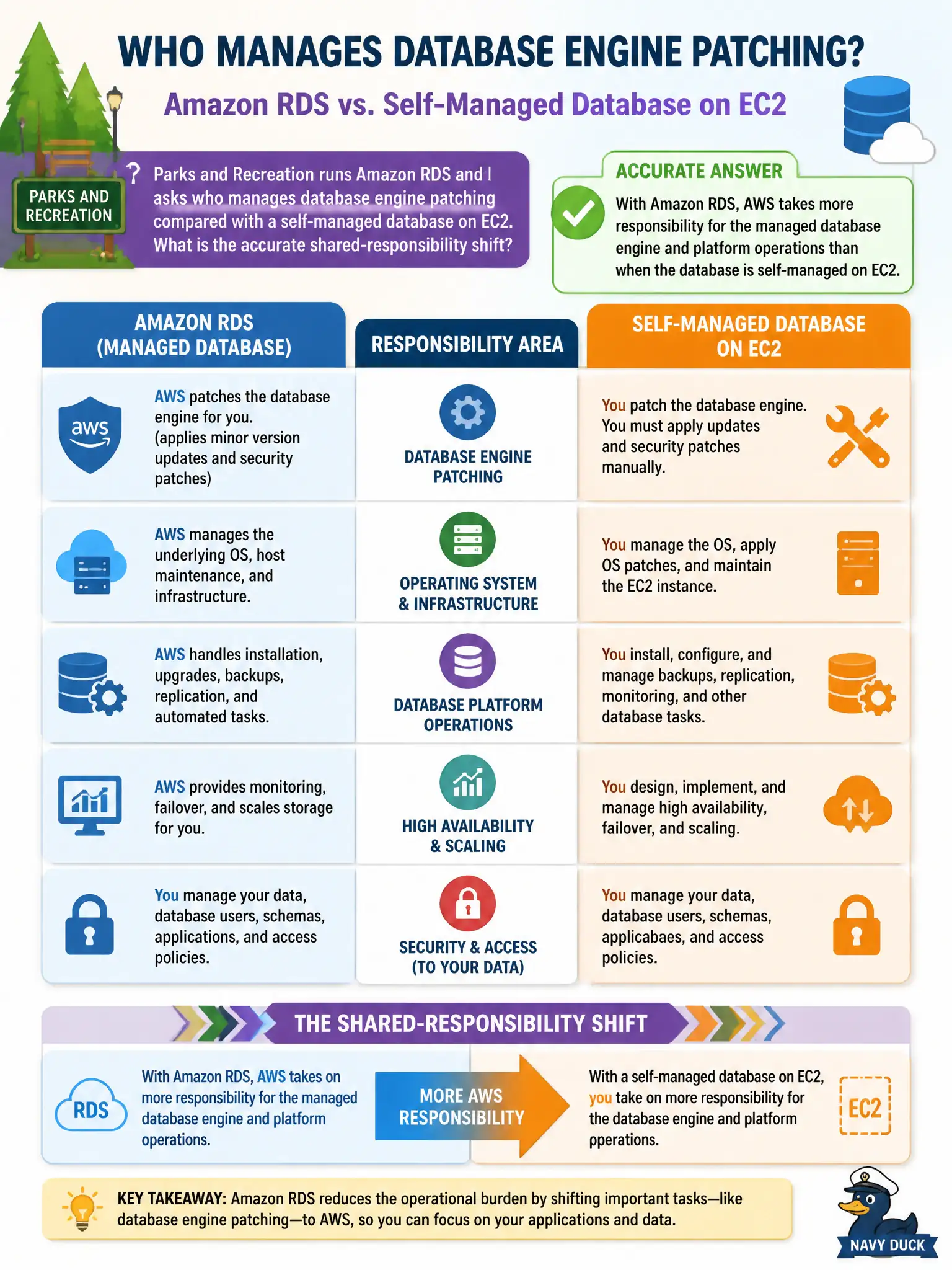
Parks and Recreation runs Amazon RDS and asks who manages database engine patching compared with a self-managed database on EC2. What is the accurate shared-responsibility shift?
Select an answer to reveal the explanation.
Short Explanation
Self-managed DB on EC2 means you own more of the engine chores; RDS is AWS taking a bigger slice of that platform work. You still care about data and who can connect. Think “more managed stove,” not “no kitchen rules.”
Full Explanation
With Amazon RDS, AWS takes more responsibility for the managed database engine and platform operations than when the database is self-managed on EC2. Parks and Recreation should understand that engine patching and much platform care shift toward AWS on RDS, while the city still owns data classification, IAM, and application-level security.
RDS and self-managed EC2 databases do not place identical engine-patching duties entirely on the customer. Customers do not physically visit AWS datacenters to apply RDS patches. RDS does not remove all customer duties for data, IAM, and application security.
Exam caveat: Managed services move the shared-responsibility line upward for the platform, not off the customer for data/access. Operational check: document who applies engine updates on RDS versus EC2 MySQL, configure RDS maintenance windows, and review IAM/database users for least privilege.
Municipal teams should keep a one-page decision record linking this Cloud Practitioner concept to resident outcomes, revisit it after major traffic or compliance changes, and ensure runbooks still match the chosen design.
Municipal teams should keep a one-page decision record linking this Cloud Practitioner concept to resident outcomes, revisit it after major traffic or compliance changes, and ensure runbooks still match the chosen design.