
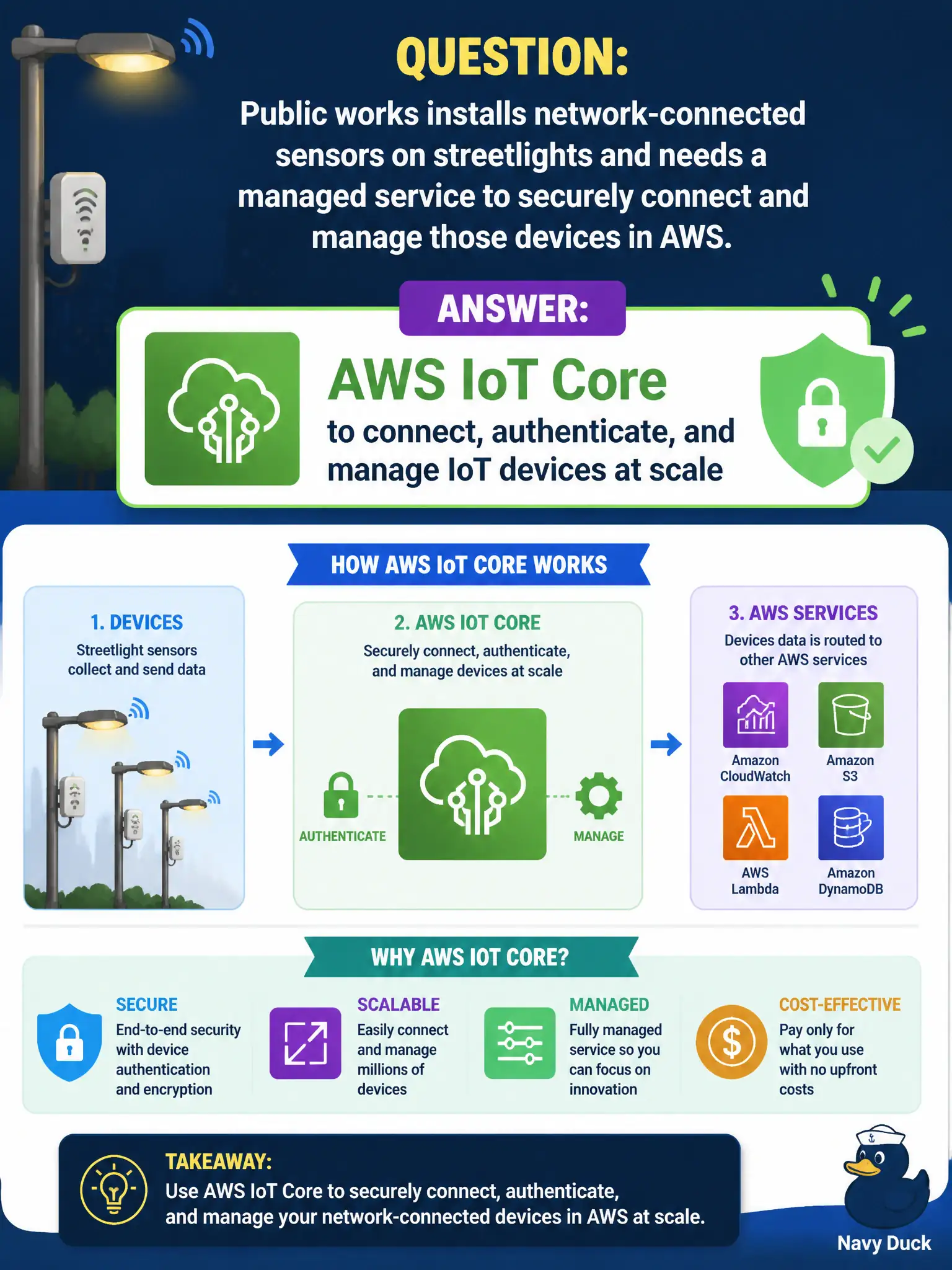
Public works installs network-connected sensors on streetlights and needs a managed service to securely connect and manage those devices in AWS. Which service should the city use?
Select an answer to reveal the explanation.
Short Explanation
IoT Core is the front desk for gadgets — streetlight sensors check in, prove who they are, and talk to the cloud without you inventing a device VPN for every pole. MQ, ElastiCache, and Storage Gateway solve messaging, caching, and hybrid storage — not fleet device connectivity.
Full Explanation
Public works installing network-connected sensors on streetlights needs a managed service to securely connect and manage those devices in AWS—AWS IoT Core. IoT Core connects, authenticates, and manages IoT devices at scale, enabling secure device identities, message ingestion, and routing into AWS analytics or control systems. Streetlight sensors, water meters, and similar civic IoT fleets map to IoT Core at Cloud Practitioner identify depth.
Amazon MQ is a managed traditional message broker for application microservices (ActiveMQ/RabbitMQ styles); it is not the device connectivity and management plane for streetlight sensors. Amazon ElastiCache is an in-memory cache for application performance; it does not onboard IoT devices. AWS Storage Gateway is a hybrid storage appliance pattern for file/volume/tape access—not IoT device management. Messaging, cache, and storage gateways are wrong categories.
Exam caveat: IoT Core = connect/manage devices; Kinesis = stream processing of telemetry after ingest; Greengrass = edge runtime. Stem language "connect and manage those devices" points to IoT Core.
Operational check for streetlight sensors: provision device certificates/policies with least privilege, use IoT policies per device fleet, encrypt in transit, route telemetry to streams or storage for outage detection, monitor disconnect rates after storms, rotate credentials, and segment device networks so a compromised sensor cannot freely reach unrelated municipal systems.