
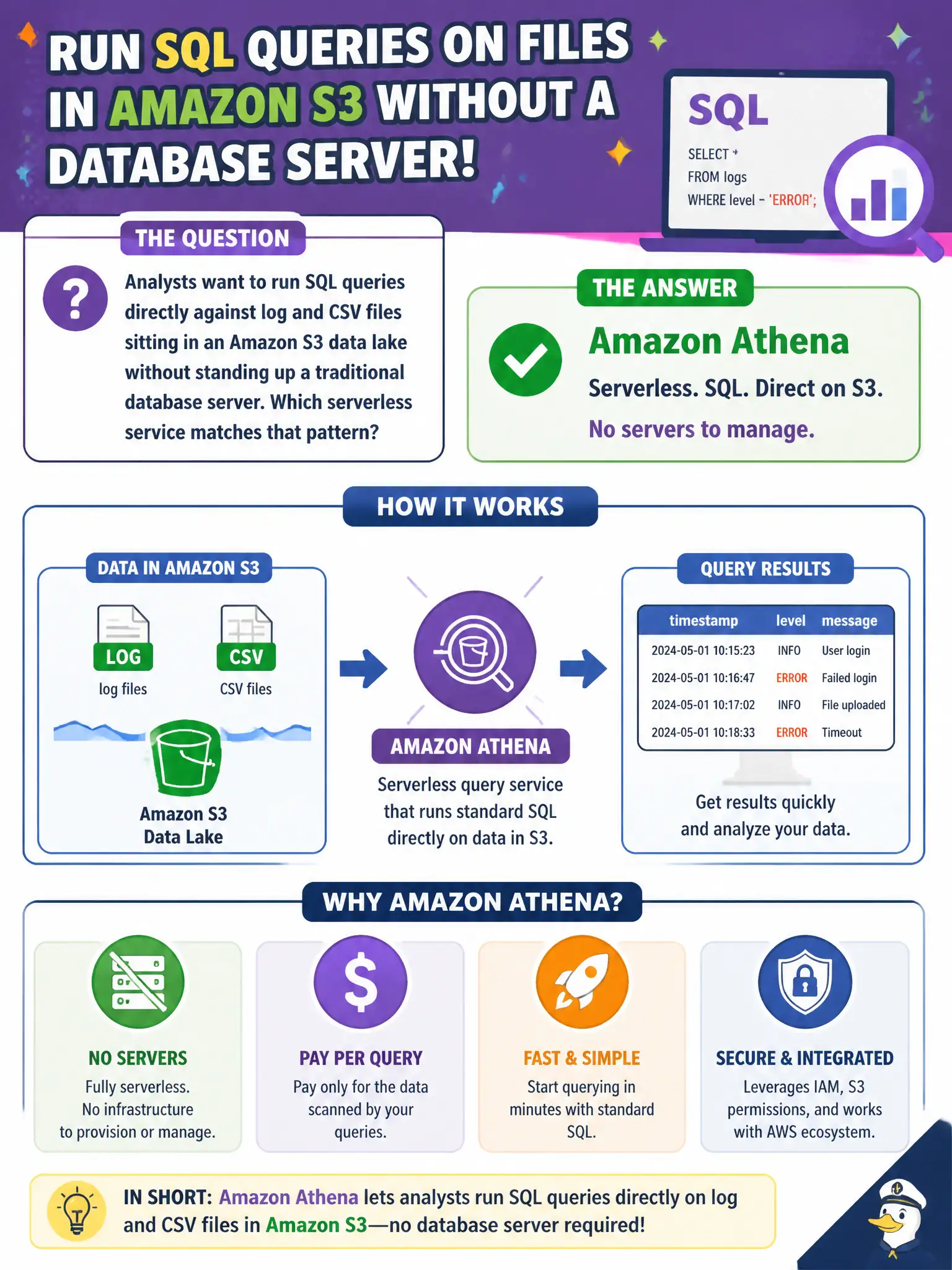
Analysts want to run SQL queries directly against log and CSV files sitting in an Amazon S3 data lake without standing up a traditional database server. Which serverless service matches that pattern?
Select an answer to reveal the explanation.
Short Explanation
SQL on files in S3 without standing up a database server? Amazon Athena is the serverless query engine for that data-lake pattern. Point it at the bucket layout, run SQL, pay for the query—not for a always-on warehouse you babysit.
Full Explanation
Analysts who want to run SQL queries directly against log and CSV files in an Amazon S3 data lake—without standing up a traditional database server—should use Amazon Athena. Athena is the serverless query service that runs SQL over data in S3 using table metadata (often via Glue Data Catalog). Municipal analytics teams can explore access logs, open-data CSVs, and partitioned datasets, paying primarily for queries scanned rather than babysitting always-on warehouse servers for ad hoc investigation.
Amazon EC2 Dedicated Hosts provide physical server tenancy for licensing; they are not a serverless SQL-on-S3 engine. AWS VPN CloudHub is a networking pattern for connecting multiple sites; it is not a query engine. Amazon WorkSpaces Application Manager relates to desktop application deployment, not data-lake SQL. None replace Athena for the serverless SQL-on-S3 pattern.
Exam caveat: Athena + S3 (+ Glue Catalog) is the classic serverless analytics trio at CLF identify depth. Redshift is a data warehouse; EMR is big-data processing; neither is the lightest answer for "SQL on files in S3 without a database server."
Operational check for the city data lake: organize prefixes/partitions sensibly, register schemas in the Glue Data Catalog, use Athena workgroups for cost controls per department, compress and columnarize large datasets where practical to reduce scan costs, restrict IAM so analysts only query authorized buckets, and validate results against known samples before publishing figures to council.