
A budget office asks whether Amazon DynamoDB can replace their relational OLAP data warehouse for long-running analytics across citywide finance history. Which statement is accurate?
Select an answer to reveal the explanation.
Short Explanation
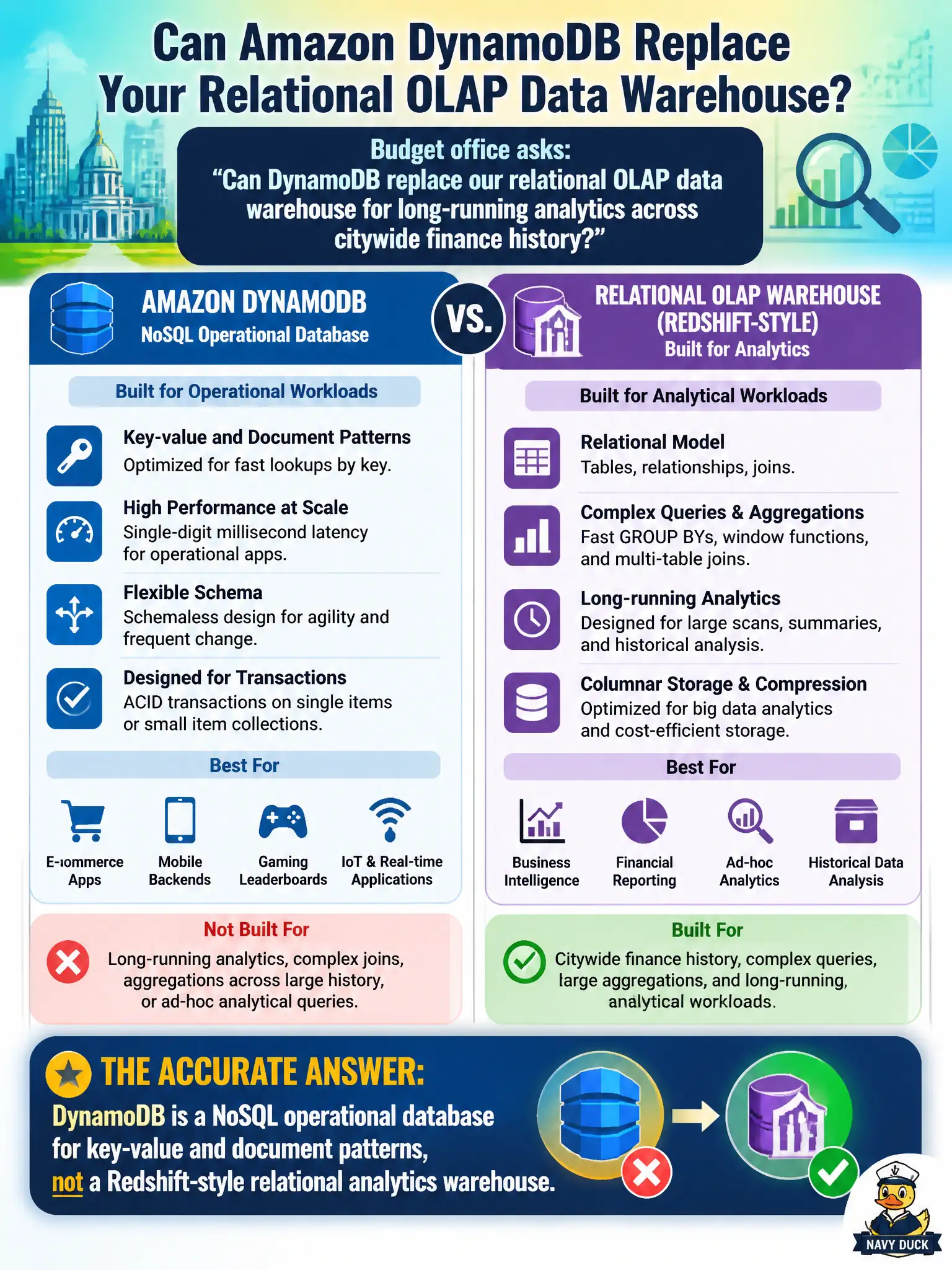
DynamoDB is the fast front-counter drawer for operational lookups; a warehouse like Redshift is the back room where analysts run long historical reports. Different jobs, different tools. DynamoDB is not a columnar OLAP twin of Redshift and it is not limited to VPC Flow Logs.
Full Explanation
When a budget office asks whether Amazon DynamoDB can replace their relational OLAP data warehouse for long-running analytics across citywide finance history, the accurate statement is that DynamoDB is a NoSQL operational database for key-value and document patterns, not a Redshift-style relational analytics warehouse. Long-running analytical queries across historical fact tables typically belong on a columnar warehouse such as Amazon Redshift (or analytics on S3 with appropriate query services), not on DynamoDB’s operational access model.
DynamoDB is not purpose-built as a columnar OLAP warehouse identical to Redshift, does not automatically convert every table into a Redshift cluster overnight, and is not limited to storing only VPC Flow Logs. Those distractors either overclaim automation or invent false limitations.
Exam caveat: Operational NoSQL → DynamoDB. Relational OLTP → RDS/Aurora. Relational/columnar OLAP warehouse → Redshift. Do not swap DynamoDB in for warehouse analytics because both are “databases.”
Operational check: keep citywide finance history analytics on Redshift or an approved lakehouse pattern, use DynamoDB only where key-driven operational access is required, and if analytics must include DynamoDB data, export or stream into the analytics store rather than running warehouse-style scans against DynamoDB as if it were Redshift.