
A city's public information portal runs on several EC2 instances. What is the primary purpose of placing a load balancer in front of them?
Select an answer to reveal the explanation.
Short Explanation
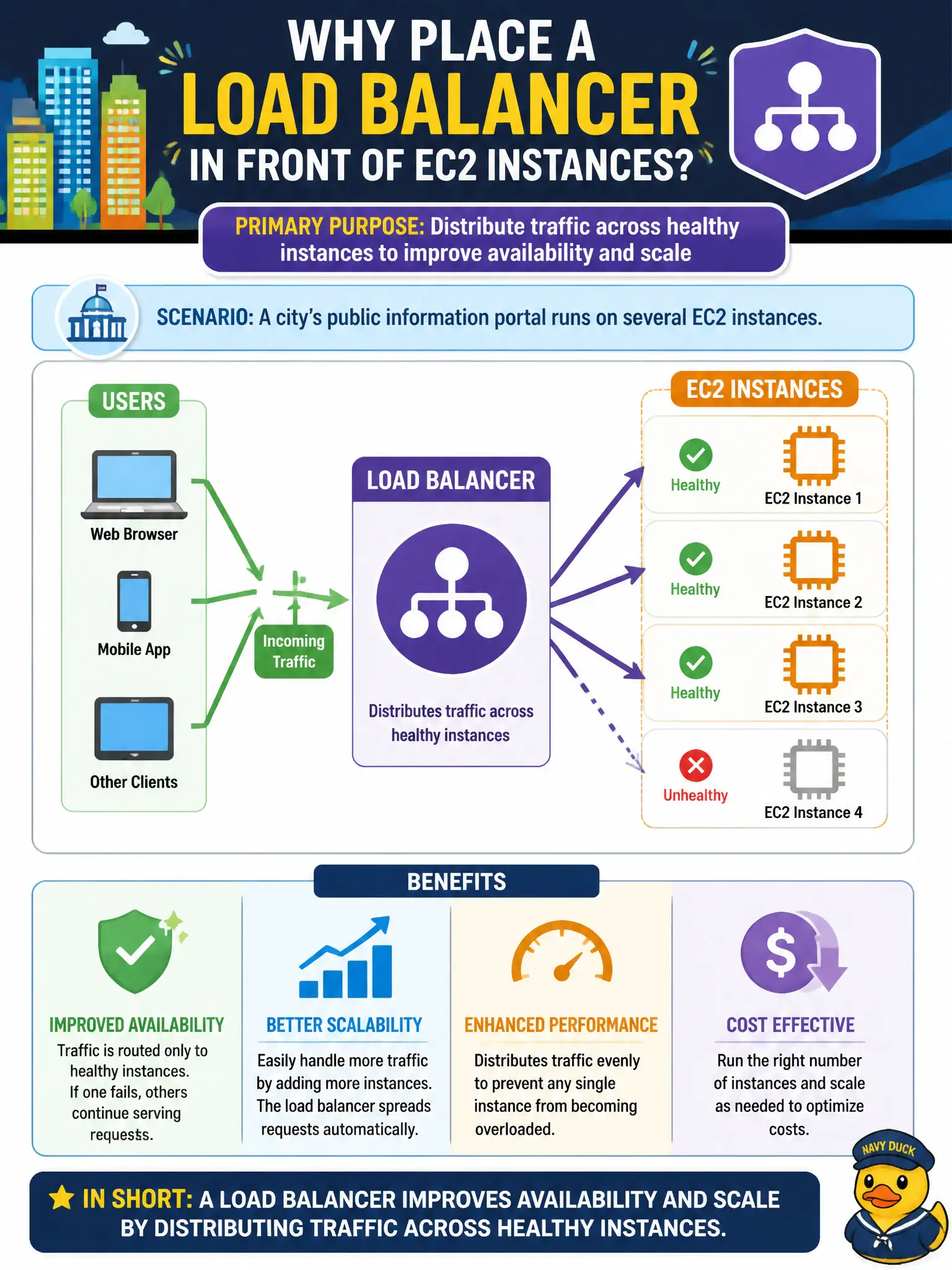
A load balancer is the traffic cop that spreads visitors across healthy portal instances so one sick box does not take the whole site down. It is about distribution and availability—not Glacier crypto, FTP, or being a database.
Full Explanation
When a city’s public information portal runs on several EC2 instances, the primary purpose of placing a load balancer in front of them is to distribute traffic across healthy instances to improve availability and scale. Elastic Load Balancing performs health checks and stops sending requests to unhealthy targets, giving citizens a more resilient entry point than a single instance IP. Combined with Auto Scaling, the load balancer is the traffic front door while the group adjusts capacity.
A load balancer does not encrypt archived Glacier objects using DNS, replace IAM users with anonymous FTP accounts, or permanently store relational data inside load-balancer nodes. Those distractors mix storage, identity, and database concerns with Layer-4/7 traffic distribution.
Exam caveat: Load balancer = distribute traffic + health checks. Auto Scaling = change instance count. Do not assign database or IAM jobs to ELB.
Operational check: deploy an Application Load Balancer for HTTP portals, register instance or IP targets in multiple AZs, configure health checks on a dedicated path, force HTTPS redirects, and confirm unhealthy targets are removed from rotation during a deliberate instance stop test.