
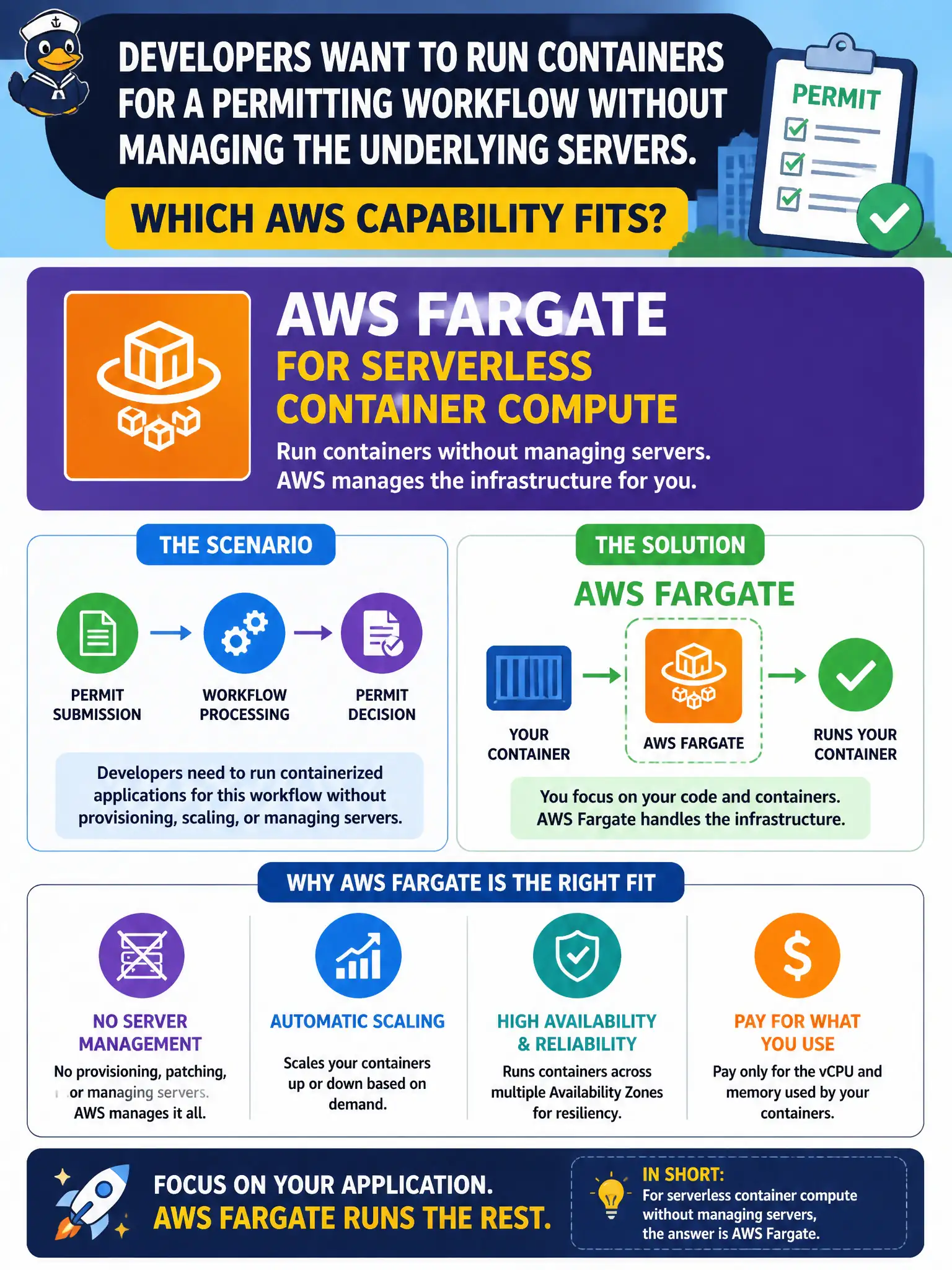
Developers want to run containers for a permitting workflow without managing the underlying servers. Which AWS capability fits?
Select an answer to reveal the explanation.
Short Explanation
No server babysitting for containers means Fargate—serverless container compute so the permitting workflow runs without patching hosts. Dedicated Hosts are the opposite vibe; Snowcone and VPC peering are not container runtimes.
Full Explanation
Developers who want to run containers for a permitting workflow without managing the underlying servers should use AWS Fargate. Fargate is the serverless compute engine for containers that lets ECS or EKS run tasks and pods without the team provisioning, patching, or scaling EC2 container hosts. That removes undifferentiated host management for municipal app teams focused on container images and service definitions.
Amazon EC2 Dedicated Hosts provide physical-server occupancy for licensing or compliance scenarios and still require the customer to manage instances—opposite of “without managing underlying servers.” AWS Snowcone is an edge device for transfer and edge compute, not the only supported container orchestrator. Amazon VPC peering connects networks; it does not replace container runtimes.
Exam caveat: Fargate = serverless containers (no host fleet to patch). EC2 launch type = you manage the instances. Dedicated Hosts are about tenancy/licensing, not serverless containers.
Operational check: migrate the permitting tasks to Fargate launch type, set task CPU/memory, attach the correct task execution and task IAM roles, place tasks in private subnets with egress as needed, and compare monthly host-patch labor before versus after to show the city the operational win.