
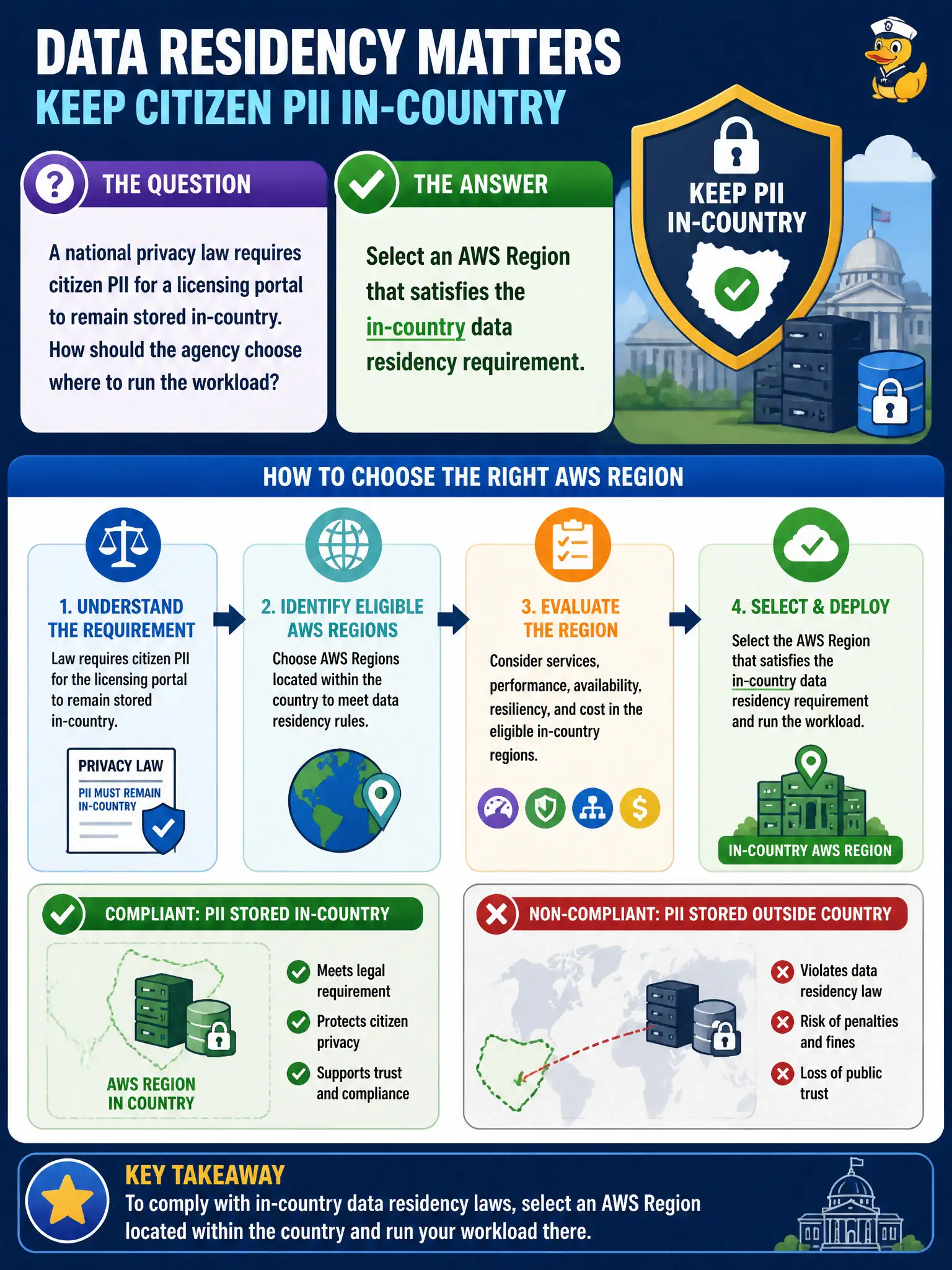
A national privacy law requires citizen PII for a licensing portal to remain stored in-country. How should the agency choose where to run the workload?
Select an answer to reveal the explanation.
Short Explanation
Laws that say 'stay in-country' are about where the bits live, not how pretty the encryption is. The agency should pick an AWS Region that meets that residency rule for the licensing portal's PII. Edge locations and Wavelength are not a free pass to ignore Region choice for primary citizen data.
Full Explanation
When a national privacy law requires citizen PII for a licensing portal to remain stored in-country, the agency should select an AWS Region that satisfies the in-country data residency requirement. Region choice is a primary control for where data at rest for Regional services resides. Encryption is necessary but does not by itself satisfy residency mandates if the storage Region is outside the required jurisdiction.
Picking any global Region because “encryption makes residency irrelevant” ignores legal residency constraints. Wavelength Zones place compute at telecom edges for ultra-low latency; they are not a general answer for keeping PII out of Regions. Storing PII only in the closest edge location and ignoring Region catalogs misunderstands edge purpose—edges are not the system of record for regulated primary databases.
Exam caveat: Data residency → choose the compliant Region (and understand which services are Regional). Encryption, Local Zones, and edges do not automatically satisfy “in-country storage” laws.
Operational check: inventory where licensing PII is stored (RDS, S3, backups, logs), confirm the chosen Region’s location meets counsel’s interpretation of the law, restrict cross-Region replication, and document residency in the DPIA/privacy assessment before go-live.