
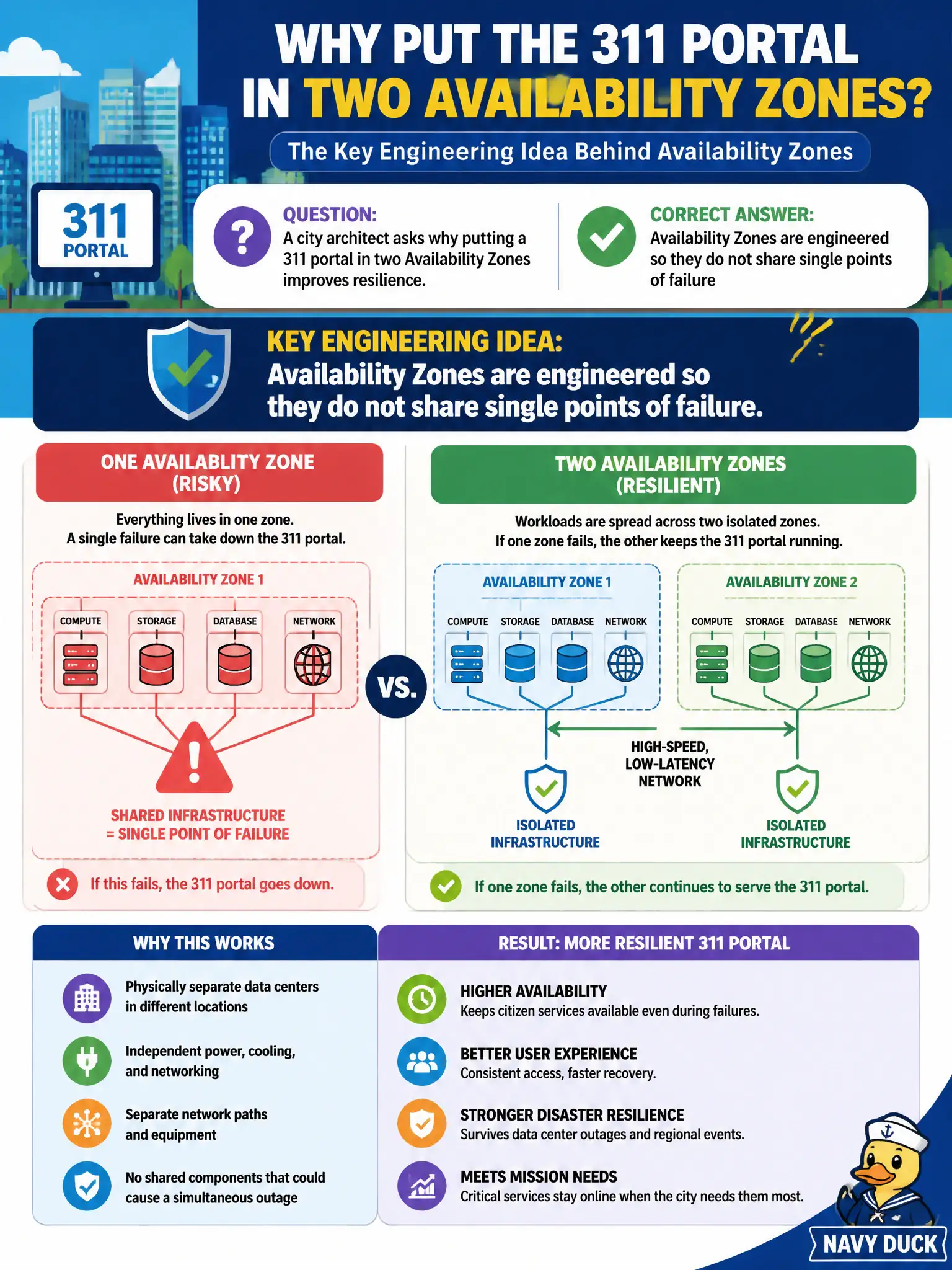
A city architect asks why putting a 311 portal in two Availability Zones improves resilience. What is the key engineering idea behind Availability Zones?
Select an answer to reveal the explanation.
Short Explanation
Picture two firehouses on opposite sides of town with separate utilities—if one loses power, the other still rolls. AWS designs AZs so they do not share single points of failure, which is why splitting a 311 portal across them actually helps. They are not the same building with a fancy name, and multi-AZ still is not a substitute for backups and DR planning.
Full Explanation
Putting a 311 portal in two Availability Zones improves resilience because Availability Zones are engineered so they do not share single points of failure—independent power, cooling, and physical infrastructure within a Region, connected by low-latency links. If one AZ is impaired, capacity in the second AZ can continue serving citizens when the architecture is designed for failover and load balancing across AZs.
AZs do not share the same power and cooling as a cost-saving design; independence is the point. They are not merely marketing labels for the same physical building. Multi-AZ also does not replace backups or disaster recovery planning—backup/restore and multi-Region strategies address different failure modes than a single-AZ outage.
Exam caveat: Core definition—AZs are isolated, physically separated facilities engineered without shared SPOFs. Exam answers that treat AZs as cosmetic labels are wrong.
Operational check: verify Auto Scaling groups and load balancers span two or more AZs for the 311 portal, confirm the data tier’s Multi-AZ setting, and run a controlled instance retirement in one AZ to prove healthy hosts in the peer AZ take traffic without manual heroics from on-call staff.