
In a city architecture 101 class, staff ask how Regions, Availability Zones, and edge locations relate. Which statement is accurate?
Select an answer to reveal the explanation.
Short Explanation
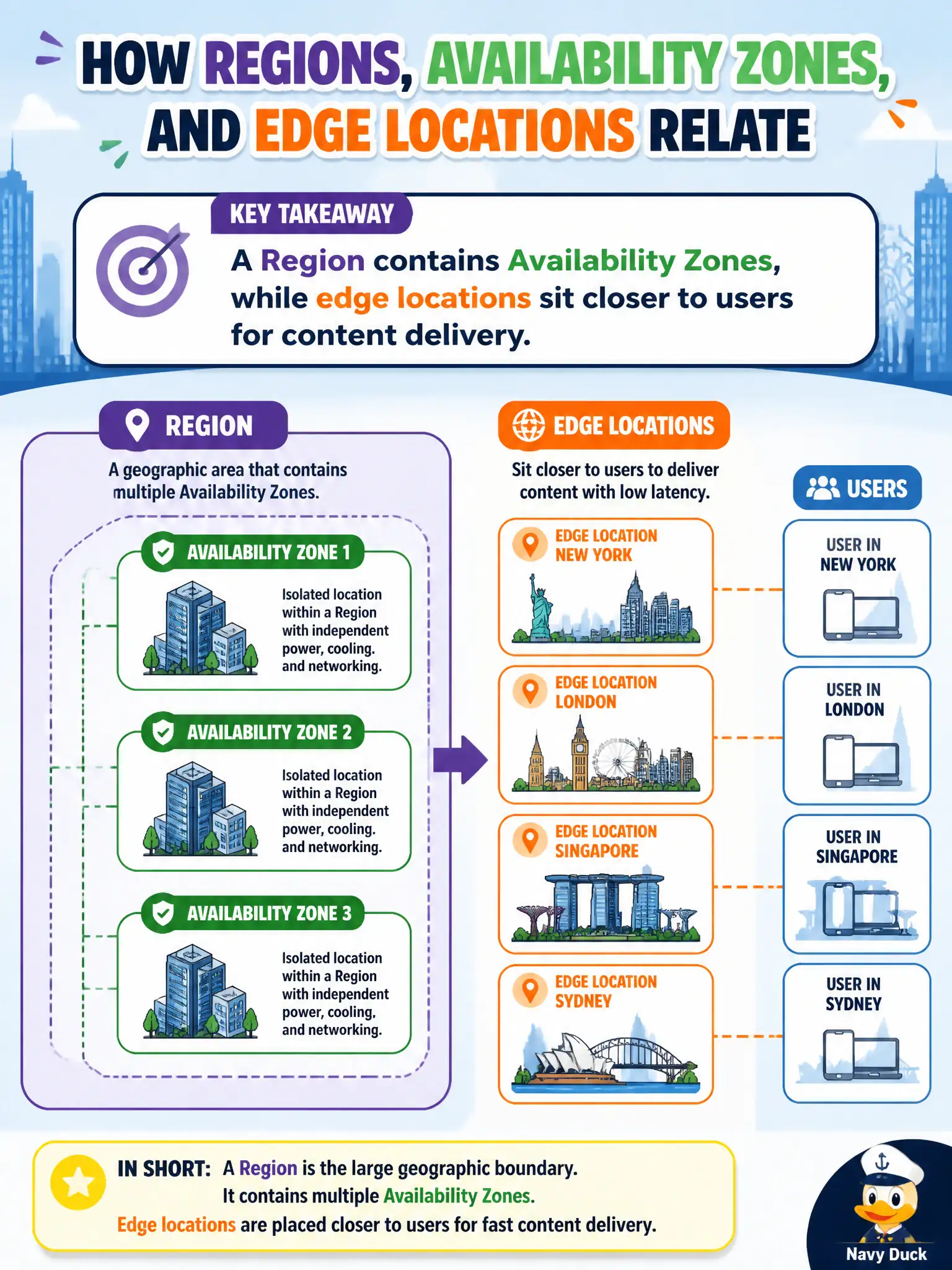
A Region is the big geographic neighborhood made of Availability Zones—separate data-center clusters. Edge locations are the little outposts closer to citizens for fast content delivery, not full VPC homes.
Full Explanation
In foundational AWS geography, a Region is a geographic area that contains multiple Availability Zones, while edge locations sit closer to users primarily to cache and deliver content (and related edge services) with lower latency. Availability Zones are isolated locations within a Region engineered with independent power, cooling, and networking so applications can be highly available inside that Region. Edge locations are part of the AWS edge network used heavily by CloudFront and related global services; they are not full Regions.
An Availability Zone does not contain multiple Regions or all global edge locations—that hierarchy is inverted. Edge locations do not host customer VPCs with full multi-AZ redundancy by default; VPC-based Regional services run in Regions/AZs. A Region is not merely a single data center, and AZs are not identical to edge locations.
Exam caveat: Memorize Region → contains AZs; edge locations → closer to users for content delivery. Multi-AZ = HA inside a Region; multi-Region = DR / global presence / residency designs.
Operational check: for the city architecture 101 class, draw concentric diagrams (Region, AZs, edge), show a 311 app multi-AZ in one Region and CloudFront edges near citizens, and quiz staff so they stop calling an edge cache a disaster-recovery Region.