
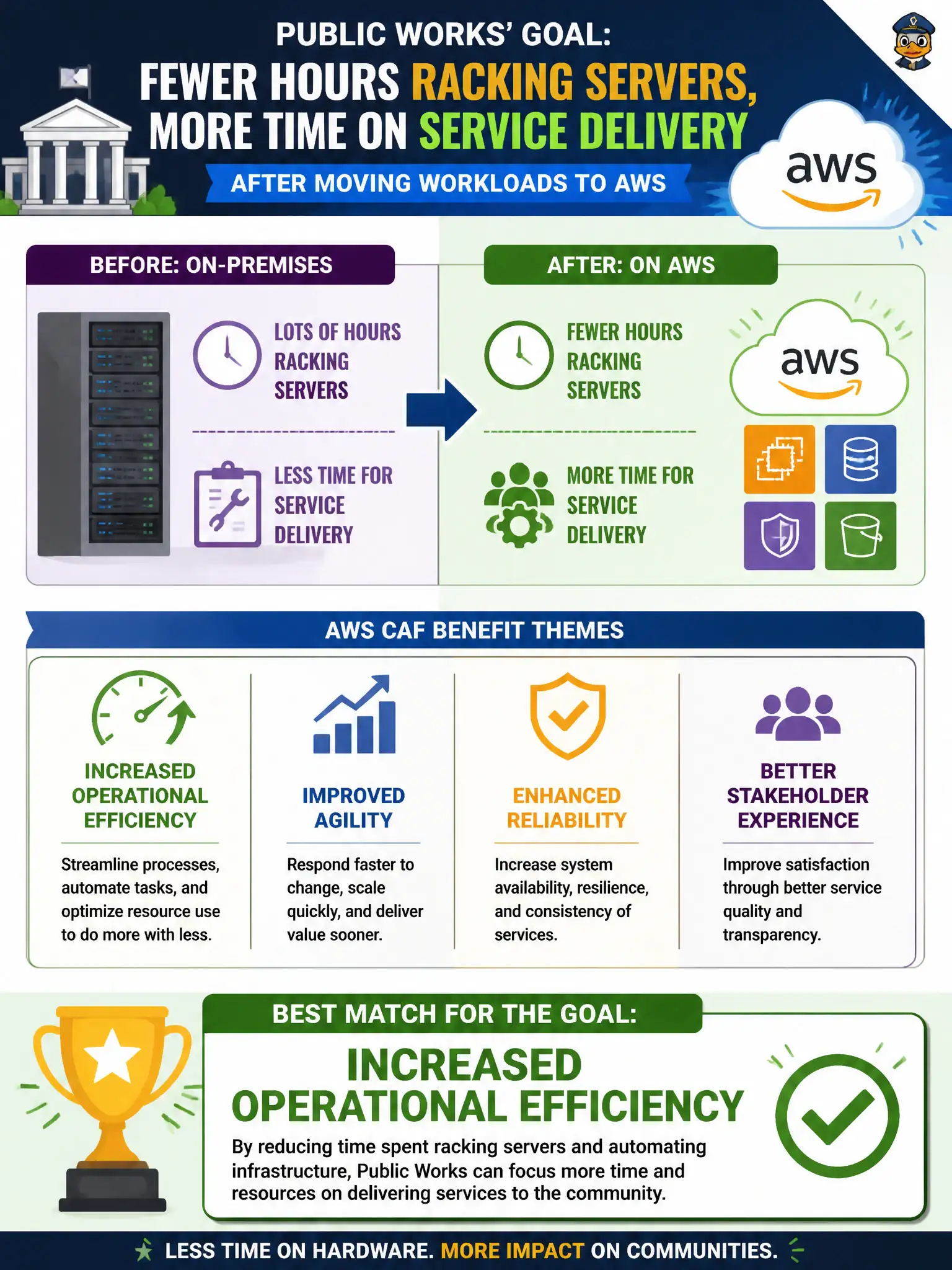
Public works wants fewer hours spent racking servers and more time on service delivery after moving workloads to AWS. Which CAF-aligned benefit theme best matches that goal?
Select an answer to reveal the explanation.
Short Explanation
Less time with a screwdriver in the server closet and more time fixing roads and water mains — that is operational efficiency. CAF calls out increased operational efficiency when cloud managed services reduce undifferentiated heavy lifting. More racking everywhere, ditching monitoring, or building private data centers for every team fight that goal.
Full Explanation
Increased operational efficiency is the CAF-aligned benefit theme for public works wanting fewer hours racking servers and more time on service delivery after moving to AWS. Offloading undifferentiated facilities work frees staff for citizen outcomes.
Increased manual racking of customer-owned servers in every Region reverses the efficiency gain. Eliminating monitoring and runbooks as unnecessary creates operational risk. Requiring every team to build its own data center maximizes inefficiency.
Exam caveat: Operational efficiency in CAF is about better ways of working after adoption—not abandoning controls. Operational check: measure hours formerly spent on racking/HVAC/refresh for migrated workloads, reassign that capacity to service delivery KPIs, and keep monitoring/runbooks mandatory.
Municipal teams should keep a one-page decision record linking this Cloud Practitioner concept to resident outcomes, revisit it after major traffic or compliance changes, and ensure runbooks still match the chosen design.
Municipal teams should keep a one-page decision record linking this Cloud Practitioner concept to resident outcomes, revisit it after major traffic or compliance changes, and ensure runbooks still match the chosen design.