
A finance analyst asks which data movement typically does not incur the same internet data-transfer charges as sending traffic out of AWS. Which statement is accurate at a Cloud Practitioner level?
Select an answer to reveal the explanation.
Short Explanation
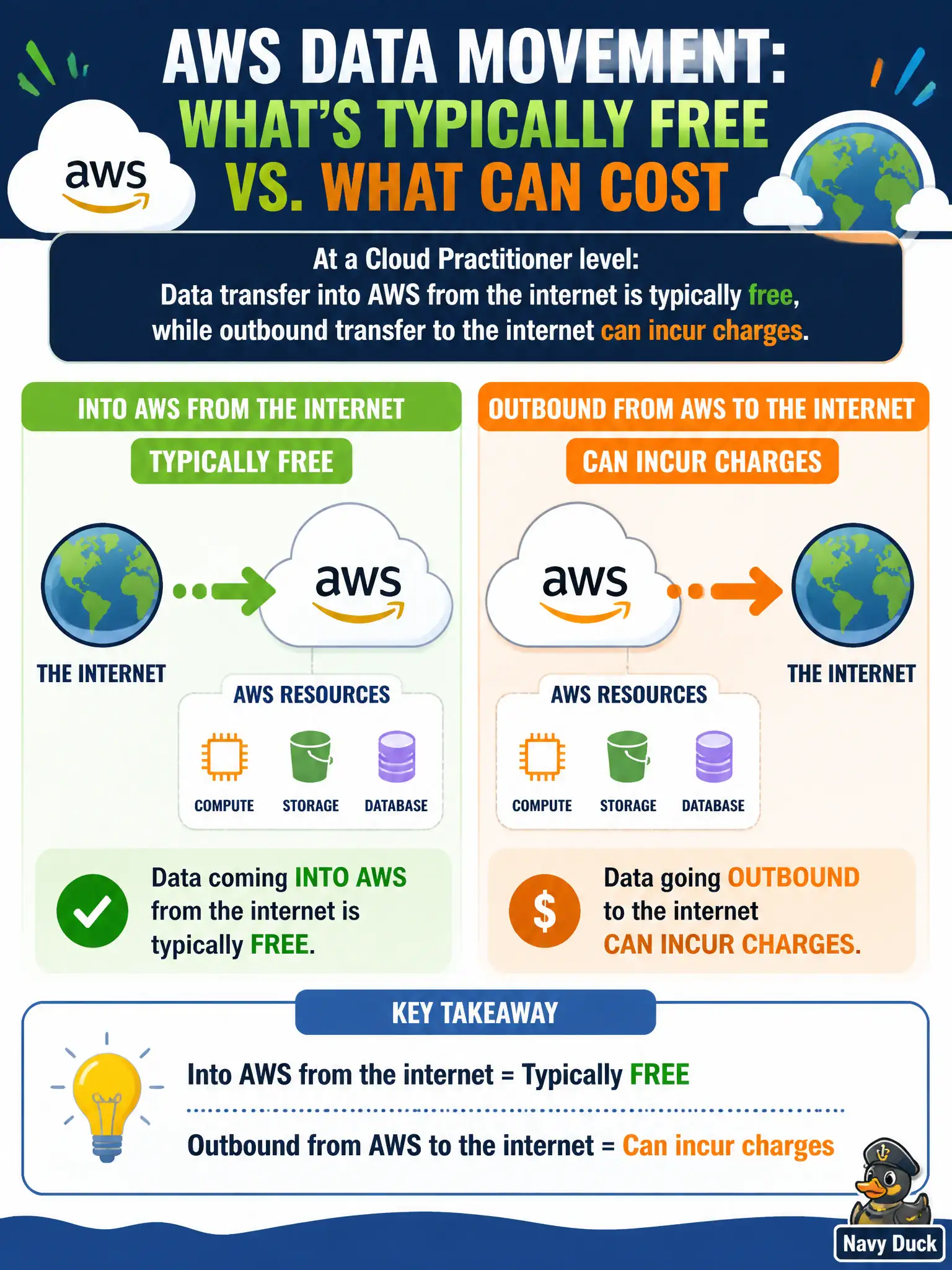
Think of AWS like a museum with a free entry line and a paid gift-shop exit — bringing data in from the internet is usually free, shipping it back out to the public internet often costs. AZ-to-AZ and Region-to-Region have their own rules, and S3 download vs upload is not “upload always costs more.”
Full Explanation
At Cloud Practitioner level, a finance analyst should know that data transfer into AWS from the internet is typically free, while outbound transfer to the internet can incur charges. That inbound-versus-outbound asymmetry is a foundational billing awareness item for municipal architects planning citizen uploads versus heavy public downloads. Uploading property images into S3 from the internet is generally not charged as data transfer in, whereas serving large open datasets out to the world can generate egress costs.
It is not accurate that all data leaving an Availability Zone to another AZ is always free with no exceptions to consider—inter-AZ transfer can incur charges in common architectures. Uploading into S3 from the internet does not always cost more per GB than downloading; the typical teaching point is the opposite directionality for internet transfer. Cross-Region replication traffic is not billed as free inbound internet transfer into the destination in the simplistic way the distractor states—cross-Region data movement has cost considerations. Stick to the core CLF statement: internet in usually free; internet out often charged.
Exam caveat: Also watch for CloudFront as a way to optimize and sometimes reduce origin egress patterns for public content, and for PrivateLink/VPC endpoints affecting how traffic stays on the AWS network. Still, the headline contrast remains inbound internet versus outbound internet.
Operational check for the city: estimate egress for open-data portals and video streaming, use CloudFront for public downloads where appropriate, keep large inter-service traffic on private paths when suitable, tag resources for cost allocation of transfer-heavy apps, and set Budgets alerts on data transfer line items after festival or emergency communications spikes.