
A request reaches the Ingress controller but matches none of the defined host or path rules. What should the developer understand about that case?
Select an answer to reveal the explanation.
Short Explanation
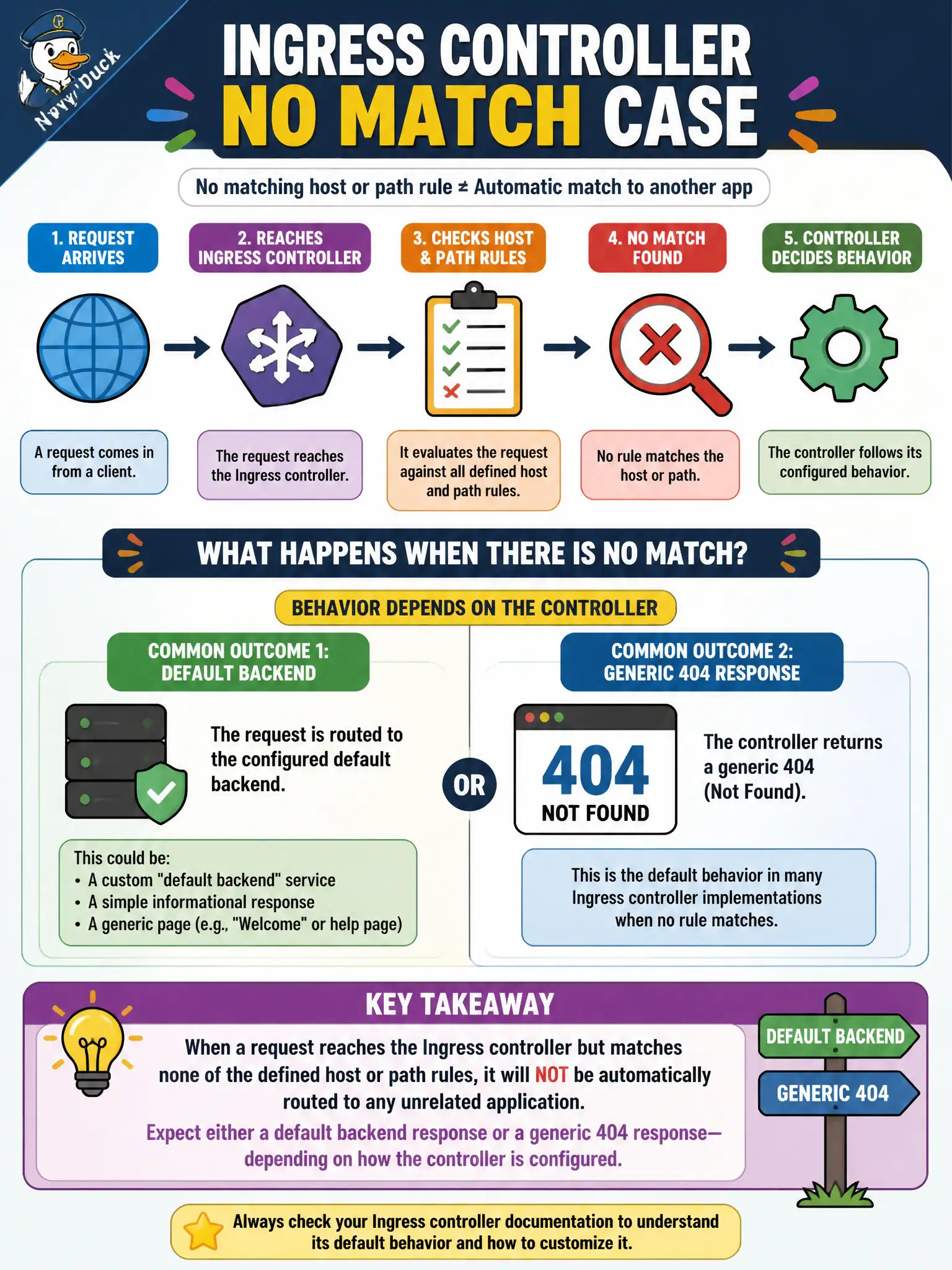
No matching rule usually means "default backend or 404," not "pick a random app." Controllers decide the exact fallback. Do not assume DNS will invent a match for you.
Full Explanation
When a request reaches the Ingress controller but matches none of the defined host or path rules, behavior depends on the controller—often a default backend or a generic 404—not an automatic match to an unrelated app rule. Unmatched requests are not silently converted into successful ClusterIP calls to kube-apiserver. They are not guaranteed to hit every Service in the namespace as a broadcast. CoreDNS does not rewrite all unmatched hosts to the first Ingress in alphabetical order.
Understanding controller-specific default-backend behavior helps municipal operators interpret unexpected 404 or generic error pages when Host headers or paths are wrong. The remediation is usually correcting host/path rules or defining an intentional default backend Service—not assuming magical fallthrough to another department’s app.
Exam caveat: always test with the correct Host header (curl -H 'Host: ...'). Operational check: send a request with an unknown host and observe default backend/404; send a request matching a defined civic rule and observe the application; document the controller’s default backend in city edge runbooks so helpdesks can distinguish “no matching Ingress rule” from application outages.