
After deploying a ClusterIP Service for a civic payments API, the developer needs to verify in-cluster reachability before opening Ingress. What is the most appropriate quick check?
Select an answer to reveal the explanation.
Short Explanation
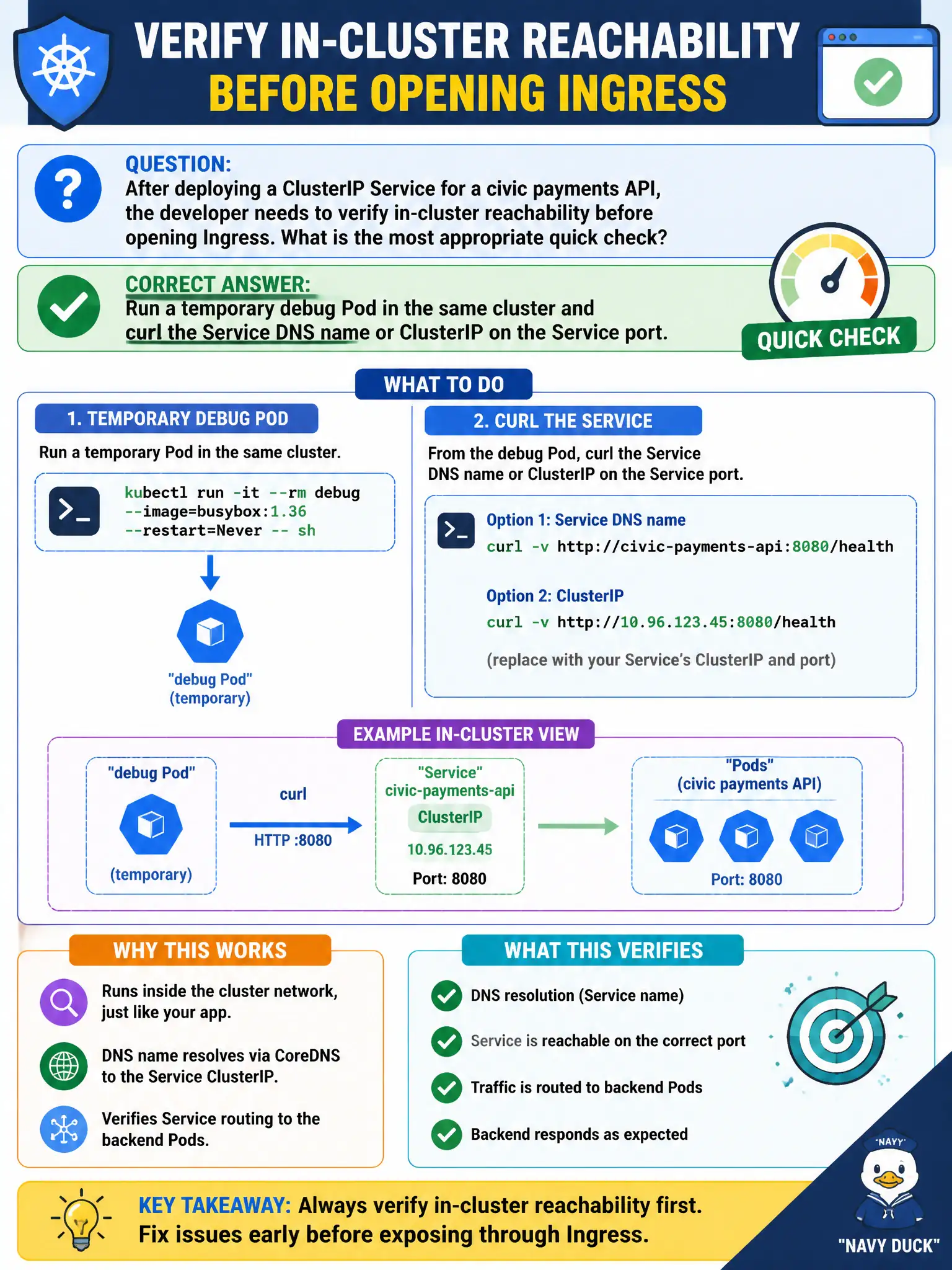
To see what other Pods see, stand inside the cluster for a minute. A throwaway debug Pod curling svc-name.namespace.svc or the ClusterIP is the classic reachability smoke test. Laptop-to-Pod-IP shortcuts skip the Service path you care about.
Full Explanation
After deploying a ClusterIP Service for a civic payments API, the most appropriate quick check for in-cluster reachability before opening Ingress is to run a temporary debug Pod in the same cluster and curl the Service DNS name or ClusterIP on the Service port. That exercises the path peer workloads actually use—DNS resolution, ClusterIP routing, Endpoints selection, and targetPort mapping—without introducing laptop network paths or changing the Service type.
Only curling from a laptop to a random Pod IP on the node network does not prove Service wiring. Deleting CoreDNS to force clients onto Pod IPs during verification breaks cluster discovery and is not a valid Service test. Changing the Service to NodePort solely so localhost on a developer laptop can supposedly prove ClusterIP works changes the object under test and fails to validate ClusterIP behavior.
Exam caveat: use a disposable debug Pod (for example kubectl run with --rm -it) in the same namespace or with a cross-namespace FQDN. Operational check: curl http://payments.<ns>.svc.cluster.local:<port> from the debug Pod; kubectl get endpoints to confirm backends; only then proceed to Ingress for external exposure. Keep a short verification snippet in the municipal payments runbook so every release repeats the same smoke test before public routing is enabled.