
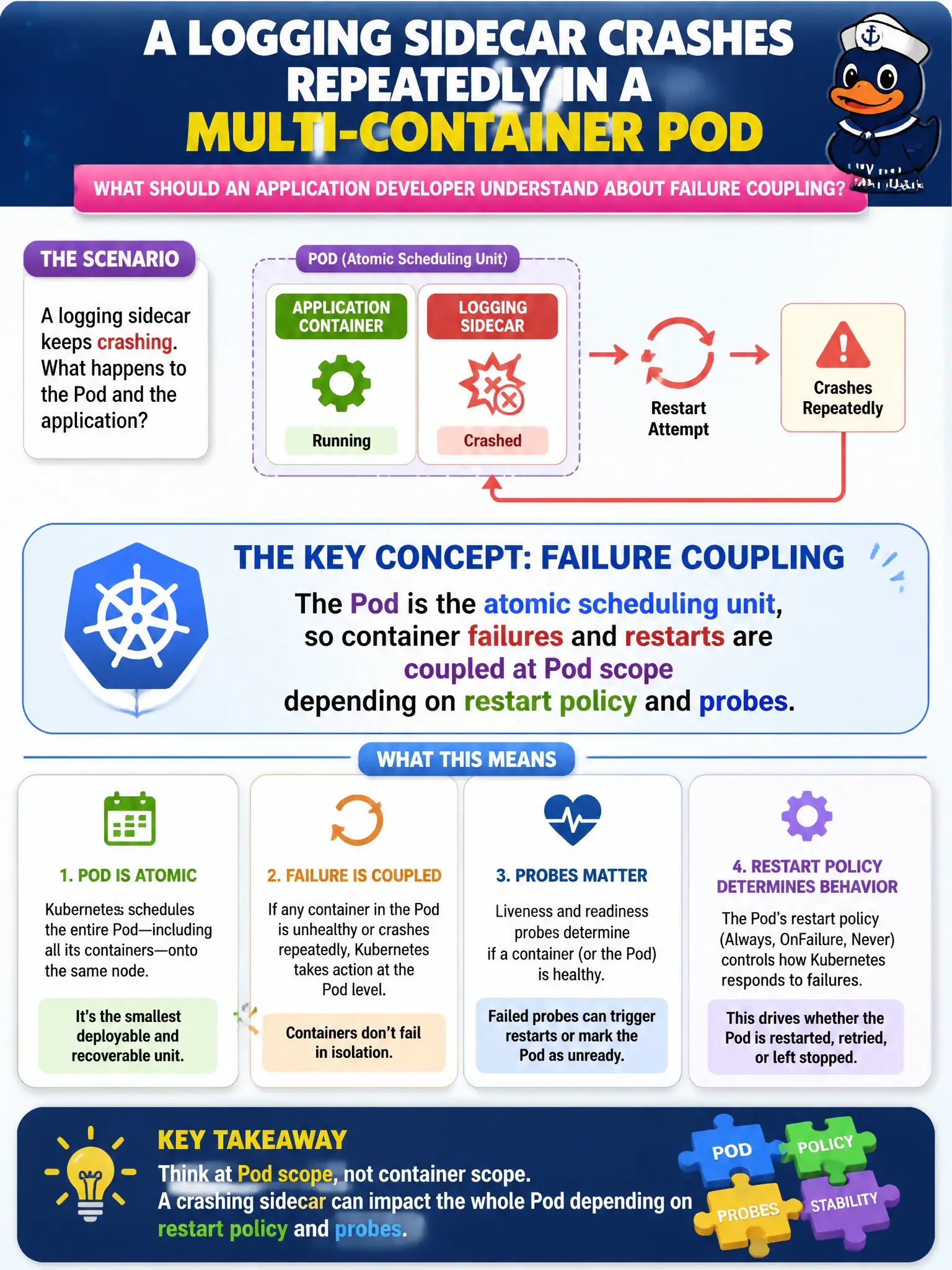
A logging sidecar crashes repeatedly in a multi-container Pod. What should an application developer understand about failure coupling?
Select an answer to reveal the explanation.
Short Explanation
A Pod is a shared fate boat: if one rower collapses, the whole boat’s status and restart story is involved. Helpers are convenient, but they are not a separate ship.
Full Explanation
When a logging sidecar crashes repeatedly in a multi-container Pod, application developers should understand failure coupling: the Pod is the atomic scheduling unit, so container failures and restarts are handled in Pod scope depending on restartPolicy and probes. A crashing sidecar can keep the Pod noisy, affect Ready conditions when probes fail, and complicate municipal incident response even if the main container still appears Running.
Kubernetes does not always keep the main container Running forever merely because any sidecar exists. Sidecar crashes do not delete a separate sidecar object—containers are fields of the Pod. Only DaemonSet Pods couple lifecycles while Deployment Pods isolate every container completely is false; both controllers manage Pods as units.
Exam caveat: Readiness probes on the application gate Service traffic. A failing sidecar removes the Pod from Endpoints only if readiness fails for a probed container. Design sidecars with resource requests and reliability similar to the app.
Operational check: kubectl get pod -o jsonpath for containerStatuses; kubectl logs -c logging-sidecar --previous; kubectl describe pod for probe failures; compare stability after removing the sidecar in nonprod.