
Operators start a rolling update on a Deployment while also adding a separate canary Deployment for the same release, and the plan becomes unclear. What guidance applies?
Select an answer to reveal the explanation.
Short Explanation
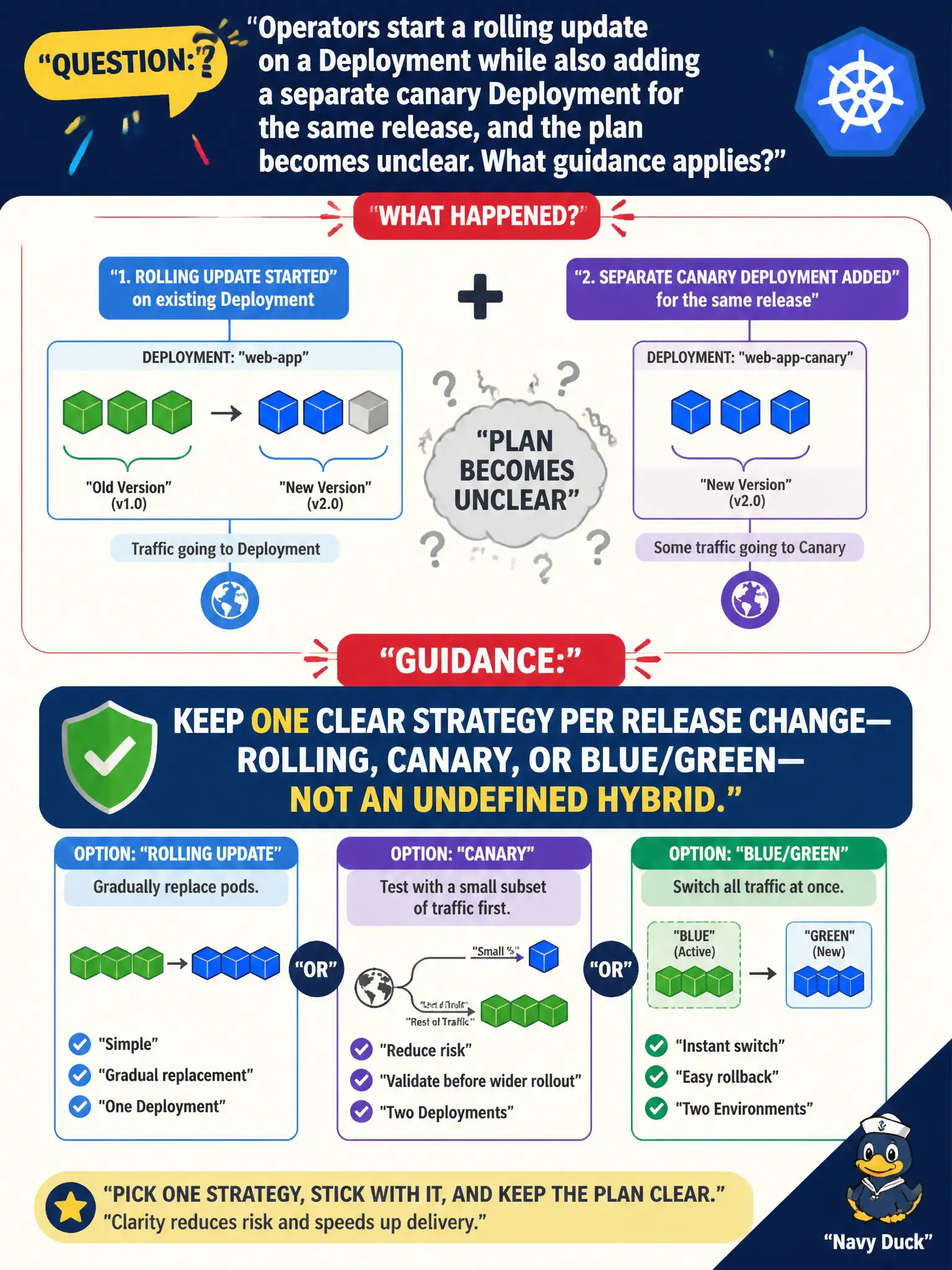
Pick a lane: rolling, canary, or blue/green—don’t drive all three at once. Mixed half-plans confuse who owns traffic and how to roll back. Clarity beats clever hybrids.
Full Explanation
If operators start a rolling update on a Deployment while also adding a separate canary Deployment for the same release, and the plan becomes unclear, guidance is to keep one clear strategy per release change—rolling, canary, or blue/green—not an undefined hybrid. Mixing strategies confuses traffic math, rollback steps, and ownership during city launch windows.
Always combining rolling, canary, and blue/green in one change reduces safety. Preferring undefined hybrids because Kubernetes merges strategies automatically is false—controllers do not reconcile marketing labels into one plan. Disabling the Deployment controller until both finish is not an operable approach.
Exam caveat: Pick the pattern that matches compatibility and risk, document it, and execute only that pattern’s steps.
Operational check: cancel the ambiguous hybrid in nonprod; rehearse a single pattern; verify with kubectl get deploy,svc,endpoints that only the intended objects participate. In municipal environments, document the chosen pattern in the service runbook so on-call engineers apply the same kubectl checks during incidents, and keep the change tied to the application Deployment or Job rather than ad-hoc node mutation.