
Under node resource contention, how does a higher PriorityClass typically affect scheduling for a municipal critical Pod versus lower-priority Pods?
Select an answer to reveal the explanation.
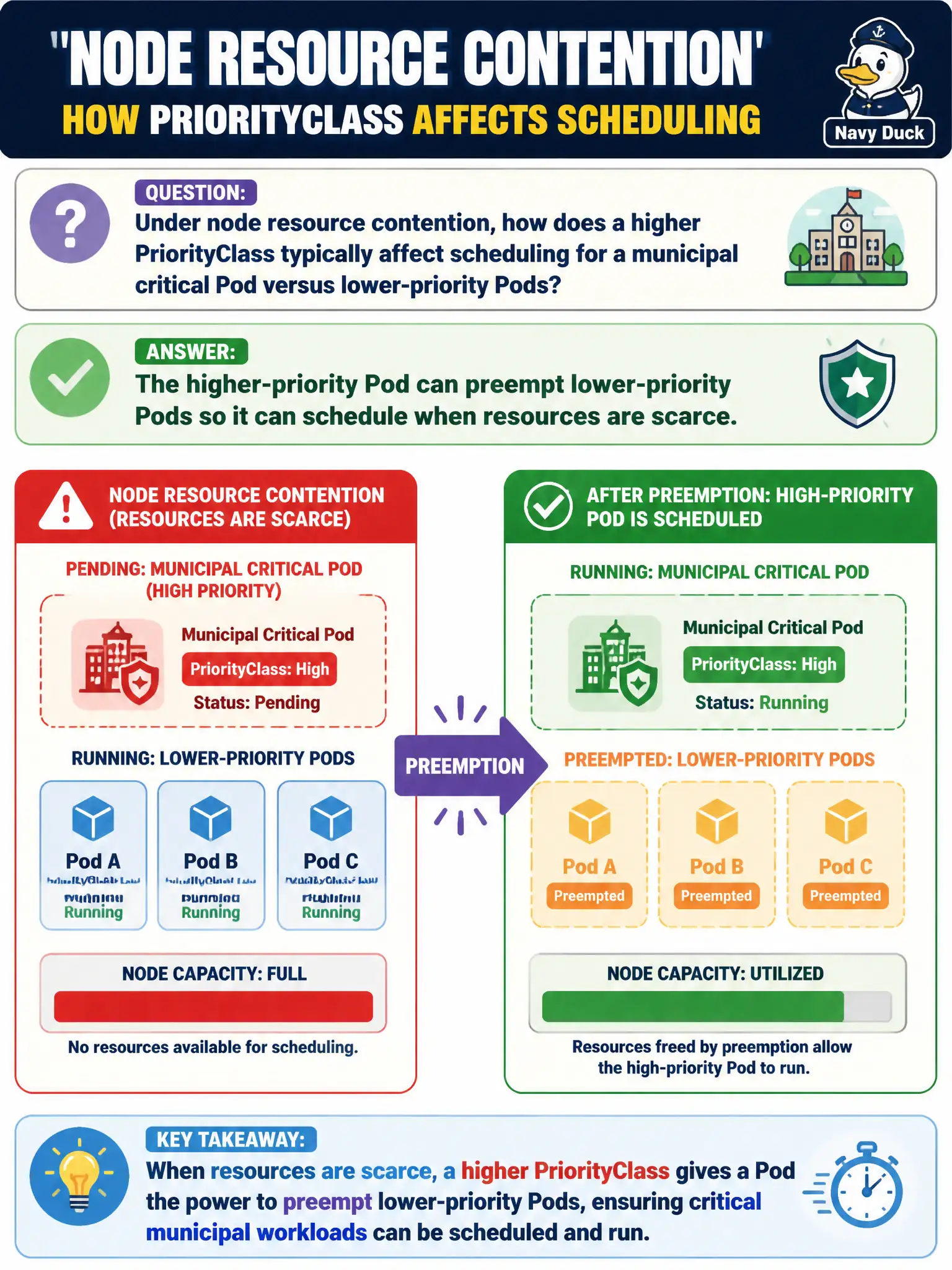
Short Explanation
Priority is the express lane under pressure—important Pods can bump lower-priority ones when the node is full. It does not rewrite DNS or turn your Pod into a DaemonSet.
Full Explanation
Under node resource contention, a higher PriorityClass typically allows the higher-priority municipal critical Pod to preempt lower-priority Pods so it can schedule when resources are scarce. Priority and preemption give critical civic workloads a path to capacity by evicting lower-priority Pods when needed, subject to PodDisruptionBudgets and other constraints on the victim side.
PriorityClass does not only change DNS search domains; that claim is false. Lower-priority Pods do not always evict higher-priority Pods to preserve fairness queues—the preemption model works in the opposite direction. PriorityClass does not convert the Pod into a DaemonSet that ignores node capacity.
Exam caveat: preemption is not instant guaranteed capacity if no suitable node exists even after victims are considered; cluster capacity planning remains necessary. Operational check: assign a high PriorityClass to the critical Pod, saturate a node with low-priority workloads, and observe whether the critical Pod schedules via preemption. This distinction matters on the CKA because distractors often mix adjacent objects that sound related but solve a different control-plane problem. This distinction matters on the CKA because distractors often mix adjacent objects that sound related but solve a different control-plane problem.