
Public-health expects a known parade-day surge at 09:00 and asks whether only waiting for HPA is always enough. Which statement is accurate?
Select an answer to reveal the explanation.
Short Explanation
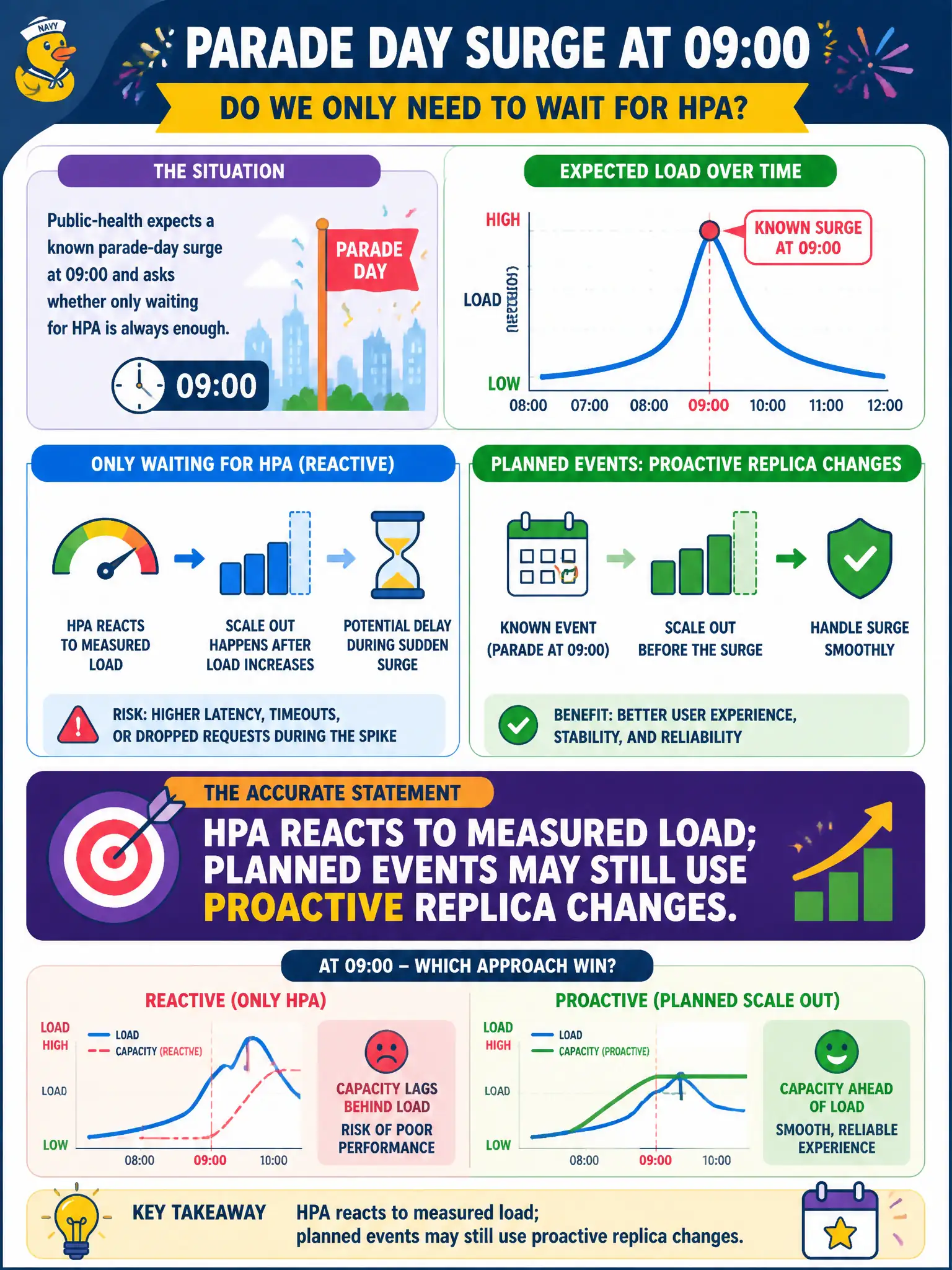
HPA is reactive—it notices the crowd when the sensors climb. For a parade you already know about, you may still open extra gates early with a proactive scale, then let HPA help with surprises.
Full Explanation
Public-health expecting a known parade-day surge at 09:00 and asking whether only waiting for HPA is always enough should understand that HPA reacts to measured load; planned events may still use proactive replica changes. HPA is reactive: it scales after metrics move. A predictable civic surge can justify pre-scaling the Deployment or raising minReplicas temporarily before the parade traffic arrives, then letting HPA manage afterward. Waiting solely for reactive scale can leave an error budget burn at the start of the event when citizens first hit the API.
HPA does not always scale Pods hours before load appears without any metrics change. Manual replica increases are not forbidden whenever an HPA object exists—though you must understand reconciliation conflicts. HPA does not replace capacity planning for every planned civic event; platforms still plan for known peaks.
Exam caveat: distinguish reactive autoscaling from proactive capacity for scheduled municipal events. Operational check: before 09:00, raise replicas or minReplicas for the public-health API, watch HPA and Pod readiness, then relax the floor after the parade load subsides. This distinction matters on the CKA because distractors often mix adjacent objects that sound related but solve a different control-plane problem.