
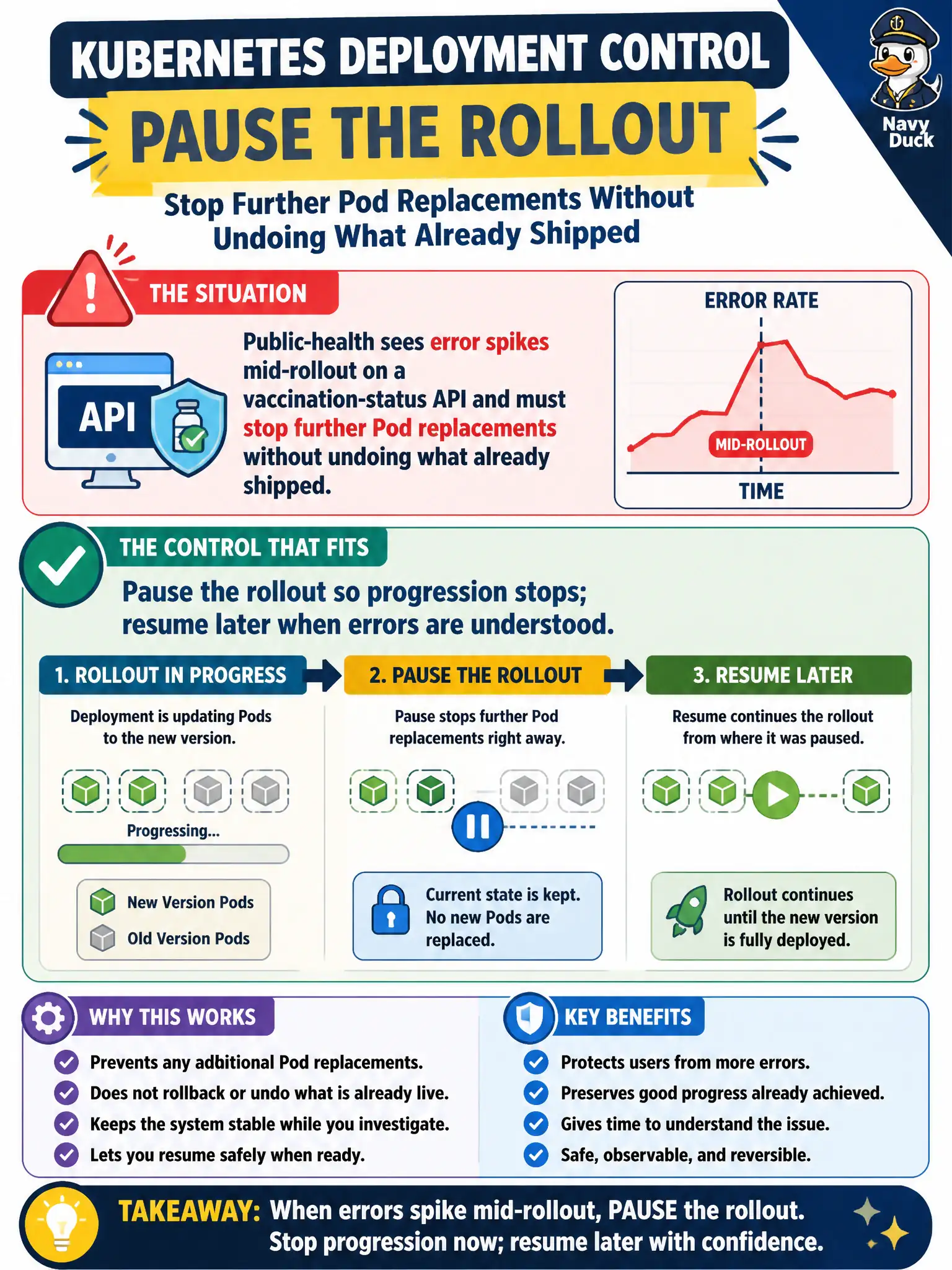
Public-health sees error spikes mid-rollout on a vaccination-status API and must stop further Pod replacements without undoing what already shipped. Which Deployment control fits?
Select an answer to reveal the explanation.
Short Explanation
Pause is the yellow light on a road crew—stop advancing the work zone without ripping out what is already paved. rollout pause freezes further replacements; resume continues when it is safe.
Full Explanation
When public-health sees error spikes mid-rollout on a vaccination-status API and must stop further Pod replacements without undoing what already shipped, the fitting Deployment control is pause. kubectl rollout pause freezes progression of the rollout: the controller stops advancing further replacements while Pods already created for the new revision remain. That yellow-light behavior lets SREs investigate error budgets without immediately rolling back healthy capacity that already landed, then resume when it is safe.
Deleting the Namespace removes every namespaced object—including the Deployment and its history—and is catastrophic overkill for pausing an update. Forcing Recreate strategy via annotating random Pods outside the Deployment does not pause a controlled rollout and fights the controller model. Removing the HorizontalPodAutoscaler does not stop an in-flight Deployment rollout, and claiming it freezes replicas forever at zero misstates both HPA and pause semantics.
Exam caveat: pause is distinct from undo—pause halts forward progress; undo reverts revision. Resume continues the same rollout. Operational check: kubectl rollout pause deployment/<api>, validate error rates and Pod health, then kubectl rollout resume (or undo if the new revision is confirmed bad).