
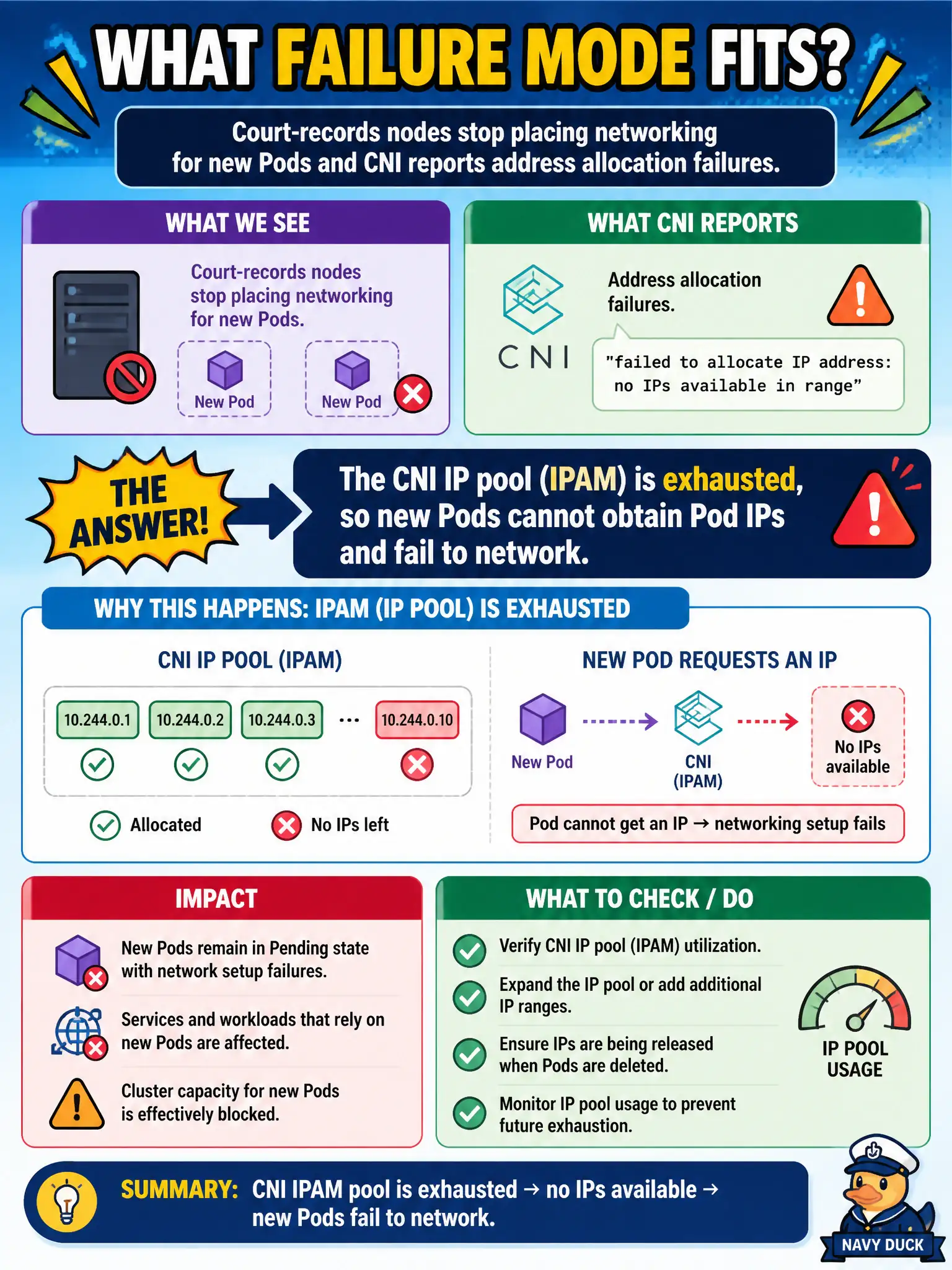
Court-records nodes stop placing networking for new Pods and CNI reports address allocation failures. What failure mode fits?
Select an answer to reveal the explanation.
Short Explanation
Every Pod needs a phone number from the CNI pool—when the pool’s empty, new hires can’t call out. Free or expand IPAM space before blaming Services.
Full Explanation
When court-records nodes stop placing networking for new Pods and CNI reports address allocation failures, the fitting failure mode is that the CNI IP pool (IPAM) is exhausted, so new Pods cannot obtain Pod IPs. Every Pod needs a number from the pool; when empty, new hires cannot call out. ClusterIP Services do not consume the Pod CIDR one-for-one with Pods; Service CIDR and Pod CIDR are separate ranges. Ingress wildcard hosts do not consume one Pod IP per TLS certificate as an IPAM mechanism. ConfigMaps do not store Pod IPs that must be resized with kubectl edit nodes to expand IPAM. Exam caveat: Symptoms include CNI errors in events and Pods stuck without IPs. Remediate by expanding podCIDR/IP pool, cleaning leaked IPs, or adding nodes with new ranges per CNI docs. Operational check: Inspect CNI/IPAM metrics and logs, free or expand address space, delete stuck Pods to retry allocation, and confirm new court Pods receive IPs. In municipal production practice, record the finding in the incident ticket with command output snippets, confirm the fix under change control, and re-validate the user-facing civic service before closing the change window. In municipal production practice, record the finding in the incident ticket with command output snippets, confirm the fix under change control, and re-validate the user-facing civic service before closing the change window.